
免疫检查点抑制剂在伴有副肿瘤综合征的实体瘤患者中的临床疗效和安全性。
Clinical outcomes and safety of immune checkpoint inhibitors in patients with solid tumors and paraneoplastic syndromes.
机构信息
Yale University, New Haven, Connecticut, USA
Yale University, New Haven, Connecticut, USA.
出版信息
J Immunother Cancer. 2024 Mar 5;12(3):e008724. doi: 10.1136/jitc-2023-008724.
BACKGROUND
Patients with paraneoplastic syndromes (PNS) are excluded from clinical trials involving immune checkpoint inhibitors (ICIs) due to safety concerns. Moreover, real-world data on efficacy and safety is scarce.
METHODS
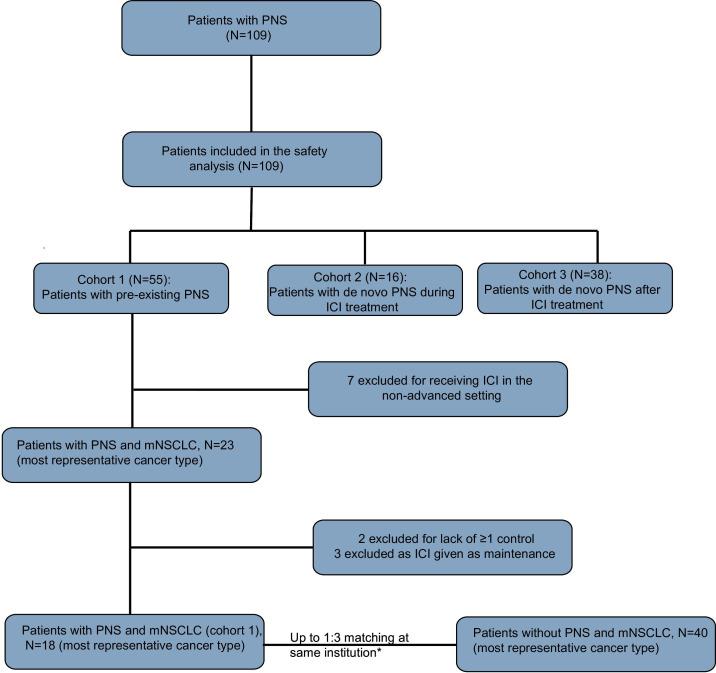
In this retrospective study, data were collected on patients with PNS and solid tumors receiving ICI between 2015 and 2022 at nine institutions. Patients were classified into: Cohort 1 (pre-existing PNS before ICI initiation), cohort 2 (PNS during ICI treatment), and cohort 3 (PNS after ICI discontinuation). Patients with metastatic non-small cell lung cancer (NSCLC) (mNSCLC) from cohort 1 were matched to patients who were PNS-free at each institution up to a 1:3 ratio for age, sex, type of ICI, use of concurrent chemotherapy, and number of lines of systemic therapy prior to ICI initiation. Kaplan-Meier method was used to assess overall survival (OS) and time-to-next treatment (TTNT).
RESULTS
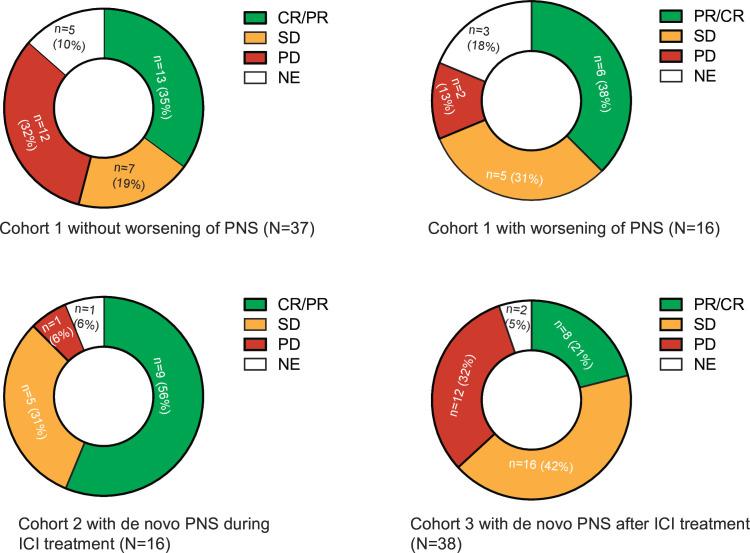
Among 109 patients with PNS treated with ICIs, median age at ICI initiation was 67 years (IQR: 58-74). The most represented cancer type was NSCLC (n=39, 36%). In cohort 1 (n=55), PNS exacerbations occurred in 16 (29%) patients with median time to exacerbation after ICI of 1.1 months (IQR: 0.7-3.3). Exacerbation or de novo PNS prompted temporary/permanent interruption of ICIs in 14 (13%) patients. For cohort 2 (n=16), median time between ICI initiation and de novo PNS was 1.2 months (IQR: 0.4-3.5). Treatment-related adverse events (trAEs) occurred in 43 (39%) patients. Grade ≥3 trAEs occurred in 18 (17%) patients. PNS-directed immunosuppressive therapy was required in 55 (50%) patients. We matched 18 patients with mNSCLC and PNS (cohort 1) to 40 without PNS, treated with ICIs. There was no significant difference in OS or TTNT between patients with mNSCLC with and without PNS, although a trend was seen towards worse outcomes in patients with PNS. TrAEs occurred in 6/18 (33%) and 14/40 (35%), respectively. Grade ≥3 trAEs occurred in 4 (22%) patients with PNS and 7 (18%) patients without PNS.
CONCLUSIONS
Exacerbations of pre-existing PNS occurred in 29% of patients treated with ICIs and both exacerbations and de novo PNS occur early in the ICI course. TrAE from ICIs were similar between patients with and without PNS. Our data suggest that pre-existing PNS should not preclude consideration of ICI therapy although patients may not derive the same clinical benefit compared with patients without PNS.
背景
由于安全性问题,患有副肿瘤综合征 (PNS) 的患者被排除在涉及免疫检查点抑制剂 (ICI) 的临床试验之外。此外,关于疗效和安全性的真实世界数据很少。
方法
在这项回顾性研究中,收集了 2015 年至 2022 年在九家机构接受 ICI 治疗的患有 PNS 和实体瘤的患者的数据。患者被分为:队列 1(ICI 开始前存在 PNS)、队列 2(ICI 治疗期间出现 PNS)和队列 3(ICI 停药后出现 PNS)。队列 1 中患有转移性非小细胞肺癌 (mNSCLC) 的患者与每个机构中无 PNS 的患者进行了匹配,按照年龄、性别、ICI 类型、是否同时使用化疗以及 ICI 开始前的全身治疗线数进行 1:3 的匹配。使用 Kaplan-Meier 法评估总生存期 (OS) 和下一次治疗时间 (TTNT)。
结果
在接受 ICI 治疗的 109 名患有 PNS 的患者中,ICI 开始时的中位年龄为 67 岁(IQR:58-74)。最常见的癌症类型是 NSCLC(n=39,36%)。在队列 1(n=55)中,16 名(29%)患者出现 PNS 恶化,ICI 后恶化的中位时间为 1.1 个月(IQR:0.7-3.3)。14 名(13%)患者因恶化或新发 PNS 而暂时/永久中断 ICI 治疗。对于队列 2(n=16),ICI 开始与新发 PNS 之间的中位时间为 1.2 个月(IQR:0.4-3.5)。43 名(39%)患者发生与治疗相关的不良事件 (trAEs)。18 名(17%)患者发生≥3 级 trAEs。55 名(50%)患者需要进行 PNS 靶向免疫抑制治疗。我们匹配了 18 名患有 mNSCLC 和 PNS(队列 1)的患者和 40 名无 PNS、接受 ICI 治疗的患者。有和没有 PNS 的 mNSCLC 患者的 OS 或 TTNT 没有显著差异,尽管有 PNS 的患者结局较差的趋势。trAEs 分别发生在 6/18(33%)和 14/40(35%)患者中。4 名(22%)有 PNS 的患者和 7 名(18%)无 PNS 的患者发生≥3 级 trAEs。
结论
接受 ICI 治疗的患者中有 29%出现了原有 PNS 的恶化,并且恶化和新发 PNS 都发生在 ICI 治疗的早期。ICI 治疗相关不良事件在有和没有 PNS 的患者之间相似。我们的数据表明,尽管与没有 PNS 的患者相比,患有 PNS 的患者可能不会获得相同的临床获益,但不应排除考虑使用 ICI 治疗。

 Zotero 插件