
运动对衰老身体功能影响的性别差异:一项荟萃分析的系统评价
Sex Differences in Effects of Exercise on Physical Function in Aging: A Systematic Review with Meta-Analysis.
作者信息
Fernández-Rodríguez Rubén, Martínez-Vizcaíno Vicente, Reina-Gutiérrez Sara, Bizzozero-Peroni Bruno, Torres-Costoso Ana, Rodríguez-Gutiérrez Eva, Díaz-Goñi Valentina, Cadenas-Sánchez Cristina
机构信息
Department of Physiotherapy, Nursing and Occupational Therapy, Universidad de Castilla-La Mancha, Health and Social Research Center, Cuenca, Spain.
Grupo de Investigacion en Educacion Fısica, Salud y Calidad de Vida, Facultad de Educacion, Universidad Autonoma de Chile, Temuco, Chile.
出版信息
World J Mens Health. 2024 Oct;42(4):694-711. doi: 10.5534/wjmh.230257. Epub 2024 Feb 7.
PURPOSE
Our objective was to synthesize and determine whether there are sex differences in physical function following exercise interventions in older adults.
MATERIALS AND METHODS
A systematic search was conducted in four databases from inception to July 8th, 2023 searching for prospective trials that conducted exercise interventions in older adults and results for physical function were reported by sex. Pooled standardized mean differences (SMDs) with their 95% confidence intervals (CIs) were estimated using a randomeffects method. The Sidik-Jonkman estimator was used to calculate the variance of heterogeneity (²).
RESULTS
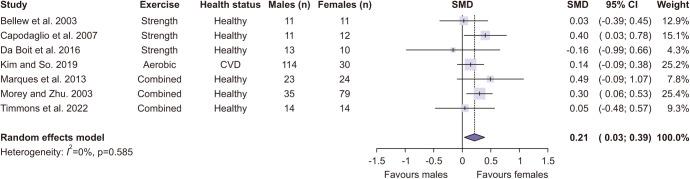
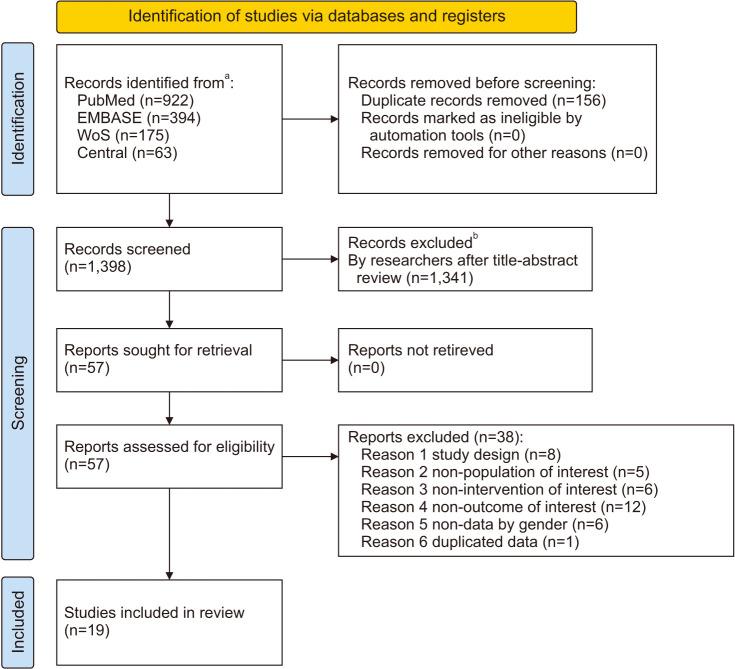
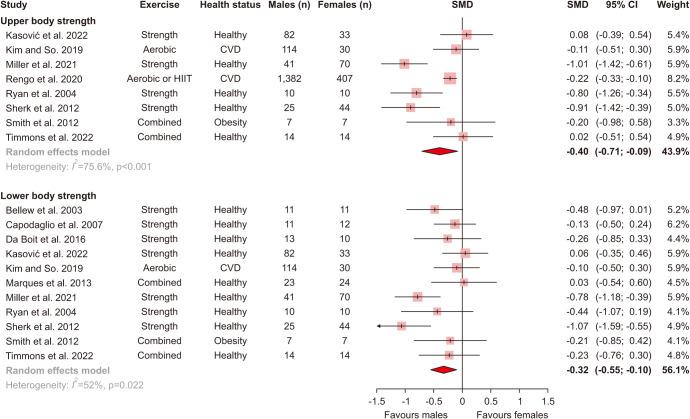
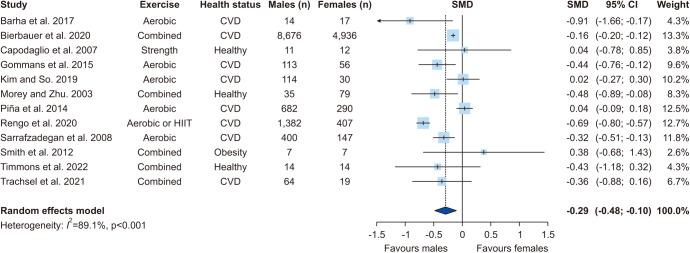
A total of 19 studies involving 20,133 older adults (mean age ≥60 years, 33.7% female) were included. After exercise interventions, males reported significantly greater pre-post changes compared to females for upper body strength (SMD=-0.40, 95% CI: -0.71 to -0.09; ²=75.6%; n=8), lower body strength (SMD=-0.32, 95% CI: -0.55 to -0.10; ²=52.0%; n=11), and cardiorespiratory fitness (SMD=-0.29, 95% CI: -0.48 to -0.10; ²=89.1%; n=12). Conversely, the pooled SMDs showed a significant effect favoring females for motor fitness (SMD=0.21, 95% CI: 0.03 to 0.39; ²=0%; n=7). Limited and inconsistent results were observed for flexibility.
CONCLUSIONS
Our study suggests the existence of sex-related differences on physical function after an exercise intervention in the older population.
目的
我们的目标是综合分析并确定老年人进行运动干预后身体功能是否存在性别差异。
材料与方法
对四个数据库进行了系统检索,检索时间从建库至2023年7月8日,寻找对老年人进行运动干预的前瞻性试验,并按性别报告身体功能结果。采用随机效应模型估计合并标准化均数差(SMD)及其95%置信区间(CI)。使用Sidik-Jonkman估计器计算异质性方差(²)。
结果
共纳入19项研究,涉及20133名老年人(平均年龄≥60岁,女性占33.7%)。运动干预后,男性在上肢力量(SMD=-0.40,95%CI:-0.71至-0.09;²=75.6%;n=8)、下肢力量(SMD=-0.32,95%CI:-0.55至-0.10;²=52.0%;n=11)和心肺适能(SMD=-0.29,95%CI:-0.48至-0.10;²=89.1%;n=12)方面的前后变化显著大于女性。相反,合并的SMD显示在运动适能方面女性有显著优势(SMD=0.21,95%CI:0.03至0.39;²=0%;n=7)。在柔韧性方面观察到的结果有限且不一致。
结论
我们的研究表明,老年人群进行运动干预后,身体功能存在与性别相关的差异。
 Zotero 插件