
囊性纤维化相关糖尿病治疗的不断变化格局
The Changing Landscape of Treatment for Cystic Fibrosis Related Diabetes.
作者信息
Amini Mehdia, Yu Kevin, Liebich Jessica, Ahir Vaishaliben, Wood Emily, Albert Stewart, Dhindsa Sandeep
机构信息
Division of Endocrinology, Diabetes and Metabolism, Saint Louis University School of Medicine, St. Louis, MO 63110, USA.
出版信息
J Clin Transl Endocrinol. 2024 Feb 28;35:100332. doi: 10.1016/j.jcte.2024.100332. eCollection 2024 Mar.
OBJECTIVE
Patients with Cystic Fibrosis related diabetes [CFRD] are treated with insulin and high calorie diets to maintain body mass. The combined CFTR modulator elexacaftor/tezacaftor/ivacaftor [ETI] decreases pulmonary exacerbations and improves nutritional status. We reviewed the effects of ETI on BMI, HbA1c and diabetes regimen in patients with CFRD over a period of three years.
METHODS
Data of previously CFTR-modulator-naïve patients with CFRD and pancreatic insufficiency on ETI therapy were retrieved from an electronic health record database. Patients were followed for a mean duration of 2.7 ± 0.8 years after ETI initiation. Data pertaining to weight, BMI, HbA1c and diabetes regimen were collected at 6 months, 12 months, 2 years and at 3 years post-ETI initiation. Patients were then dichotomized based on their baseline BMI into a low BMI group and an "at target" BMI group. The effects of ETI on changes in weight, BMI, A1c and diabetes regimen were compared in both groups over a period of three years.
RESULTS
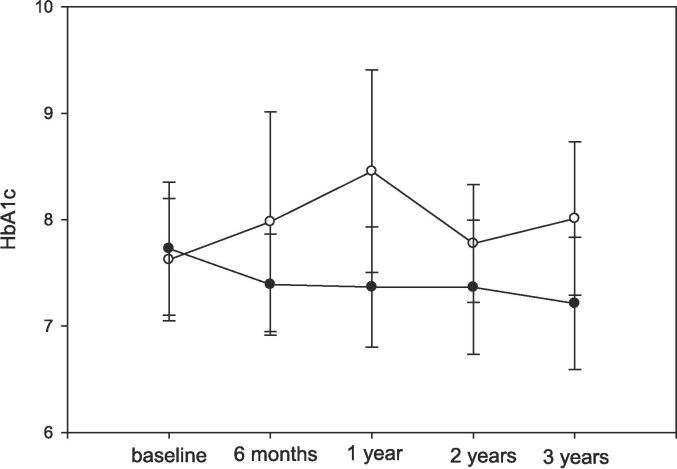
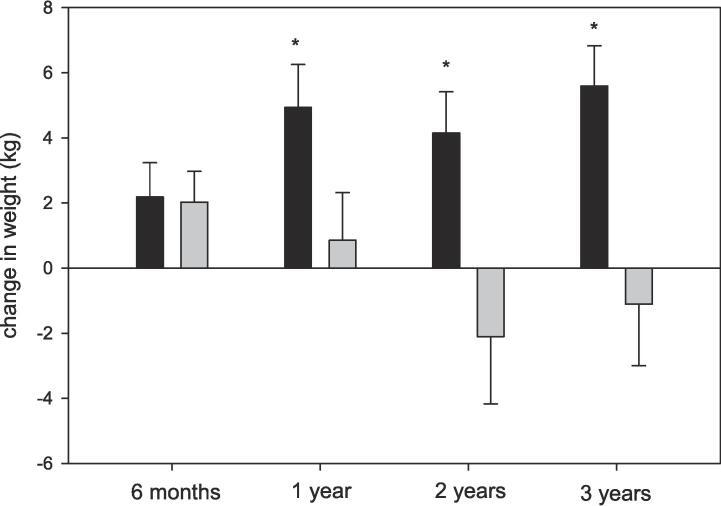
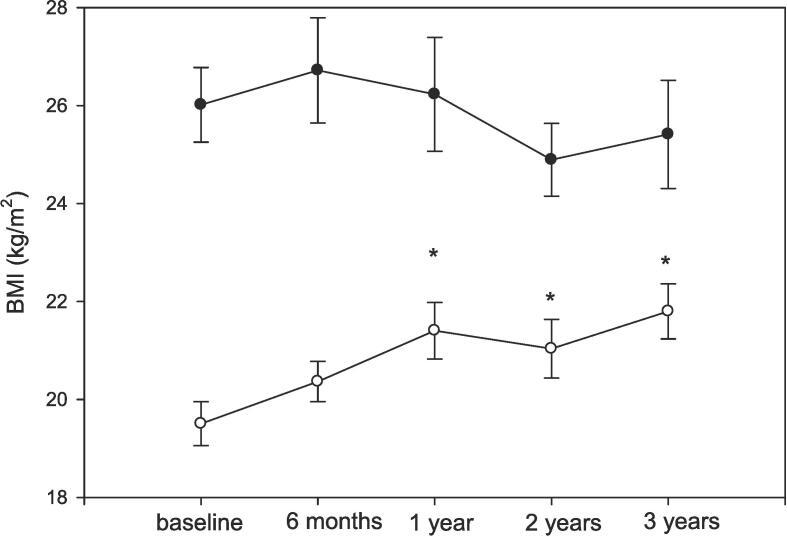
Twenty-seven patients with CFRD (15 men/12 women), age 30.6 ± 11.5 (SD) years, BMI 22.4 ± 4.0 kg/m, were included. Fifteen patients had low BMI (<22 kg/m for women, <23 kg/m for men) and 12 patients had at target BMI (≥22 kg/mfor women, ≥BMI 23 kg/m for men). Patients with low BMI had an increase in their BMI from 19.5 ± 1.7 to 21.4 ± 2.2 kg/m at one year (p = 0.002), and 21.8 ± 1.8 kg/m at three years (p = 0.004) after ETI initiation. Four patients (out of 15) in the low BMI group had achieved normal BMI by the end of study follow up. There was no change in weight in the at target BMI group. HbA1c and basal insulin requirements did not change in either group. Five patients started non-insulin therapies.
CONCLUSION
BMI increased after ETI therapy in CFRD patients with low BMI, but not in those with at target BMI. The use of non-insulin therapies is increasing in CFRD and should be evaluated in future studies.
目的
囊性纤维化相关糖尿病(CFRD)患者采用胰岛素和高热量饮食进行治疗以维持体重。三联CFTR调节剂依列卡福/替扎卡福/艾伐卡福(ETI)可减少肺部急性加重并改善营养状况。我们回顾了ETI在三年时间里对CFRD患者体重指数(BMI)、糖化血红蛋白(HbA1c)和糖尿病治疗方案的影响。
方法
从电子健康记录数据库中检索此前未使用过CFTR调节剂、患有CFRD且存在胰腺功能不全并接受ETI治疗的患者的数据。患者在开始ETI治疗后平均随访2.7±0.8年。在开始ETI治疗后的6个月、12个月、2年和3年收集有关体重、BMI、HbA1c和糖尿病治疗方案的数据。然后根据患者的基线BMI将其分为低BMI组和“达标”BMI组。在三年时间里比较两组中ETI对体重、BMI、糖化血红蛋白(A1c)和糖尿病治疗方案变化的影响。
结果
纳入了27例CFRD患者(15例男性/12例女性),年龄30.6±11.5(标准差)岁,BMI为22.4±4.0kg/m²。15例患者BMI较低(女性<22kg/m²,男性<23kg/m²),12例患者BMI达标(女性≥22kg/m²,男性≥23kg/m²)。低BMI患者在开始ETI治疗后1年时BMI从19.5±1.7增加至21.4±2.2kg/m²(p=0.002),3年时为21.8±1.8kg/m²(p=0.004)。低BMI组中的4例患者(共15例)在研究随访结束时BMI达到正常。达标BMI组体重无变化。两组的HbA1c和基础胰岛素需求量均未改变。5例患者开始采用非胰岛素治疗。
结论
ETI治疗后,低BMI的CFRD患者BMI增加,而达标BMI的患者则未增加。CFRD患者中使用非胰岛素治疗的情况正在增加,应在未来研究中进行评估。

 Zotero 插件