
基于 T 细胞的 SARS-CoV-2 刺突蛋白疫苗提供无抗体保护。
A T cell-based SARS-CoV-2 spike protein vaccine provides protection without antibodies.
机构信息
Institute for Biomedical Sciences, Georgia State University, Atlanta, Georgia, USA.
Department of Microbiology and Immunology, and Department of Pediatrics, University of Iowa, Iowa City, Iowa, USA.
出版信息
JCI Insight. 2024 Mar 8;9(5):e155789. doi: 10.1172/jci.insight.155789.
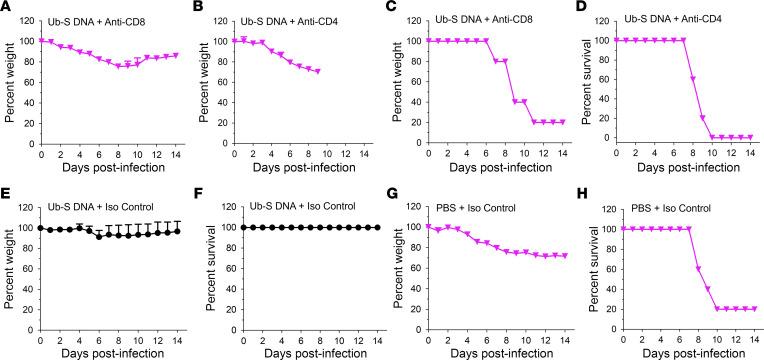
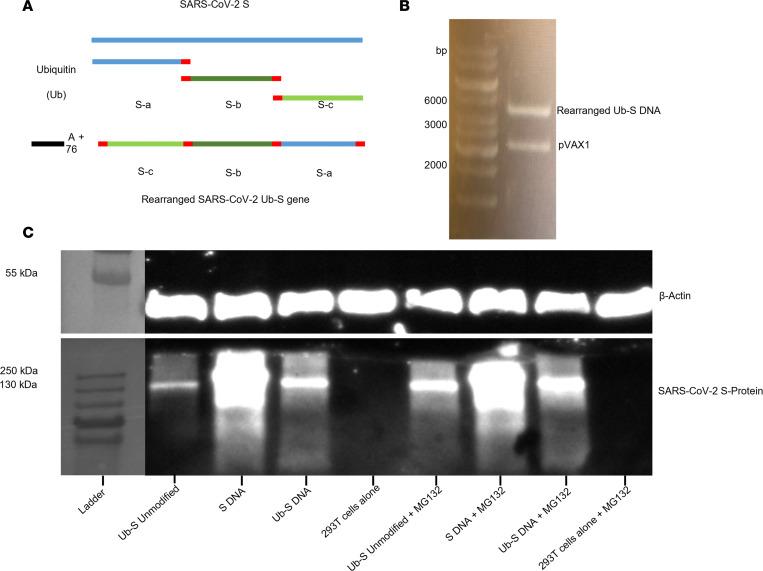
SARS-CoV-2 spike-based vaccines are used to control the COVID-19 pandemic. However, emerging variants have become resistant to antibody neutralization and further mutations may lead to full resistance. We tested whether T cells alone could provide protection without antibodies. We designed a T cell-based vaccine in which SARS-CoV-2 spike sequences were rearranged and attached to ubiquitin. Immunization of mice with the vaccine induced no specific antibodies, but strong specific T cell responses. We challenged mice with SARS-CoV-2 wild-type strain or an Omicron variant after the immunization and monitored survival or viral titers in the lungs. The mice were significantly protected against death and weight loss caused by the SARS-CoV-2 wild-type strain, and the viral titers in the lungs of mice challenged with the SARS-CoV-2 wild-type strain or the Omicron variant were significantly reduced. Importantly, depletion of CD4+ or CD8+ T cells led to significant loss of the protection. Our analyses of spike protein sequences of the variants indicated that fewer than one-third presented by dominant HLA alleles were mutated and that most of the mutated epitopes were in the subunit 1 region. As the subunit 2 region is conservative, the vaccines targeting spike protein are expected to protect against future variants due to the T cell responses.
SARS-CoV-2 刺突蛋白疫苗被用于控制 COVID-19 大流行。然而,新兴变异株已对抗体中和产生耐药性,进一步的突变可能导致完全耐药。我们检测了仅 T 细胞是否可以在没有抗体的情况下提供保护。我们设计了一种基于 T 细胞的疫苗,其中 SARS-CoV-2 刺突序列被重新排列并连接到泛素上。用该疫苗免疫小鼠不会诱导产生特异性抗体,但会引起强烈的特异性 T 细胞反应。在免疫后,我们用 SARS-CoV-2 野生型株或奥密克戎变异株对小鼠进行攻毒,并监测其存活或肺部病毒滴度。与 SARS-CoV-2 野生型株相比,小鼠对该疫苗具有显著的保护作用,可防止由 SARS-CoV-2 野生型株引起的死亡和体重减轻,且用 SARS-CoV-2 野生型株或奥密克戎变异株攻毒的小鼠肺部病毒滴度也显著降低。重要的是,耗尽 CD4+或 CD8+T 细胞会导致保护作用显著丧失。我们对变异株刺突蛋白序列的分析表明,不到三分之一由主要 HLA 等位基因呈递的表位发生突变,且大多数突变表位位于亚单位 1 区域。由于亚单位 2 区域保守,针对刺突蛋白的疫苗有望通过 T 细胞反应来预防未来的变异株。


 Zotero 插件