
轴突刺激影响三位 Argus II 用户单点感知的线性总和。
Axonal stimulation affects the linear summation of single-point perception in three Argus II users.
机构信息
Department of Computer Science, University of California, Santa Barbara, CA, United States of America.
Department of Psychological & Brain Sciences, University of California, Santa Barbara, CA, United States of America.
出版信息
J Neural Eng. 2024 Apr 8;21(2):026031. doi: 10.1088/1741-2552/ad31c4.
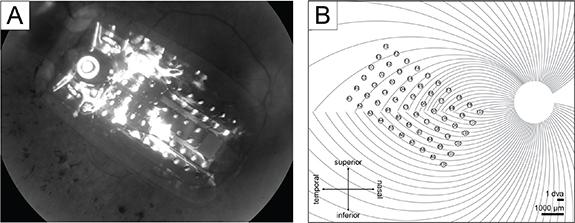
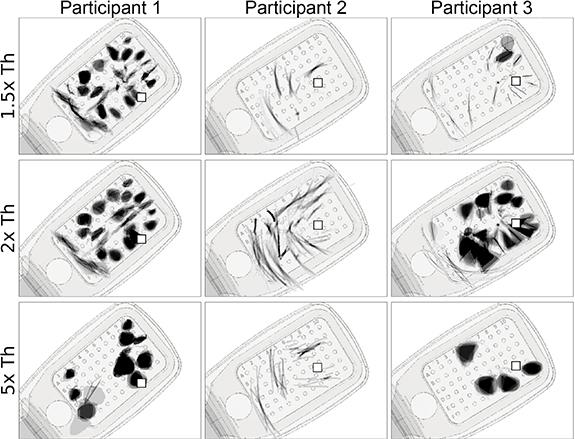
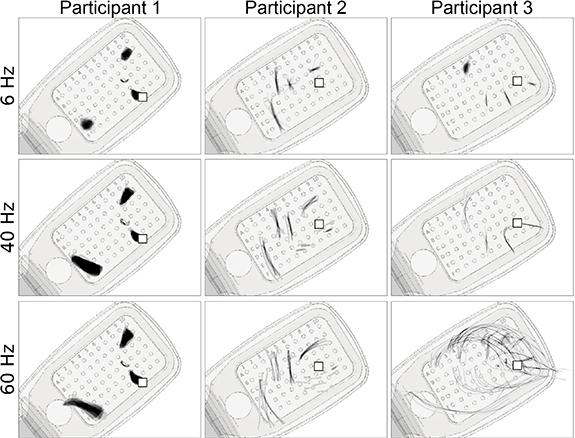
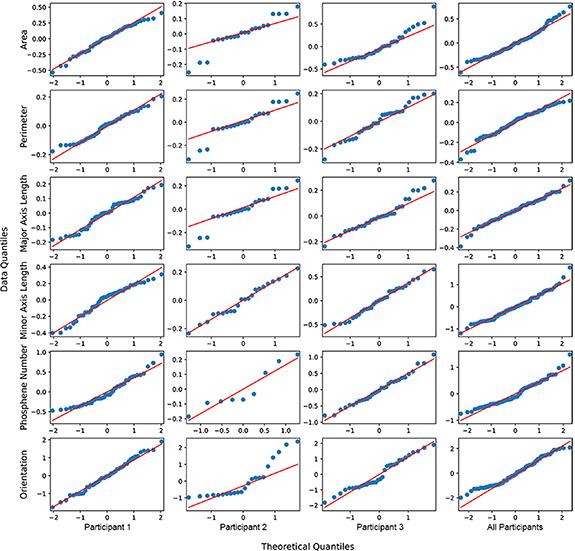
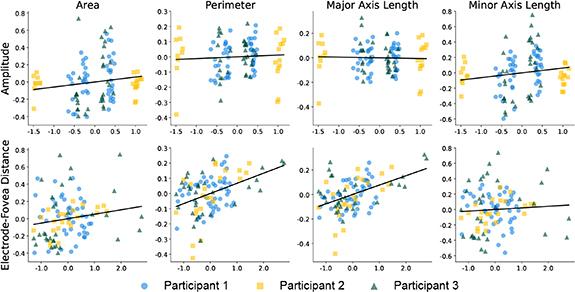
Retinal implants use electrical stimulation to elicit perceived flashes of light ('phosphenes'). Single-electrode phosphene shape has been shown to vary systematically with stimulus parameters and the retinal location of the stimulating electrode, due to incidental activation of passing nerve fiber bundles. However, this knowledge has yet to be extended to paired-electrode stimulation.We retrospectively analyzed 3548 phosphene drawings made by three blind participants implanted with an Argus II Retinal Prosthesis. Phosphene shape (characterized by area, perimeter, major and minor axis length) and number of perceived phosphenes were averaged across trials and correlated with the corresponding single-electrode parameters. In addition, the number of phosphenes was correlated with stimulus amplitude and neuroanatomical parameters: electrode-retina and electrode-fovea distance as well as the electrode-electrode distance to ('between-axon') and along axon bundles ('along-axon'). Statistical analyses were conducted using linear regression and partial correlation analysis.Simple regression revealed that each paired-electrode shape descriptor could be predicted by the sum of the two corresponding single-electrode shape descriptors ( < .001). Multiple regression revealed that paired-electrode phosphene shape was primarily predicted by stimulus amplitude and electrode-fovea distance ( < .05). Interestingly, the number of elicited phosphenes tended to increase with between-axon distance ( < .05), but not with along-axon distance, in two out of three participants.The shape of phosphenes elicited by paired-electrode stimulation was well predicted by the shape of their corresponding single-electrode phosphenes, suggesting that two-point perception can be expressed as the linear summation of single-point perception. The impact of the between-axon distance on the perceived number of phosphenes provides further evidence in support of the axon map model for epiretinal stimulation. These findings contribute to the growing literature on phosphene perception and have important implications for the design of future retinal prostheses.
视网膜植入物利用电刺激产生可感知的闪光(“光幻视”)。由于偶然激活经过的神经纤维束,单电极光幻视的形状已被证明会随着刺激参数和刺激电极在视网膜上的位置而系统地变化。然而,这一知识尚未扩展到双电极刺激。
我们回顾性地分析了三名植入 Argus II 视网膜假体的盲人参与者的 3548 个光幻视图。将每个试验的光幻视形状(用面积、周长、长轴和短轴长度来表示)和感知到的光幻视数量进行平均,并与相应的单电极参数相关联。此外,还将光幻视的数量与刺激幅度和神经解剖学参数相关联:电极-视网膜和电极-中央凹的距离,以及电极-轴突之间的距离(“轴突间”)和沿轴突束的距离(“沿轴突”)。使用线性回归和偏相关分析进行统计分析。
简单回归表明,每个双电极形状描述符都可以通过两个相应的单电极形状描述符的总和来预测( < .001)。多元回归表明,双电极光幻视形状主要由刺激幅度和电极-中央凹的距离来预测( < .05)。有趣的是,在三个参与者中的两个参与者中,诱发的光幻视数量随着轴突间距离的增加而增加( < .05),但不随沿轴突距离的增加而增加。
双电极刺激产生的光幻视形状可以很好地通过其对应的单电极光幻视形状来预测,这表明两点感知可以表示为单点感知的线性总和。轴突间距离对感知到的光幻视数量的影响进一步支持了视网膜外刺激的轴突图模型。这些发现为光幻视感知的不断增长的文献做出了贡献,并对未来视网膜假体的设计具有重要意义。










 Zotero 插件