
特定领域体力活动与糖尿病前期和糖尿病患者白蛋白尿的关系:一项大型横断面研究。
Association of domain-specific physical activity with albuminuria among prediabetes and diabetes: a large cross-sectional study.
机构信息
Department of Cardiology, The Second Affiliated Hospital of Chongqing Medical University, No.74, Linjiang Road, Chonqing, 400010, China.
Department of Cardiovascular Medicine Intensive Care Unit, The Second Affiliated Hospital of Hainan Medical University, Hainan, China.
出版信息
J Transl Med. 2024 Mar 8;22(1):252. doi: 10.1186/s12967-024-05061-6.
BACKGROUND
Albuminuria, the presence of excess of protein in urine, is a well-known risk factor for early kidney damage among diabetic/prediabetic patients. There is a complex interaction between physical activity (PA) and albuminuria. However, the relationship of specific-domain PA and albuminuria remained obscure.
METHODS
Albuminuria was defined as urinary albumin/creatinine ratio (ACR) > 30 mg/g. PA was self-reported by participants and classified into transportation-related PA (TPA), occupation-related PA (OPA), and leisure-time PA (LTPA). Weighted logistic regression was conducted to compute the odds ratios (ORs) and 95% confidence intervals (CIs). Restricted cubic spline (RCS) was used to evaluate the dose-response of PA domains with the risk of albuminuria.
RESULTS
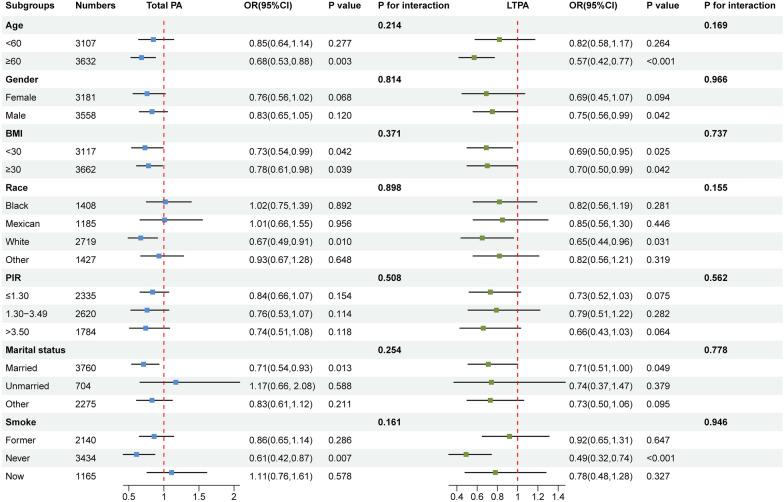
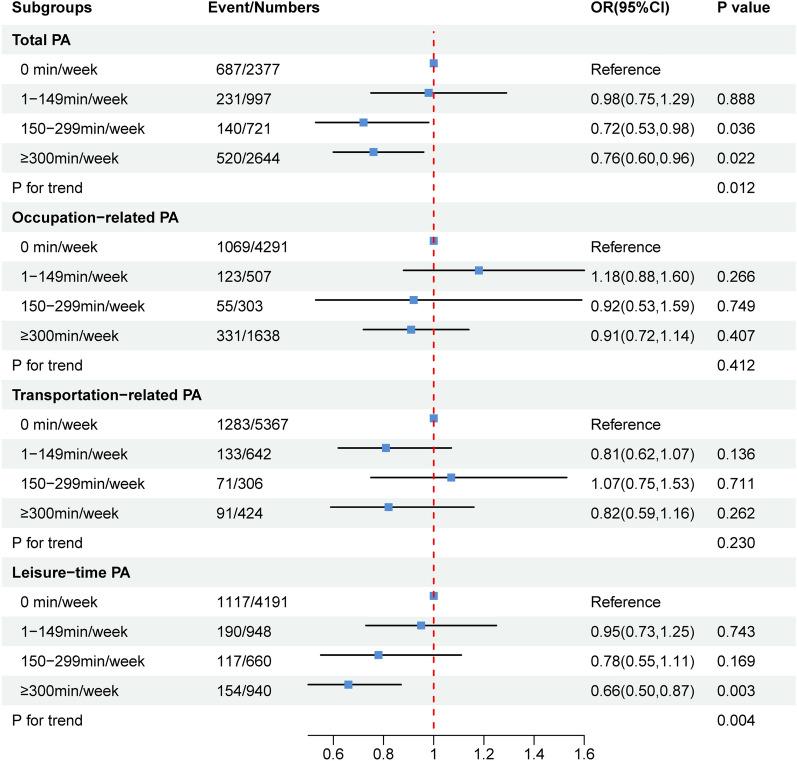
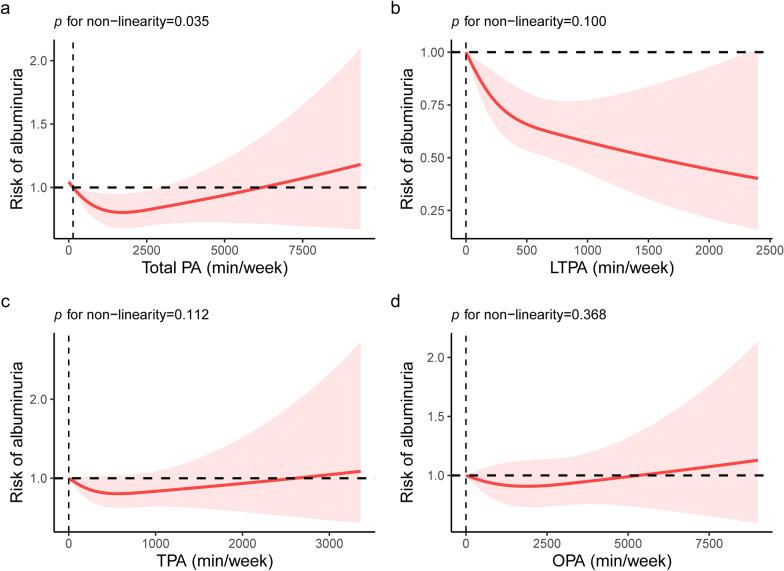
A total of 6739 diabetic/prediabetic patients (mean age: 56.52 ± 0.29 years) were enrolled in our study, including 3181 (47.20%) females and 3558 (52.80%) males. Of them, 1578 (23.42%) were identified with albuminuria, and 5161(76.58%) were without albuminuria. Diabetic/prediabetic patients who adhered the PA guidelines for total PA had a 22% decreased risk of albuminuria (OR = 0.78, 95%CI 0.64-0.95), and those met the PA guidelines for LTPA had a 28% decreased of albuminuria (OR = 0.72, 95%CI 0.57-0.92). However, OPA and TPA were both not associated with decreased risk of albuminuria. RCS showed linear relationship between the risk of albuminuria with LTPA.
CONCLUSIONS
Meeting the PA guideline for LTPA, but not OPA and TPA, was inversely related to the risk of albuminuria among diabetic/prediabetic patients. Additionally, achieving more than 300 min/week of LTPA conferred the positive effects in reducing albuminuria among diabetic/prediabetic patients.
背景
蛋白尿,即尿液中存在过量蛋白质,是糖尿病/糖尿病前期患者早期肾脏损伤的一个已知危险因素。体力活动(PA)和蛋白尿之间存在复杂的相互作用。然而,特定领域 PA 与蛋白尿之间的关系仍不清楚。
方法
蛋白尿定义为尿白蛋白/肌酐比值(ACR)>30mg/g。PA 由参与者自我报告,并分为交通相关 PA(TPA)、职业相关 PA(OPA)和休闲时间 PA(LTPA)。使用加权逻辑回归计算比值比(OR)和 95%置信区间(CI)。限制性三次样条(RCS)用于评估 PA 域与蛋白尿风险的剂量反应关系。
结果
共纳入 6739 例糖尿病/糖尿病前期患者(平均年龄:56.52±0.29 岁),其中女性 3181 例(47.20%),男性 3558 例(52.80%)。其中,1578 例(23.42%)被诊断为蛋白尿,5161 例(76.58%)无蛋白尿。总体上,遵循 PA 指南进行 PA 的糖尿病/糖尿病前期患者蛋白尿风险降低 22%(OR=0.78,95%CI 0.64-0.95),遵循 LTPA 指南进行 PA 的患者蛋白尿风险降低 28%(OR=0.72,95%CI 0.57-0.92)。然而,OPA 和 TPA 均与蛋白尿风险降低无关。RCS 显示,LTPA 与蛋白尿风险之间呈线性关系。
结论
遵循 LTPA 指南,而不是 OPA 和 TPA,与糖尿病/糖尿病前期患者蛋白尿风险呈负相关。此外,每周进行超过 300 分钟的 LTPA 可降低糖尿病/糖尿病前期患者的蛋白尿风险。

 Zotero 插件