
肝细胞癌伴微血管侵犯患者肝切除术后几种辅助治疗的比较疗效
Comparative effectiveness of several adjuvant therapies after hepatectomy for hepatocellular carcinoma patients with microvascular invasion.
作者信息
Pei Yin-Xuan, Su Chen-Guang, Liao Zheng, Li Wei-Wei, Wang Zi-Xiang, Liu Jin-Long
机构信息
Department of Hepatobiliary Surgery, The Affiliated Hospital of Chengde Medical University, Chengde 067000, Hebei Province, China.
出版信息
World J Gastrointest Surg. 2024 Feb 27;16(2):554-570. doi: 10.4240/wjgs.v16.i2.554.
BACKGROUND
For resectable hepatocellular carcinoma (HCC), radical hepatectomy is commonly used as a curative treatment. However, postoperative recurrence significantly diminishes the overall survival (OS) of HCC patients, especially with microvascular invasion (MVI) as an independent high-risk factor for recurrence. While some studies suggest that postoperative adjuvant therapy may decrease the risk of recurrence following liver resection in HCC patients, the specific role of adjuvant therapies in those with MVI remains unclear.
AIM
To conduct a network meta-analysis (NMA) to evaluate the efficacy of various adjuvant therapies and determine the optimal adjuvant regimen.
METHODS
A systematic literature search was conducted on PubMed, EMBASE, and Web of Science until April 6, 2023. Studies comparing different adjuvant therapies or comparing adjuvant therapy with hepatectomy alone were included. Hazard ratios (HRs) with 95% confidence intervals were used to combine data on recurrence free survival and OS in both pairwise meta-analyses and NMA.
RESULTS
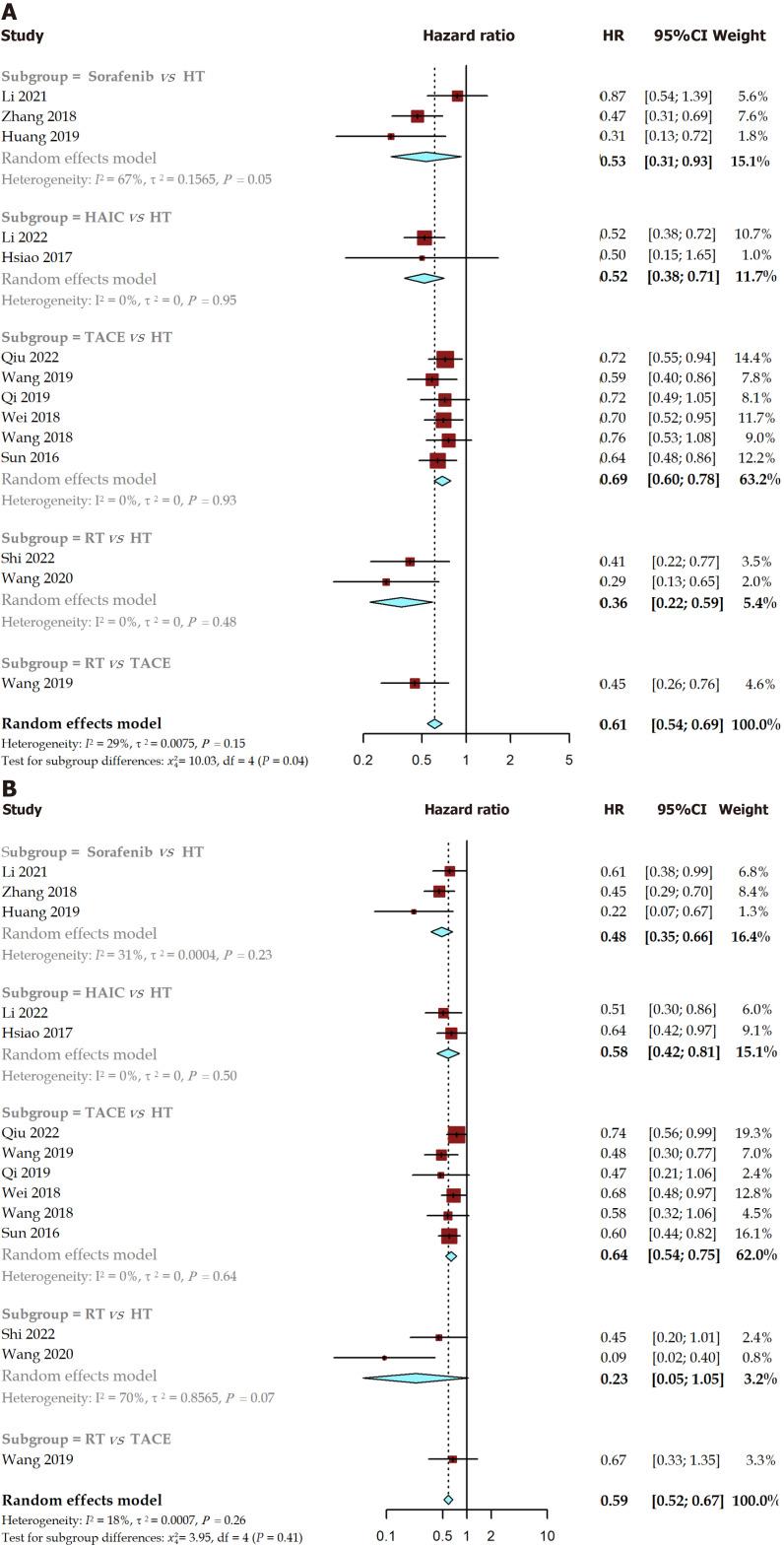
Fourteen eligible trials (2268 patients) reporting five different therapies were included. In terms of reducing the risk of recurrence, radiotherapy (RT) [HR = 0.34 (0.23, 0.5); surface under the cumulative ranking curve (SUCRA) = 97.7%] was found to be the most effective adjuvant therapy, followed by hepatic artery infusion chemotherapy [HR = 0.52 (0.35, 0.76); SUCRA = 65.1%]. Regarding OS improvement, RT [HR: 0.35 (0.2, 0.61); SUCRA = 93.1%] demonstrated the highest effectiveness, followed by sorafenib [HR = 0.48 (0.32, 0.69); SUCRA = 70.9%].
CONCLUSION
Adjuvant therapy following hepatectomy may reduce the risk of recurrence and provide a survival benefit for HCC patients with MVI. RT appears to be the most effective adjuvant regimen.
背景
对于可切除的肝细胞癌(HCC),根治性肝切除术通常作为一种治愈性治疗方法。然而,术后复发显著降低了HCC患者的总生存期(OS),尤其是微血管侵犯(MVI)作为复发的独立高危因素。虽然一些研究表明术后辅助治疗可能降低HCC患者肝切除术后的复发风险,但辅助治疗在MVI患者中的具体作用仍不清楚。
目的
进行一项网状Meta分析(NMA),以评估各种辅助治疗的疗效并确定最佳辅助方案。
方法
在PubMed、EMBASE和Web of Science上进行系统的文献检索,直至2023年4月6日。纳入比较不同辅助治疗或比较辅助治疗与单纯肝切除术的研究。在成对Meta分析和NMA中,使用具有95%置信区间的风险比(HRs)来合并无复发生存期和OS的数据。
结果
纳入了14项符合条件的试验(2268例患者),报告了五种不同的治疗方法。在降低复发风险方面,放疗(RT)[HR = 0.34(0.23,0.5);累积排序曲线下面积(SUCRA)= 97.7%]被发现是最有效的辅助治疗方法,其次是肝动脉灌注化疗[HR = 0.52(0.35,0.76);SUCRA = 65.1%]。在改善OS方面,RT[HR:0.35(0.2,0.61);SUCRA = 93.1%]显示出最高的有效性,其次是索拉非尼[HR = 0.48(0.32,0.69);SUCRA = 70.9%]。
结论
肝切除术后的辅助治疗可能降低复发风险,并为伴有MVI的HCC患者提供生存益处。放疗似乎是最有效的辅助方案。



 Zotero 插件