
通过生物信息学和血清学分析鉴定的T淋巴细胞白血病/淋巴瘤中的关键候选基因和信号通路。
Key candidate genes and pathways in T lymphoblastic leukemia/lymphoma identified by bioinformatics and serological analyses.
作者信息
Ren Yansong, Liang Haoyue, Huang Yali, Miao Yuyang, Li Ruihua, Qiang Junlian, Wu Lihong, Qi Jinfeng, Li Ying, Xia Yonghui, Huang Lunhui, Wang Shoulei, Kong Xiaodong, Zhou Yuan, Zhang Qiang, Zhu Guoqing
机构信息
State Key Laboratory of Experimental Hematology, National Clinical Research Center for Blood Diseases, Haihe Laboratory of Cell Ecosystem, Institute of Hematology & Blood Diseases Hospital, Chinese Academy of Medical Sciences & Peking Union Medical College, Tianjin, China.
Tianjin Institutes of Health Science, Tianjin, China.
出版信息
Front Immunol. 2024 Feb 23;15:1341255. doi: 10.3389/fimmu.2024.1341255. eCollection 2024.
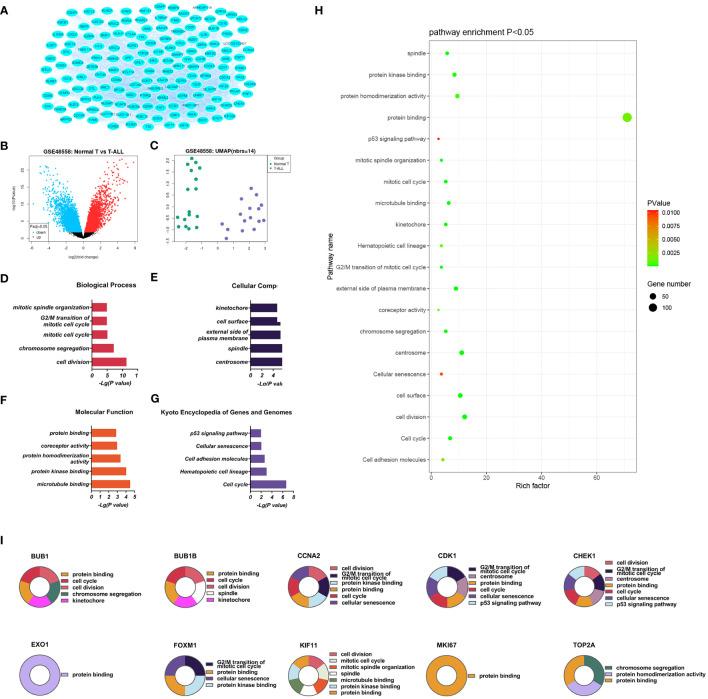
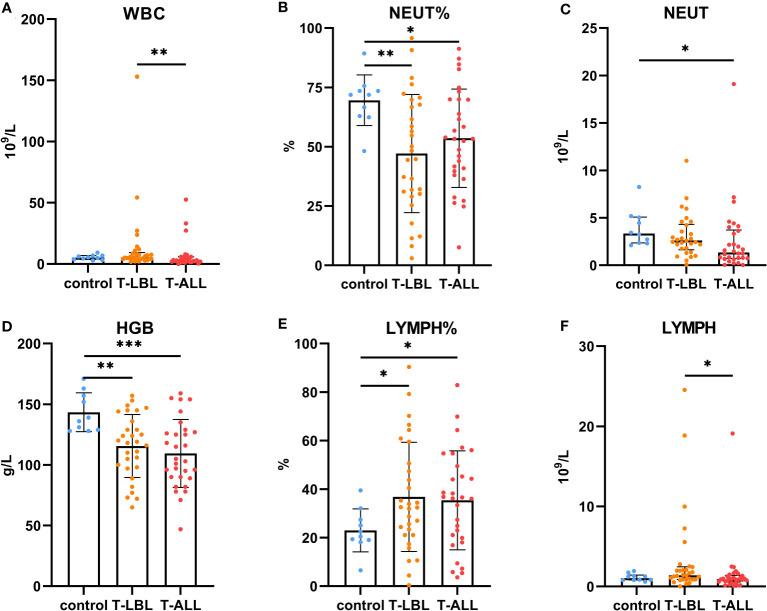
T-cell acute lymphoblastic leukemia (TALL)/T-cell lymphoblastic lymphoma (T-LBL) is an uncommon but highly aggressive hematological malignancy. It has high recurrence and mortality rates and is challenging to treat. This study conducted bioinformatics analyses, compared genetic expression profiles of healthy controls with patients having T-ALL/T-LBL, and verified the results through serological indicators. Data were acquired from the GSE48558 dataset from Gene Expression Omnibus (GEO). T-ALL patients and normal T cells-related differentially expressed genes (DEGs) were investigated using the online analysis tool GEO2R in GEO, identifying 78 upregulated and 130 downregulated genes. Gene Ontology (GO) and protein-protein interaction (PPI) network analyses of the top 10 DEGs showed enrichment in pathways linked to abnormal mitotic cell cycles, chromosomal instability, dysfunction of inflammatory mediators, and functional defects in T-cells, natural killer (NK) cells, and immune checkpoints. The DEGs were then validated by examining blood indices in samples obtained from patients, comparing the T-ALL/T-LBL group with the control group. Significant differences were observed in the levels of various blood components between T-ALL and T-LBL patients. These components include neutrophils, lymphocyte percentage, hemoglobin (HGB), total protein, globulin, erythropoietin (EPO) levels, thrombin time (TT), D-dimer (DD), and C-reactive protein (CRP). Additionally, there were significant differences in peripheral blood leukocyte count, absolute lymphocyte count, creatinine, cholesterol, low-density lipoprotein, folate, and thrombin times. The genes and pathways associated with T-LBL/T-ALL were identified, and peripheral blood HGB, EPO, TT, DD, and CRP were key molecular markers. This will assist the diagnosis of T-ALL/T-LBL, with applications for differential diagnosis, treatment, and prognosis.
T细胞急性淋巴细胞白血病(TALL)/T细胞淋巴母细胞淋巴瘤(T-LBL)是一种罕见但侵袭性很强的血液系统恶性肿瘤。它具有高复发率和死亡率,治疗具有挑战性。本研究进行了生物信息学分析,比较了健康对照与T-ALL/T-LBL患者的基因表达谱,并通过血清学指标验证了结果。数据来自基因表达综合数据库(GEO)的GSE48558数据集。使用GEO中的在线分析工具GEO2R研究T-ALL患者和正常T细胞相关的差异表达基因(DEG),鉴定出78个上调基因和130个下调基因。对前10个DEG进行基因本体论(GO)和蛋白质-蛋白质相互作用(PPI)网络分析,结果显示这些基因在与异常有丝分裂细胞周期、染色体不稳定、炎症介质功能障碍以及T细胞、自然杀伤(NK)细胞和免疫检查点功能缺陷相关的通路中富集。然后通过检查从患者获得的样本中的血液指标,将T-ALL/T-LBL组与对照组进行比较,对DEG进行验证。在T-ALL和T-LBL患者之间观察到各种血液成分水平存在显著差异。这些成分包括中性粒细胞、淋巴细胞百分比、血红蛋白(HGB)、总蛋白、球蛋白、促红细胞生成素(EPO)水平、凝血酶时间(TT)、D-二聚体(DD)和C反应蛋白(CRP)。此外,外周血白细胞计数、绝对淋巴细胞计数、肌酐、胆固醇、低密度脂蛋白、叶酸和凝血酶时间也存在显著差异。确定了与T-LBL/T-ALL相关的基因和通路,外周血HGB、EPO、TT、DD和CRP是关键分子标志物。这将有助于T-ALL/T-LBL的诊断,可用于鉴别诊断、治疗和预后评估。




 Zotero 插件