
吉特替尼作为伴有. 内部串联重复突变的 AML 移植后维持治疗。
Gilteritinib as Post-Transplant Maintenance for AML With Internal Tandem Duplication Mutation of .
机构信息
Johns Hopkins University, Baltimore, MD.
CIBMTR/Medical College of Wisconsin, Milwaukee, WI.
出版信息
J Clin Oncol. 2024 May 20;42(15):1766-1775. doi: 10.1200/JCO.23.02474. Epub 2024 Mar 12.
PURPOSE
Allogeneic hematopoietic cell transplantation (HCT) improves outcomes for patients with AML harboring an internal tandem duplication mutation of () AML. These patients are routinely treated with a FLT3 inhibitor after HCT, but there is limited evidence to support this. Accordingly, we conducted a randomized trial of post-HCT maintenance with the FLT3 inhibitor gilteritinib (ClinicalTrials.gov identifier: NCT02997202) to determine if all such patients benefit or if detection of measurable residual disease (MRD) could identify those who might benefit.
METHODS
Adults with AML in first remission underwent HCT and were randomly assigned to placebo or 120 mg once daily gilteritinib for 24 months after HCT. The primary end point was relapse-free survival (RFS). Secondary end points included overall survival (OS) and the effect of MRD pre- and post-HCT on RFS and OS.
RESULTS
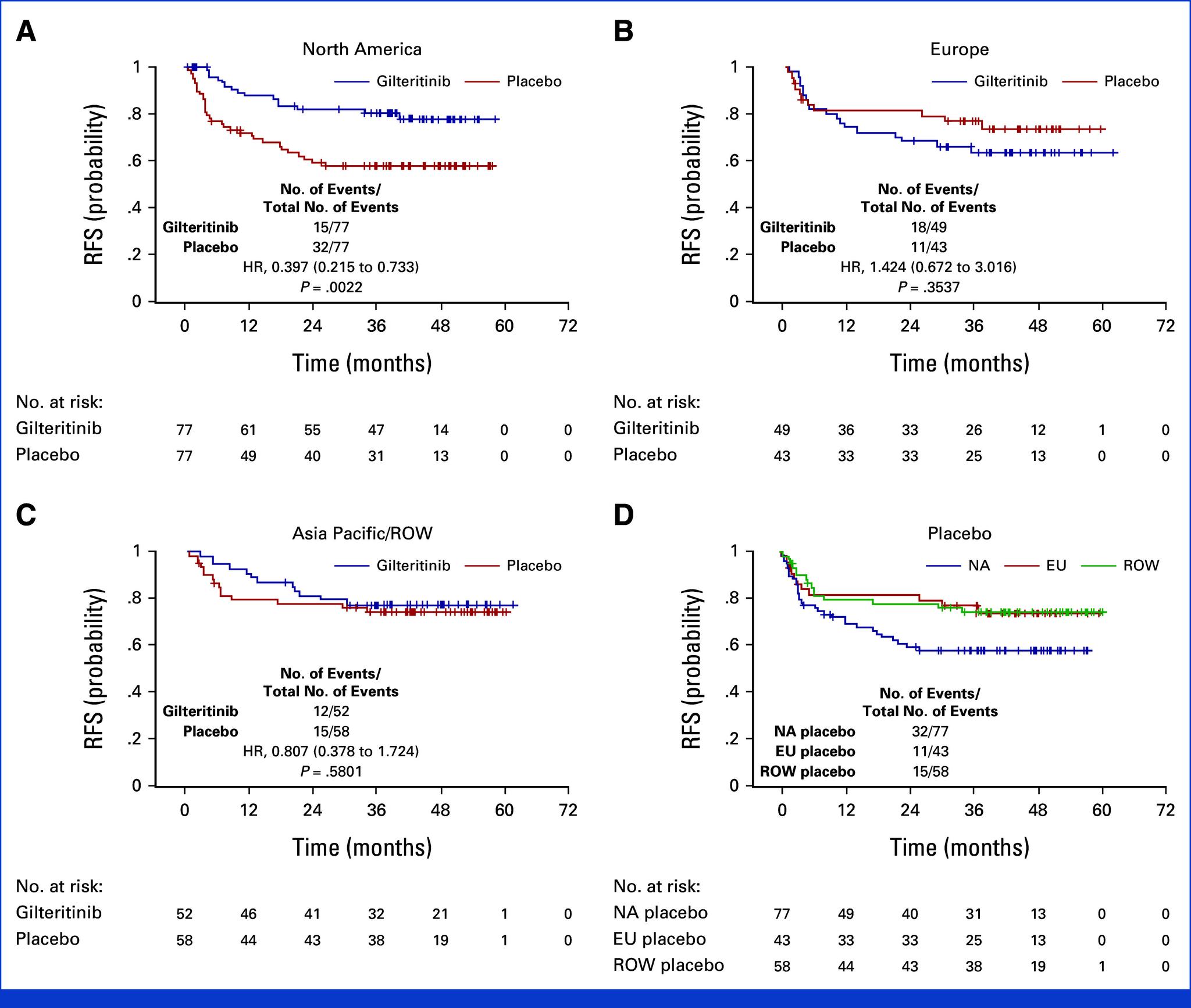
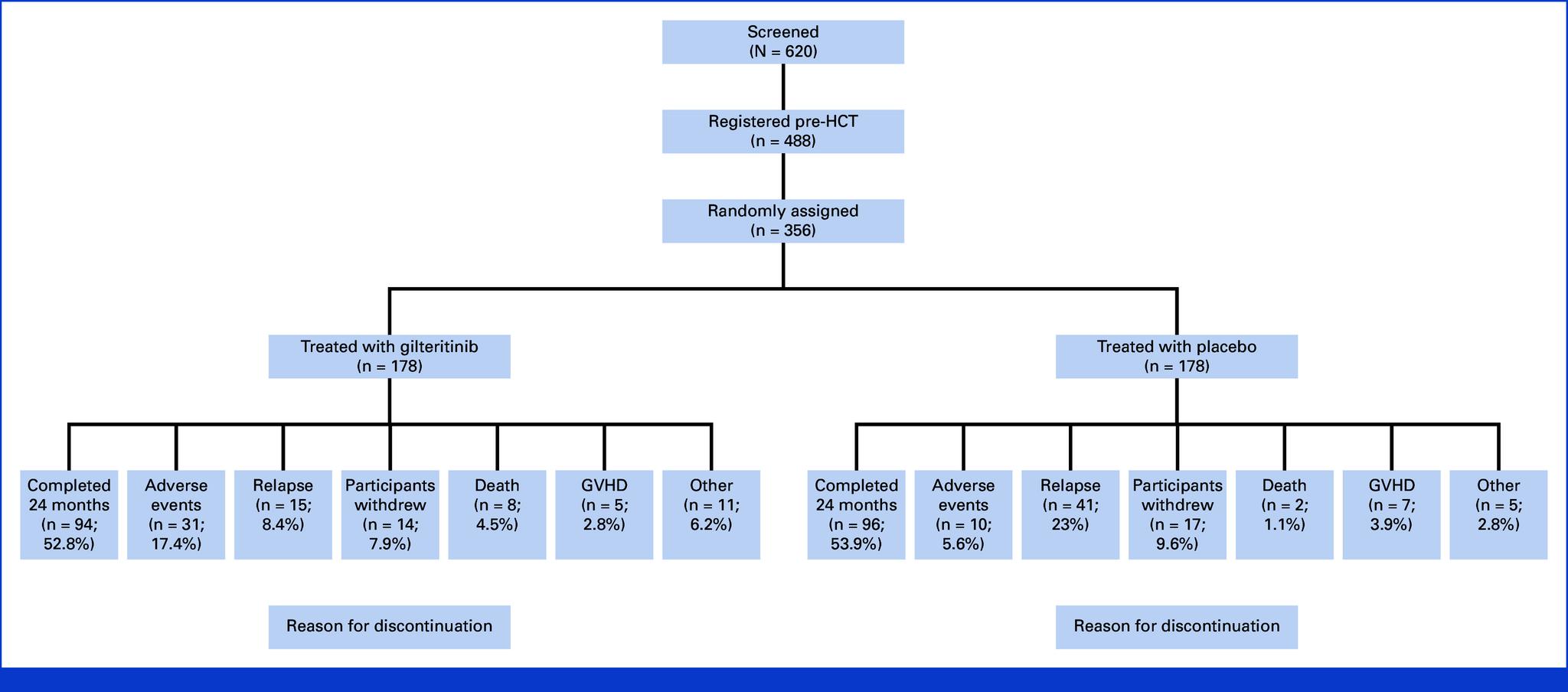
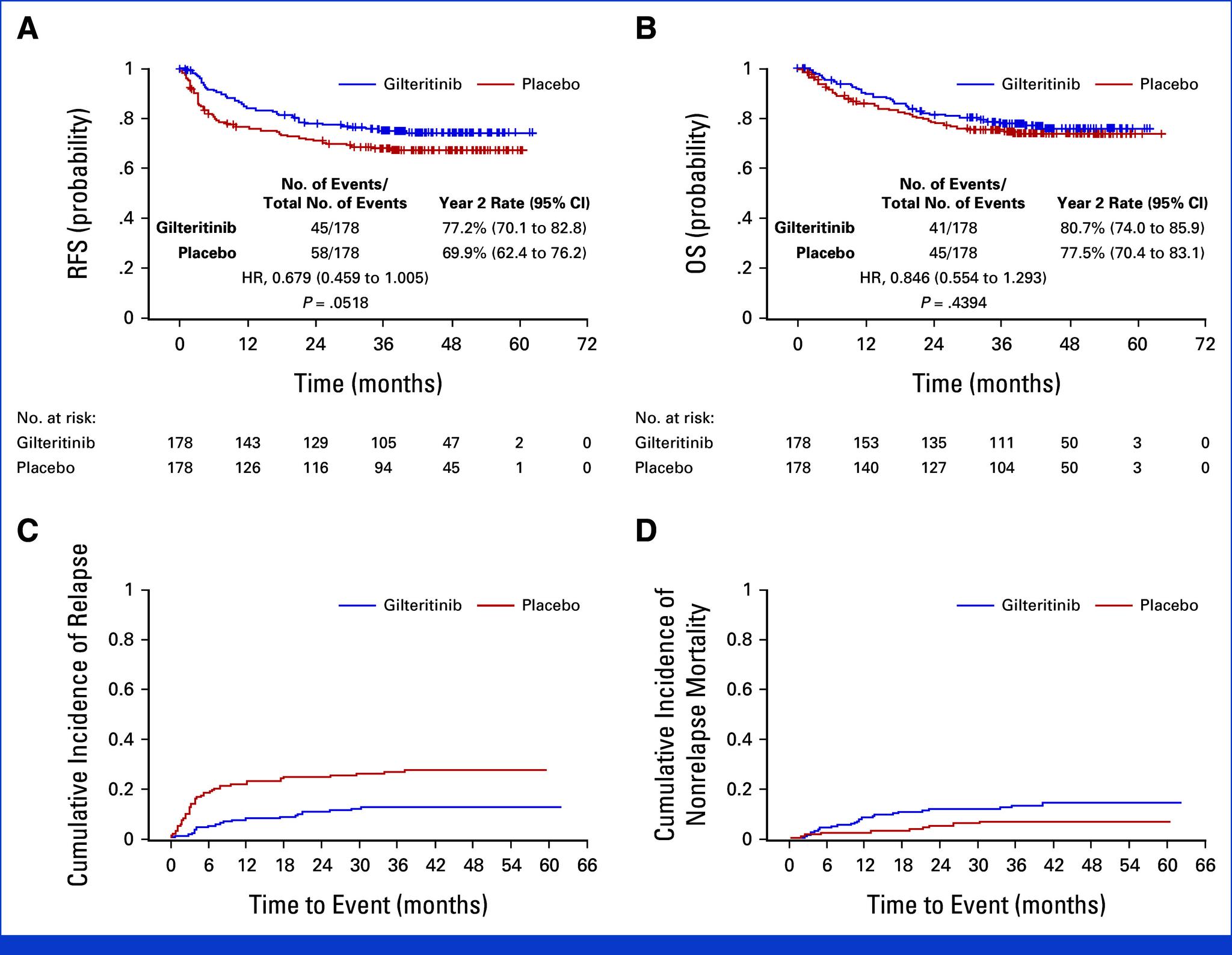
Three hundred fifty-six participants were randomly assigned post-HCT to receive gilteritinib or placebo. Although RFS was higher in the gilteritinib arm, the difference was not statistically significant (hazard ratio [HR], 0.679 [95% CI, 0.459 to 1.005]; two-sided = .0518). However, 50.5% of participants had MRD detectable pre- or post-HCT, and, in a prespecified subgroup analysis, gilteritinib was beneficial in this population (HR, 0.515 [95% CI, 0.316 to 0.838]; = .0065). Those without detectable MRD showed no benefit (HR, 1.213 [95% CI, 0.616 to 2.387]; = .575).
CONCLUSION
Although the overall improvement in RFS was not statistically significant, RFS was higher for participants with detectable MRD pre- or post-HCT who received gilteritinib treatment. To our knowledge, these data are among the first to support the effectiveness of MRD-based post-HCT therapy.
目的
异基因造血细胞移植(HCT)可改善携带内部串联重复突变(FLT3-ITD)的 AML 患者的结局。这些患者在 HCT 后通常接受 FLT3 抑制剂治疗,但支持这一治疗的证据有限。因此,我们开展了一项 HCT 后维持治疗用 FLT3 抑制剂吉特替尼的随机试验(ClinicalTrials.gov 标识符:NCT02997202),以确定是否所有此类患者均受益,或者是否可检测到微小残留病(MRD)来识别可能受益的患者。
方法
处于首次缓解的成人 AML 患者接受 HCT,并随机分配至接受安慰剂或 HCT 后每日 120mg 吉特替尼治疗 24 个月。主要终点为无复发生存(RFS)。次要终点包括总生存(OS)和 HCT 前后 MRD 对 RFS 和 OS 的影响。
结果
356 名患者在 HCT 后随机分配接受吉特替尼或安慰剂。尽管吉特替尼组的 RFS 更高,但差异无统计学意义(风险比[HR],0.679[95%CI,0.459 至 1.005];双侧 =.0518)。然而,50.5%的患者在 HCT 前或后可检测到 MRD,在预先指定的亚组分析中,吉特替尼在该人群中有益(HR,0.515[95%CI,0.316 至 0.838]; =.0065)。未检测到 MRD 的患者无获益(HR,1.213[95%CI,0.616 至 2.387]; =.575)。
结论
尽管总体 RFS 改善无统计学意义,但 HCT 前或后可检测到 MRD 的患者接受吉特替尼治疗时 RFS 更高。据我们所知,这些数据是支持基于 MRD 的 HCT 后治疗有效性的首批数据之一。

 Zotero 插件