
洋蓟(L.)各部分、其副产品及膳食补充剂的多功能性概述
An Overview of the Versatility of the Parts of the Globe Artichoke ( L.), Its By-Products and Dietary Supplements.
作者信息
Olas Beata
机构信息
Department of General Biochemistry, Faculty of Biology and Environmental Protection, University of Lodz, Pomorska 141/143, 90-236 Lodz, Poland.
出版信息
Nutrients. 2024 Feb 22;16(5):599. doi: 10.3390/nu16050599.
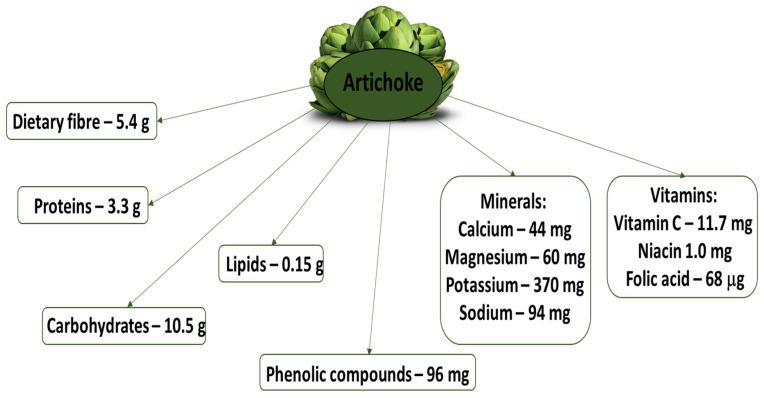
, also known as the globe artichoke or artichoke, is grown as a food, mainly in the Mediterranean, Canary Islands, and Egypt, as well as in Asia and South America. It has also been associated with various health benefits and is used in plant-based dietary supplements and herbal infusions. Its edible parts, consisting of the head or capitula, flower, and leaves, have shown various biological activities, including anti-cancer, hepatoprotective and antimicrobial potential. The leaves are mainly used in infusions and extracts for their health-promoting properties, although all their edible parts may also be consumed as fresh, frozen, or canned foods. However, its primary health-promoting activity is associated with its antioxidant potential, which has been linked to its chemical composition, particularly its phenolic compounds (representing 96 mg of gallic acid equivalent per 100 g of raw plant material) and dietary fiber. The main phenolic compounds in the heads and leaves are caffeic acid derivatives, while the flavonoids luteolin and apigenin (both present as glucosides and rutinosides) have also been identified. In addition, heat-treated artichokes (i.e., boiled, steamed or fried), their extracts, and waste from artichoke processing also have antioxidant activity. The present paper reviews the current literature concerning the biological properties of different parts of , its by-products and dietary supplements, as well as their chemical content and toxicity. The literature was obtained by a search of PubMed/Medline, Google Scholar, Web of Knowledge, ScienceDirect, and Scopus, with extra papers being identified by manually reviewing the references.
,也被称为球茎甘蓝或洋蓟,主要在地中海地区、加那利群岛、埃及以及亚洲和南美洲作为一种食物种植。它还与各种健康益处相关联,并被用于植物性膳食补充剂和草药浸剂中。其可食用部分包括头部或头状花序、花朵和叶子,已显示出多种生物活性,包括抗癌、保肝和抗菌潜力。叶子主要因其促进健康的特性而用于浸剂和提取物中,不过其所有可食用部分也可以作为新鲜、冷冻或罐装食品食用。然而,其主要的促进健康活动与其抗氧化潜力有关,这与其化学成分,特别是其酚类化合物(每100克生植物材料中相当于96毫克没食子酸)和膳食纤维有关。头部和叶子中的主要酚类化合物是咖啡酸衍生物,同时还鉴定出了黄酮类化合物木犀草素和芹菜素(均以糖苷和芸香糖苷形式存在)。此外,经过热处理的洋蓟(即煮、蒸或炸)、其提取物以及洋蓟加工产生的废料也具有抗氧化活性。本文综述了关于洋蓟不同部位、其副产品和膳食补充剂的生物学特性、化学含量和毒性的现有文献。这些文献是通过搜索PubMed/Medline、谷歌学术、Web of Knowledge、ScienceDirect和Scopus获得的,另外还通过手动查阅参考文献确定了一些额外的论文。

 Zotero 插件