
通过铜绿假单胞菌的轨迹重建揭示GacS在进化进程中的介导作用。
Uncovering the GacS-mediated role in evolutionary progression through trajectory reconstruction in Pseudomonas aeruginosa.
作者信息
Jiang Bo, Qiu Huifang, Lu Chenghui, Lu Mingqi, Li Yuanhao, Dai Weijun
机构信息
Integrative Microbiology Research Center, College of Plant Protection, South China Agricultural University, Guangzhou 510642, China.
出版信息
Nucleic Acids Res. 2024 Apr 24;52(7):3856-3869. doi: 10.1093/nar/gkae187.
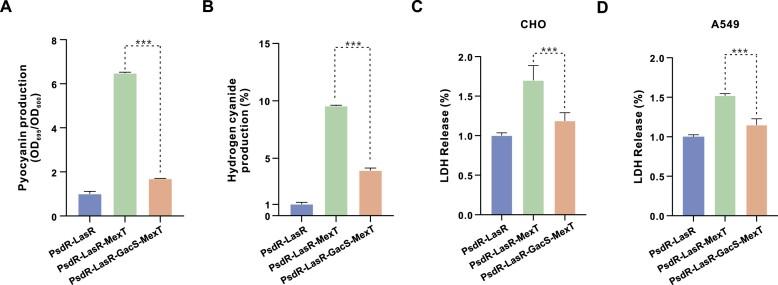
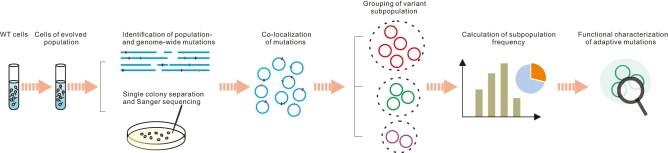
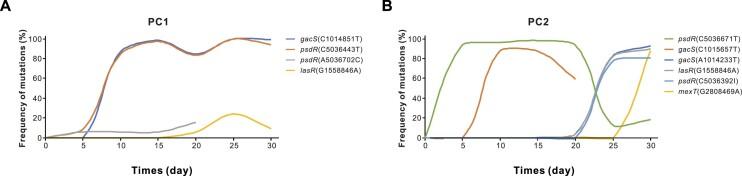
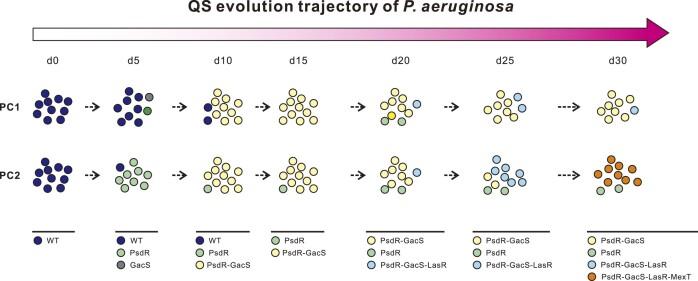
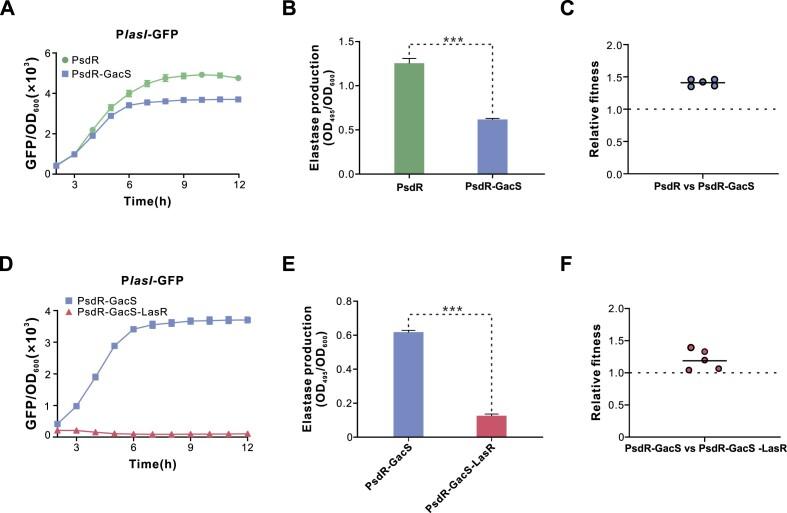
The genetic diversities of subpopulations drive the evolution of pathogens and affect their ability to infect hosts and cause diseases. However, most studies to date have focused on the identification and characterization of adaptive mutations in single colonies, which do not accurately reflect the phenotypes of an entire population. Here, to identify the composition of variant subpopulations within a pathogen population, we developed a streamlined approach that combines high-throughput sequencing of the entire population cells with genotyping of single colonies. Using this method, we reconstructed a detailed quorum-sensing (QS) evolutionary trajectory in Pseudomonas aeruginosa. Our results revealed a new adaptive mutation in the gacS gene, which codes for a histidine kinase sensor of a two-component system (TCS), during QS evolution. This mutation reduced QS activity, allowing the variant to sweep throughout the whole population, while still being vulnerable to invasion by the emerging QS master regulator LasR-null mutants. By tracking the evolutionary trajectory, we found that mutations in gacS facilitated QS-rewiring in the LasR-null mutant. This rapid QS revertant caused by inactive GacS was found to be associated with the promotion of ribosome biogenesis and accompanied by a trade-off of reduced bacterial virulence on host cells. In conclusion, our findings highlight the crucial role of the global regulator GacS in modulating the progression of QS evolution and the virulence of the pathogen population.
亚群的遗传多样性推动病原体的进化,并影响其感染宿主和引发疾病的能力。然而,迄今为止的大多数研究都集中在单个菌落中适应性突变的鉴定和表征上,而这并不能准确反映整个群体的表型。在此,为了确定病原体群体内变异亚群的组成,我们开发了一种简化方法,该方法将整个群体细胞的高通量测序与单个菌落的基因分型相结合。使用这种方法,我们重建了铜绿假单胞菌中详细的群体感应(QS)进化轨迹。我们的结果揭示了在QS进化过程中,gacS基因(编码双组分系统(TCS)的组氨酸激酶传感器)出现了一个新的适应性突变。这种突变降低了QS活性,使该变体能够在整个群体中占据主导地位,同时仍然容易受到新出现的QS主调控因子LasR缺失突变体的入侵。通过追踪进化轨迹,我们发现gacS中的突变促进了LasR缺失突变体中的QS重编程。由无活性的GacS引起的这种快速QS回复突变体被发现与核糖体生物合成的促进有关,并伴随着宿主细胞上细菌毒力降低的权衡。总之,我们的研究结果突出了全局调控因子GacS在调节QS进化进程和病原体群体毒力方面的关键作用。




 Zotero 插件