
在新加坡延长糖尿病视网膜病变筛查间隔时间:一项队列研究的方法学和初步发现。
Extending the diabetic retinopathy screening intervals in Singapore: methodology and preliminary findings of a cohort study.
机构信息
Singapore Eye Research Institute and Singapore National Eye Centre, Singapore, Singapore.
Duke-NUS Medical School, Singapore, Singapore.
出版信息
BMC Public Health. 2024 Mar 13;24(1):786. doi: 10.1186/s12889-024-18287-2.
BACKGROUND
The Diabetic Retinopathy Extended Screening Study (DRESS) aims to develop and validate a new DR/diabetic macular edema (DME) risk stratification model in patients with Type 2 diabetes (DM) to identify low-risk groups who can be safely assigned to biennial or triennial screening intervals. We describe the study methodology, participants' baseline characteristics, and preliminary DR progression rates at the first annual follow-up.
METHODS
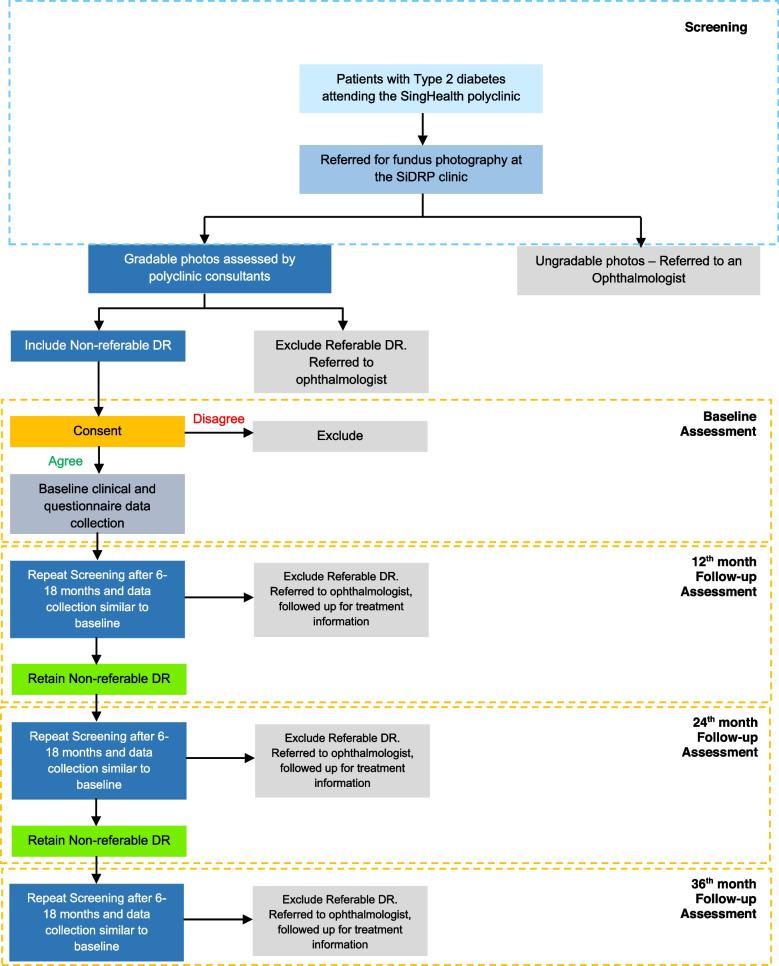
DRESS is a 3-year ongoing longitudinal study of patients with T2DM and no or mild non-proliferative DR (NPDR, non-referable) who underwent teleophthalmic screening under the Singapore integrated Diabetic Retinopathy Programme (SiDRP) at four SingHealth Polyclinics. Patients with referable DR/DME (> mild NPDR) or ungradable fundus images were excluded. Sociodemographic, lifestyle, medical and clinical information was obtained from medical records and interviewer-administered questionnaires at baseline. These data are extracted from medical records at 12, 24 and 36 months post-enrollment. Baseline descriptive characteristics stratified by DR severity at baseline and rates of progression to referable DR at 12-month follow-up were calculated.
RESULTS
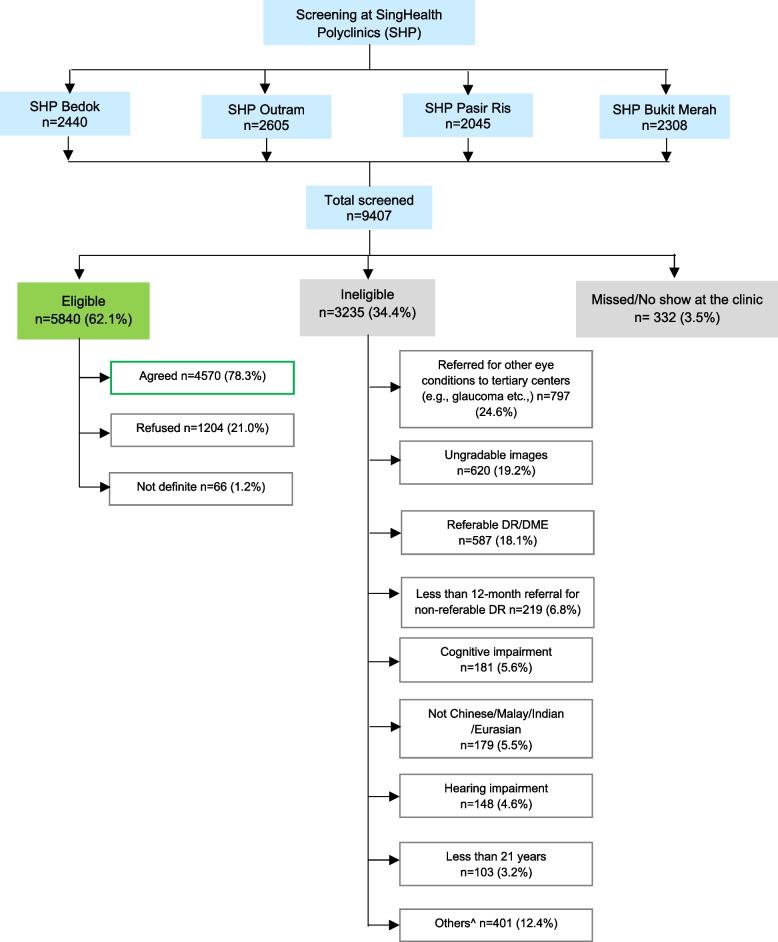
Of 5,840 eligible patients, 78.3% (n = 4,570, median [interquartile range [IQR] age 61.0 [55-67] years; 54.7% male; 68.0% Chinese) completed the baseline assessment. At baseline, 97.4% and 2.6% had none and mild NPDR (worse eye), respectively. Most participants had hypertension (79.2%) and dyslipidemia (92.8%); and almost half were obese (43.4%, BMI ≥ 27.5 kg/m). Participants without DR (vs mild DR) reported shorter DM duration, and had lower haemoglobin A1c, triglycerides and urine albumin/creatinine ratio (all p < 0.05). To date, we have extracted 41.8% (n = 1909) of the 12-month follow-up data. Of these, 99.7% (n = 1,904) did not progress to referable DR. Those who progressed to referable DR status (0.3%) had no DR at baseline.
CONCLUSIONS
In our prospective study of patients with T2DM and non-referable DR attending polyclinics, we found extremely low annual DR progression rates. These preliminary results suggest that extending screening intervals beyond 12 months may be viable and safe for most participants, although our 3-year follow up data are needed to substantiate this claim and develop the risk stratification model to identify low-risk patients with T2DM who can be assigned biennial or triennial screening intervals.
背景
糖尿病视网膜病变扩展筛查研究(DRESS)旨在为 2 型糖尿病(DM)患者开发和验证一种新的 DR/糖尿病性黄斑水肿(DME)风险分层模型,以识别低危人群,以便将其安全分配至每两年或每三年一次的筛查间隔。我们描述了该研究的方法学、参与者的基线特征以及首次年度随访时的初步 DR 进展率。
方法
DRESS 是一项正在进行的 3 年纵向研究,纳入了在新加坡综合糖尿病视网膜病变计划(SiDRP)下接受远程眼科筛查的无或轻度非增殖性糖尿病视网膜病变(NPDR,非转诊)的 T2DM 患者。患有转诊 DR/DME(>轻度 NPDR)或无法分级眼底图像的患者被排除在外。在基线时,通过医疗记录和访谈者管理的问卷获得社会人口统计学、生活方式、医学和临床信息。这些数据在入组后 12、24 和 36 个月从医疗记录中提取。根据基线 DR 严重程度和 12 个月随访时进展至转诊 DR 的比率对基线描述性特征进行分层。
结果
在 5840 名合格患者中,78.3%(n=4570 人,中位[四分位间距[IQR]年龄 61.0[55-67]岁;54.7%为男性;68.0%为中国人)完成了基线评估。基线时,97.4%和 2.6%的患者分别无 NPDR 和轻度 NPDR(最差眼)。大多数患者患有高血压(79.2%)和血脂异常(92.8%);近一半患者肥胖(43.4%,BMI≥27.5kg/m)。无 DR(vs 轻度 DR)的患者报告 DM 病程较短,且糖化血红蛋白 A1c、甘油三酯和尿白蛋白/肌酐比值较低(均 p<0.05)。迄今为止,我们已经提取了 12 个月随访数据的 41.8%(n=1909)。其中,99.7%(n=1904)未进展至转诊 DR。进展至转诊 DR 状态(0.3%)的患者在基线时无 DR。
结论
在我们对在诊所就诊的无转诊 DR 的 T2DM 患者进行的前瞻性研究中,我们发现 DR 的年进展率极低。这些初步结果表明,将筛查间隔延长至 12 个月以上对大多数患者可能是可行且安全的,尽管我们需要 3 年的随访数据来证实这一说法,并开发风险分层模型来识别可以分配每两年或每三年一次筛查间隔的 T2DM 低危患者。
 Zotero 插件