
评估全球健康决定因素:2000-2018 年全球疾病负担研究的计量经济学分析 - 强调对 DALY、YLL 和 YLD 指标有影响的因素。
Assessing health determinants worldwide: Econometric analysis of the Global Burden of Diseases Study 2000-18 - Highlighting impactful factors on DALY, YLL, and YLD indicators.
机构信息
Department of Health Management, Policy, and Economics, School of Public Health, Tehran University of Medical Sciences, Tehran, Iran.
Department of Health Economics, School of Health Management and Information Sciences, Iran University of Medical Sciences, Tehran, Iran.
出版信息
J Glob Health. 2024 Mar 15;14:04051. doi: 10.7189/jogh.14.04051.
BACKGROUND
As the health status of a population is influenced by a variety of health determinants, we sought to assess their impact on health outcomes, both at the global and regional levels.
METHODS
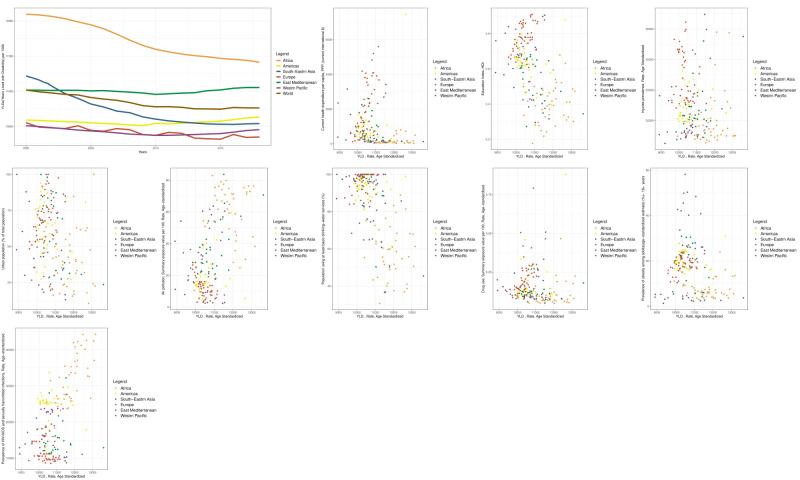
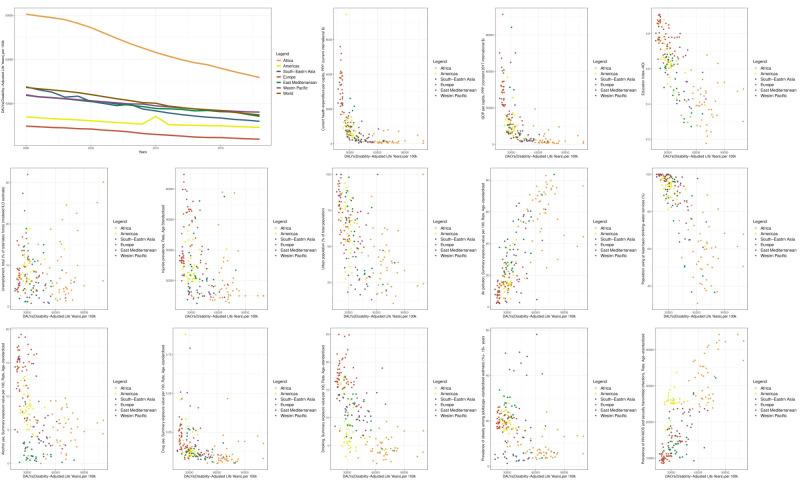
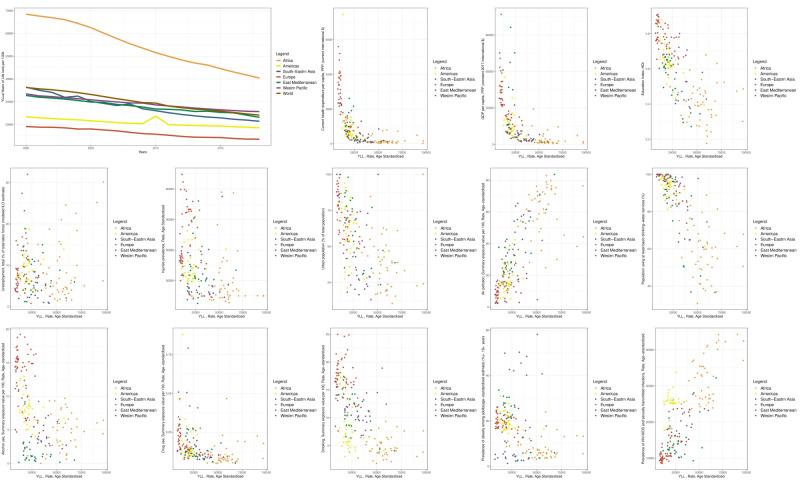
This ecological study encompassed all 194 member countries of the World Health Organization (WHO) from 2000 to 2018. We first identified all health determinants and then retrieved the related data from various global databases. We additionally considered three indicators - disability-adjusted life years (DALYs), years of life lost (YLL), and years lived with disability (YLD) - in evaluating health outcomes; we extracted their data from the Global Burden of Disease (GBD) 2019 study. We then applied econometric analyses using a multilevel mixed-effects linear regression model.
RESULTS
The analysis using the DALY indicator showed that the variables of sexually transmitted infections, injuries prevalence, and urbanisation had the highest effect size or regression coefficients (β) for health outcomes. The variables of sexually transmitted infection (β = 0.75, P < 0.001) in the African region; drinking water (β = -0.60, P < 0.001), alcohol use (β = 0.20, P < 0.001), and drug use (β = 0.05, P = 0.036) in the Americas region; urbanisation (β = -0.34, P < 0.001) in the Eastern Mediterranean region; current health expenditure (β = -0.21, P < 0.001) in the Europe region; injuries (β = 0.65, P < 0.001), air pollution (β = 0.29, P < 0.001), and obesity (β = 0.92, P < 0.001) in the South-East Asia region; and gross domestic product (β = -0.25, P < 0.001), education (β = -0.90, P < 0.001), and smoking (β = 0.28, P < 0.001) in the Western Pacific region had the most significant role in explaining global health outcomes. Except for the drug use variable in regional findings, the role of other variables in explaining the YLL indicator was greater than that of the YLD indicator.
CONCLUSIONS
To address global health disparities and optimise resource allocation, global and interregional policymakers should focus on determinants that had the highest β with health outcomes in each region compared to other regions. These determinants likely have a higher marginal health product, and investing in them is likely to be more cost-effective.
背景
由于人口的健康状况受到多种健康决定因素的影响,我们试图评估这些因素对全球和地区层面健康结果的影响。
方法
本生态研究涵盖了 2000 年至 2018 年期间世卫组织的所有 194 个成员国。我们首先确定了所有的健康决定因素,然后从各种全球数据库中检索相关数据。我们还考虑了三个指标——伤残调整生命年(DALY)、生命损失年(YLL)和伤残生存年(YLD)——来评估健康结果;我们从全球疾病负担(GBD)2019 研究中提取了它们的数据。然后,我们使用多层次混合效应线性回归模型进行了计量经济学分析。
结果
使用 DALY 指标进行的分析表明,性传播感染、伤害流行率和城市化等变量对健康结果的影响最大,其效应大小或回归系数(β)最高。在非洲地区,性传播感染变量(β=0.75,P<0.001);在美洲地区,饮用水(β=-0.60,P<0.001)、酒精使用(β=0.20,P<0.001)和药物使用(β=0.05,P=0.036);在东地中海地区,城市化变量(β=-0.34,P<0.001);在欧洲地区,当前卫生支出变量(β=-0.21,P<0.001);在东南亚地区,伤害(β=0.65,P<0.001)、空气污染(β=0.29,P<0.001)和肥胖(β=0.92,P<0.001);在西太平洋地区,国内生产总值(β=-0.25,P<0.001)、教育(β=-0.90,P<0.001)和吸烟(β=0.28,P<0.001)变量在解释全球健康结果方面的作用最大。除了区域研究中药物使用变量外,其他变量在解释 YLL 指标方面的作用大于 YLD 指标。
结论
为了解决全球健康差距问题并优化资源配置,全球和区域间政策制定者应关注与其他区域相比,每个区域与健康结果关联度最高的β的决定因素。这些决定因素可能具有更高的边际健康产出,投资于这些因素可能更具成本效益。
 Zotero 插件