
血清肌生成抑制蛋白作为脊髓性肌萎缩症疾病严重程度和进展的候选生物标志物。
Serum myostatin as a candidate disease severity and progression biomarker of spinal muscular atrophy.
作者信息
de Albuquerque Ana Letícia Amorim, Chadanowicz Júlia Kersting, Giudicelli Giovanna Câmara, Staub Ana Lucia Portella, Weber Arthur Carpeggiani, Silva Jordana Miranda De Souza, Becker Michele Michelin, Kowalski Thayne Woycinck, Siebert Marina, Saute Jonas Alex Morales
机构信息
Graduate Program in Medicine, Medical Sciences, Federal University of Rio Grande do Sul, Porto Alegre 90035-003, Brazil.
Clinical Neurogenetics research group, Hospital de Clínicas de Porto Alegre, Porto Alegre 90035-007, Brazil.
出版信息
Brain Commun. 2024 Feb 28;6(2):fcae062. doi: 10.1093/braincomms/fcae062. eCollection 2024.
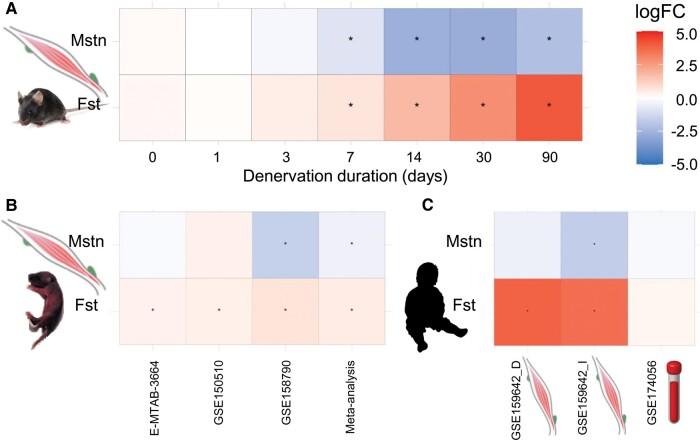
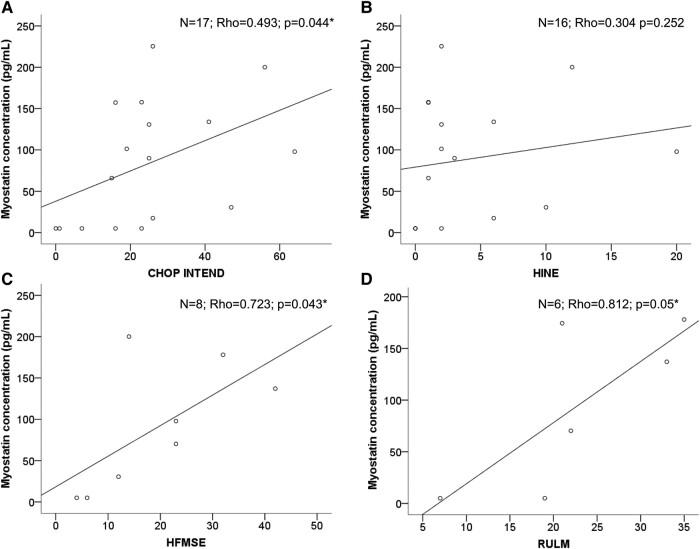
The identification of biomarkers for spinal muscular atrophy is crucial for predicting disease progression, severity, and response to new disease-modifying therapies. This study aimed to investigate the role of serum levels of myostatin and follistatin as biomarkers for spinal muscular atrophy, considering muscle atrophy secondary to denervation as the main clinical manifestation of the disease. The study evaluated the differential gene expression of myostatin and follistatin in a lesional model of denervation in mice, as well as in a meta-analysis of three datasets in transgenic mice models of spinal muscular atrophy, and in two studies involving humans with spinal muscular atrophy. Subsequently, a case-control study involving 27 spinal muscular atrophy patients and 27 controls was conducted, followed by a 12-month cohort study with 25 spinal muscular atrophy cases. Serum levels of myostatin and follistatin were analysed using enzyme-linked immunosorbent assay at a single centre in southern Brazil. Skeletal muscle gene expression of myostatin decreased and of follistatin increased following lesional muscle denervation in mice, consistent with findings in the spinal muscular atrophy transgenic mice meta-analysis and in the muscle of five patients with spinal muscular atrophy type 1. Median serum myostatin levels were significantly lower in spinal muscular atrophy patients (98 pg/mL; 5-157) compared to controls (412 pg/mL; 299-730) ( < 0.001). Lower myostatin levels were associated with greater disease severity based on clinician-rated outcomes (Rho = 0.493-0.812; < 0.05). After 12 months, there was a further reduction in myostatin levels among spinal muscular atrophy cases ( = 0.021). Follistatin levels did not differ between cases and controls, and no significant changes were observed over time. The follistatin:myostatin ratio was significantly increased in spinal muscular atrophy subjects and inversely correlated with motor severity. Serum myostatin levels show promise as a novel biomarker for evaluating the severity and progression of spinal muscular atrophy. The decrease in myostatin levels and the subsequent favourable environment for muscle growth may be attributed to denervation caused by motor neuron dysfunction.
鉴定脊髓性肌萎缩症的生物标志物对于预测疾病进展、严重程度以及对新型疾病修正疗法的反应至关重要。本研究旨在探讨血清中肌生成抑制素和卵泡抑素水平作为脊髓性肌萎缩症生物标志物的作用,将去神经支配继发的肌肉萎缩视为该疾病的主要临床表现。该研究评估了小鼠去神经支配损伤模型中肌生成抑制素和卵泡抑素的差异基因表达,以及脊髓性肌萎缩症转基因小鼠模型的三个数据集的荟萃分析,还有两项涉及脊髓性肌萎缩症患者的研究。随后,进行了一项病例对照研究,纳入27例脊髓性肌萎缩症患者和27名对照,接着是一项对25例脊髓性肌萎缩症病例进行的为期12个月的队列研究。在巴西南部的一个单一中心,使用酶联免疫吸附测定法分析了肌生成抑制素和卵泡抑素的血清水平。小鼠损伤性肌肉去神经支配后,骨骼肌中肌生成抑制素的基因表达降低,卵泡抑素的基因表达增加,这与脊髓性肌萎缩症转基因小鼠荟萃分析以及5例1型脊髓性肌萎缩症患者肌肉中的发现一致。脊髓性肌萎缩症患者的血清肌生成抑制素水平中位数(98 pg/mL;5 - 157)显著低于对照组(412 pg/mL;299 - 730)(<0.001)。根据临床医生评定的结果,较低的肌生成抑制素水平与更严重疾病相关(Rho = 0.493 - 0.812;<0.05)。12个月后,脊髓性肌萎缩症病例的肌生成抑制素水平进一步降低(= 0.021)。病例组和对照组的卵泡抑素水平无差异,且未观察到随时间的显著变化。脊髓性肌萎缩症患者的卵泡抑素:肌生成抑制素比值显著升高,且与运动严重程度呈负相关。血清肌生成抑制素水平有望成为评估脊髓性肌萎缩症严重程度和进展的新型生物标志物。肌生成抑制素水平的降低以及随后有利于肌肉生长的环境可能归因于运动神经元功能障碍导致的去神经支配。




 Zotero 插件