
水滴中活性氧形成对相对湿度的依赖性。
Dependence on relative humidity in the formation of reactive oxygen species in water droplets.
作者信息
Mofidfar Mohammad, Mehrgardi Masoud A, Xia Yu, Zare Richard N
机构信息
Department of Chemistry, Stanford University, Stanford, CA 94305.
Department of Chemistry, University of Isfahan, Isfahan 81743, Iran.
出版信息
Proc Natl Acad Sci U S A. 2024 Mar 19;121(12):e2315940121. doi: 10.1073/pnas.2315940121. Epub 2024 Mar 15.
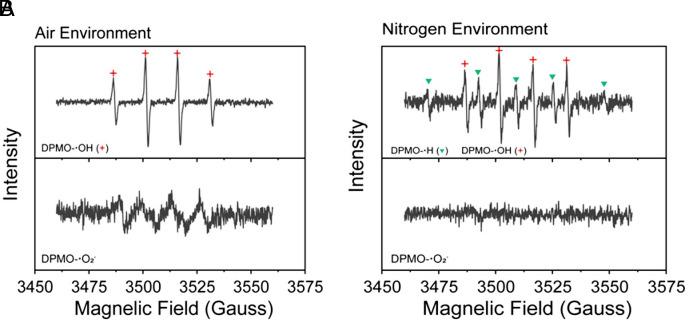
Water microdroplets (7 to 11 µm average diameter, depending on flow rate) are sprayed in a closed chamber at ambient temperature, whose relative humidity (RH) is controlled. The resulting concentration of ROS (reactive oxygen species) formed in the microdroplets, measured by the amount of hydrogen peroxide (HO), is determined by nuclear magnetic resonance (NMR) and by spectrofluorimetric assays after the droplets are collected. The results are found to agree closely with one another. In addition, hydrated hydroxyl radical cations (•OH-HO) are recorded from the droplets using mass spectrometry and superoxide radical anions (•O) and hydroxyl radicals (•OH) by electron paramagnetic resonance spectroscopy. As the RH varies from 15 to 95%, the concentration of HO shows a marked rise by a factor of about 3.5 in going from 15 to 50%, then levels off. By replacing the HO of the sprayed water with deuterium oxide (DO) but keeping the gas surrounding droplets with HO, mass spectrometric analysis of the hydrated hydroxyl radical cations demonstrates that the water in the air plays a dominant role in producing HO and other ROS, which accounts for the variation with RH. As RH increases, the droplet evaporation rate decreases. These two facts help us understand why viruses in droplets both survive better at low RH values, as found in indoor air in the wintertime, and are disinfected more effectively at higher RH values, as found in indoor air in the summertime, thus explaining the recognized seasonality of airborne viral infections.
在环境温度下,将平均直径为7至11微米(取决于流速)的水微滴喷入一个相对湿度(RH)受控的密闭腔室中。微滴中形成的活性氧(ROS)的最终浓度通过过氧化氢(HO)的量来测量,在收集微滴后通过核磁共振(NMR)和荧光光谱测定法来确定。结果发现彼此非常吻合。此外,使用质谱法记录微滴中的水合羟基自由基阳离子(•OH-HO),并通过电子顺磁共振光谱法记录超氧自由基阴离子(•O)和羟基自由基(•OH)。随着相对湿度从15%变化到95%,HO的浓度在从15%升至50%时显著上升约3.5倍,然后趋于平稳。通过用氧化氘(DO)替代喷雾水中的HO,但保持微滴周围气体为含HO的气体,对水合羟基自由基阳离子的质谱分析表明,空气中的水在产生HO和其他ROS方面起主导作用,这解释了其随相对湿度的变化。随着相对湿度增加,微滴蒸发速率降低。这两个事实有助于我们理解为什么冬季室内空气中低相对湿度下液滴中的病毒存活得更好,而夏季室内空气中高相对湿度下病毒能更有效地被消毒,从而解释了空气传播病毒感染公认的季节性。


 Zotero 插件