
单发免气腹腹腔镜子宫肌瘤剔除术后复发并腹膜播散:1 例病例报告及文献复习。
Recurrence complicated with peritoneal dissemination after single-port gasless myomectomy for cellular uterine leiomyoma: A case report and literature review.
机构信息
Department of Graduate School, Hubei University of Medicine, Shiyan, China.
Department of Gynecology, Maternal and Child Health Hospital of Hubei Province, Wuhan, China.
出版信息
Medicine (Baltimore). 2024 Mar 15;103(11):e37444. doi: 10.1097/MD.0000000000037444.
RATIONALE
Cellular uterine leiomyomas (CL) represent the prevailing subtype among uterine leiomyomas. In this study, we report a case of recurrent peritoneal disseminated uterine fibroids 2 years after single-port laparoscopic gasless myomectomy. This article endeavors to examine the potential limitations of the aforementioned surgical procedure and outline the distinguishing features of recurrent cases with primary postoperative pathology as CL. Additionally, it aims to provide a summary of previous retrospective studies on CL and propose the existence of immunohistochemical molecules that may serve as predictors for the postoperative recurrence of cellular uterine fibroids. The ultimate objective is to enhance clinicians' comprehension of the disease.
PATIENT CONCERNS
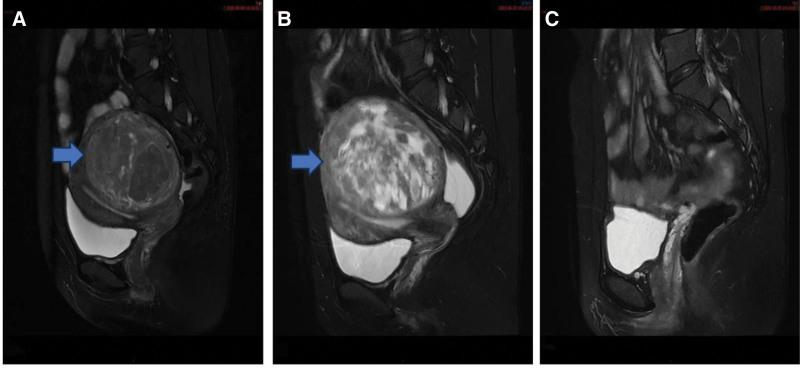
Two years ago, the patient underwent a single-port gasless laparoscopic myomectomy for uterine fibroids. Gynecological color Doppler ultrasound conducted 3 months ago revealed recurrence of uterine fibroids, and the patient experienced abdominal distension, mild urinary frequency, and constipation for the past month.
DIAGNOSES
After the second surgical procedure, a comprehensive pathological examination and immunohistochemical analysis of both the uterine mass and metastatic lesions revealed that the definitive diagnosis was CLs.
INTERVENTIONS
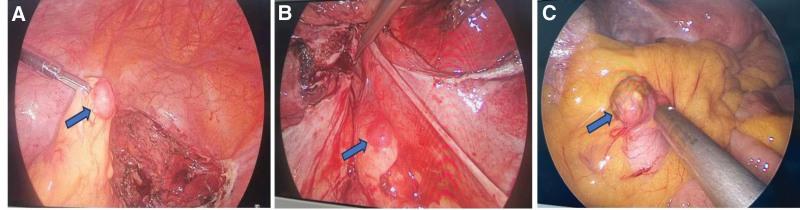
The patient underwent the total hysterectomy, bilateral salpingectomy, pelvic adhesiolysis, omental mass resection, mesenteric mass resection, and pelvic peritoneal mass resection. All specimens were sent for rapid frozen examination and showed to be leiomyomas.
OUTCOMES
The patient was discharged from the hospital on the 10th day after the operation. At the date of writing the article, the patient had no recurrence for 1 year and 5 months.
LESSONS
The single-port gasless approach did not achieve the desired reduction in fibroid recurrence, as anticipated by the surgeon. The act of pulling the tumor towards the abdominal incision for resection, on the contrary, may serve as an iatrogenic factor contributing to postoperative recurrence of CL into peritoneal dissemination leiomyomatosis. The single-port gasless assisted bag may be a more suitable option for myomectomy. The utmost effort should be made to prevent the potential recurrence of myoma caused by iatrogenic factors.
背景
细胞性子宫肌瘤(CL)是子宫肌瘤的主要亚型。本研究报告了 1 例单孔腹腔镜非气腹子宫肌瘤剔除术后 2 年复发的腹膜播散性子宫肌瘤病例。本文旨在探讨该术式的潜在局限性,并描述与原发性术后病理为 CL 的复发性病例的区别特征。此外,本文还对 CL 的既往回顾性研究进行了总结,并提出了可能作为细胞性子宫肌瘤术后复发预测因子的免疫组织化学分子。最终目标是提高临床医生对该疾病的认识。
病例关注点
患者 2 年前因子宫肌瘤行单孔非气腹腔镜子宫肌瘤剔除术。3 个月前妇科彩色多普勒超声发现子宫肌瘤复发,近 1 个月来出现腹胀、轻度尿频和便秘。
诊断
第二次手术后,对子宫肿块和转移灶进行全面的病理检查和免疫组织化学分析,明确诊断为 CL。
干预措施
患者接受了全子宫切除术、双侧输卵管切除术、盆腔粘连松解术、大网膜肿块切除术、肠系膜肿块切除术和盆腔腹膜肿块切除术。所有标本均行快速冷冻检查,结果均为子宫肌瘤。
结果
患者术后第 10 天出院。截至本文撰写日期,患者无复发,随访 1 年 5 个月。
教训
单孔非气腹腔镜手术并未如术者预期的那样降低子宫肌瘤的复发率。相反,将肿瘤向腹部切口方向牵拉以切除的操作可能成为术后 CL 腹膜播散性平滑肌瘤病复发的医源性因素。单孔非气腹腔镜辅助袋可能是更适合的子宫肌瘤剔除术式。应尽最大努力防止医源性因素导致的子宫肌瘤潜在复发。
 Zotero 插件