
野生大山雀社交网络的个体发生()。 (注:原文括号部分内容缺失,翻译可能不太完整准确)
The ontogeny of social networks in wild great tits ().
作者信息
Wild Sonja, Alarcón-Nieto Gustavo, Aplin Lucy M
机构信息
Cognitive and Cultural Ecology Research Group, Max Planck Institute of Animal Behavior, Am Obstberg 1, 78315 Radolfzell, Germany.
Centre for the Advanced Study of Collective Behaviour, University of Konstanz, Universitätsstrasse 10, 78464 Konstanz, Germany.
出版信息
Behav Ecol. 2024 Feb 29;35(2):arae011. doi: 10.1093/beheco/arae011. eCollection 2024 Mar-Apr.
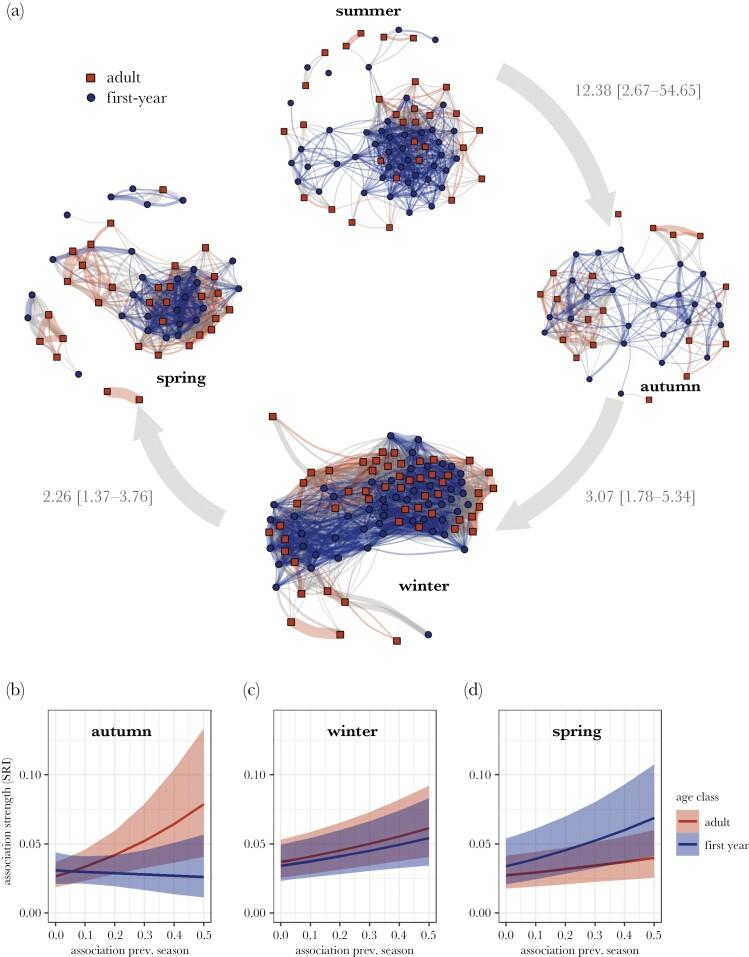
Sociality impacts many biological processes and can be tightly linked to an individual's fitness. To maximize the advantages of group living, many social animals prefer to associate with individuals that provide the most benefits, such as kin, familiar individuals, or those of similar phenotypes. Such social strategies are not necessarily stable over time but can vary with changing selection pressures. In particular, young individuals transitioning to independence should continuously adjust their social behavior in light of developmental changes. However, social strategies exhibited during adolescence in animals are understudied, and the factors underlying social network formation during ontogeny remain elusive. Here, we tracked associations of wild great tits () during the transition to independence and across their first year of life. Both spatial and social factors predicted dyadic associations. During the transition to independence in spring, fledglings initially preferred to associate with siblings and peers over non-parent adults. We found no evidence for preferred associations among juveniles of similar age or fledge weight during that time but weak evidence for some potential inheritance of the parental social network. By autumn, after juveniles had reached full independence, they exhibited social strategies similar to those of adults by establishing stable social ties based on familiarity that persisted through winter into the next spring. Overall, this research demonstrates dynamic changes in social networks during ontogeny in a species with a fast life history and limited parental care, which likely reflect changes in selective pressures. It further highlights the importance of long-term social bonds based on familiarity in this species.
社会性会影响许多生物过程,并且可能与个体的适应性紧密相连。为了使群体生活的优势最大化,许多群居动物更倾向于与能带来最大益处的个体交往,比如亲属、熟悉的个体或具有相似表型的个体。这类社会策略不一定会随着时间推移而保持稳定,而是可能会随选择压力的变化而改变。特别是,正过渡到独立生活的幼体应根据自身发育变化不断调整其社会行为。然而,动物青春期所展现出的社会策略尚未得到充分研究,个体发育过程中社会网络形成的潜在因素也仍不明确。在此,我们追踪了野生大山雀在向独立过渡期间及其出生后第一年的交往情况。空间因素和社会因素都能预测二元交往关系。在春季向独立过渡期间,雏鸟最初更倾向于与兄弟姐妹和同伴交往,而非与非亲代成年个体交往。在那段时间里,我们没有发现年龄或 fledgl 体重相似的幼鸟之间存在偏好交往的证据,但有微弱证据表明存在一些亲代社会网络的潜在传承。到了秋季,幼鸟完全独立后,它们通过建立基于熟悉度的稳定社会关系,表现出与成年个体相似的社会策略,这种关系会持续整个冬季直至次年春季。总体而言,这项研究表明,在一个具有快速生活史且亲代照料有限的物种中,个体发育过程中社会网络会发生动态变化,这可能反映了选择压力的变化。它还进一步凸显了基于熟悉度的长期社会关系在该物种中的重要性。
需注意,原文中“fledgl”可能有误,不太明确其准确含义,翻译时保留了原文。

 Zotero 插件