
哪种神经影像学和体液生物标志物方法在阿尔茨海默病的诊疗中更具优势?一项系统评价。
Which neuroimaging and fluid biomarkers method is better in theranostic of Alzheimer's disease? An umbrella review.
作者信息
Mohammadi Hossein, Ariaei Armin, Ghobadi Zahra, Gorgich Enam Alhagh Charkhat, Rustamzadeh Auob
机构信息
Department of Bioimaging, School of Advanced Technologies in Medicine, Isfahan University of Medical Sciences (MUI), Isfahan, Islamic Republic of Iran.
Student Research Committee, School of Medicine, Iran University of Medical Sciences, Tehran, Islamic Republic of Iran.
出版信息
IBRO Neurosci Rep. 2024 Feb 29;16:403-417. doi: 10.1016/j.ibneur.2024.02.007. eCollection 2024 Jun.
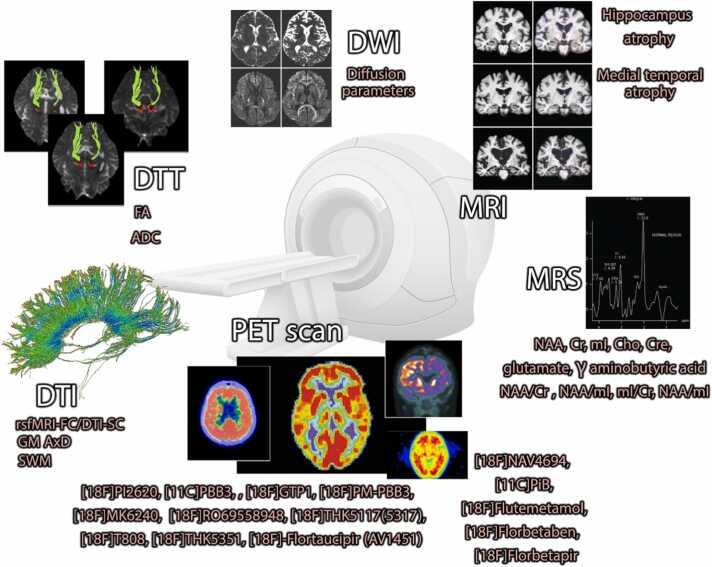
Biomarkers are measured to evaluate physiological and pathological processes as well as responses to a therapeutic intervention. Biomarkers can be classified as diagnostic, prognostic, predictor, clinical, and therapeutic. In Alzheimer's disease (AD), multiple biomarkers have been reported so far. Nevertheless, finding a specific biomarker in AD remains a major challenge. Three databases, including PubMed, Web of Science, and Scopus were selected with the keywords of Alzheimer's disease, neuroimaging, biomarker, and blood. The results were finalized with 49 potential CSF/blood and 35 neuroimaging biomarkers. To distinguish normal from AD patients, amyloid-beta (Aβ), plasma glial fibrillary acidic protein (GFAP), and neurofilament light (NFL) as potential biomarkers in cerebrospinal fluid (CSF) as well as the serum could be detected. Nevertheless, most of the biomarkers fairly change in the CSF during AD, listed as kallikrein 6, virus-like particles (VLP-1), galectin-3 (Gal-3), and synaptotagmin-1 (Syt-1). From the neuroimaging aspect, atrophy is an accepted biomarker for the neuropathologic progression of AD. In addition, Magnetic resonance spectroscopy (MRS), diffusion weighted imaging (DWI), diffusion tensor imaging (DTI), tractography (DTT), positron emission tomography (PET), and functional magnetic resonance imaging (fMRI), can be used to detect AD. Using neuroimaging and CSF/blood biomarkers, in combination with artificial intelligence, it is possible to obtain information on prognosis and follow-up on the different stages of AD. Hence physicians could select the suitable therapy to attenuate disease symptoms and follow up on the efficiency of the prescribed drug.
生物标志物用于评估生理和病理过程以及对治疗干预的反应。生物标志物可分为诊断性、预后性、预测性、临床性和治疗性。到目前为止,在阿尔茨海默病(AD)中已报道了多种生物标志物。然而,在AD中找到一种特异性生物标志物仍然是一项重大挑战。我们选择了三个数据库,包括PubMed、科学网和Scopus,使用阿尔茨海默病、神经影像学、生物标志物和血液等关键词进行检索。最终确定了49种潜在的脑脊液/血液生物标志物和35种神经影像学生物标志物。为了区分正常人和AD患者,可以检测脑脊液以及血清中作为潜在生物标志物的β淀粉样蛋白(Aβ)、血浆胶质纤维酸性蛋白(GFAP)和神经丝轻链(NFL)。然而,大多数生物标志物在AD期间脑脊液中会发生相当大的变化,如激肽释放酶6、病毒样颗粒(VLP-1)、半乳糖凝集素-3(Gal-3)和突触结合蛋白-1(Syt-1)。从神经影像学角度来看,萎缩是AD神经病理进展公认的生物标志物。此外,磁共振波谱(MRS)、扩散加权成像(DWI)、扩散张量成像(DTI)、纤维束成像(DTT)、正电子发射断层扫描(PET)和功能磁共振成像(fMRI)可用于检测AD。利用神经影像学和脑脊液/血液生物标志物,结合人工智能,有可能获得AD不同阶段的预后信息并进行随访。因此,医生可以选择合适的治疗方法来减轻疾病症状并跟踪所开药物的疗效。


 Zotero 插件