
秘鲁的脆弱新生儿表型:一项基于2012年至2021年全国及国家以下各级3841531例出生情况的人群研究。
Vulnerable newborn phenotypes in Peru: a population-based study of 3,841,531 births at national and subnational levels from 2012 to 2021.
作者信息
Cajachagua-Torres Kim N, Quezada-Pinedo Hugo G, Guzman-Vilca Wilmer Cristobal, Tarazona-Meza Carla, Carrillo-Larco Rodrigo M, Huicho Luis
机构信息
The Generation R Study Group, Erasmus MC, University Medical Center Rotterdam, Rotterdam, the Netherlands.
Department of Paediatrics, Erasmus MC, University Medical Center Rotterdam, Rotterdam, the Netherlands.
出版信息
Lancet Reg Health Am. 2024 Feb 15;31:100695. doi: 10.1016/j.lana.2024.100695. eCollection 2024 Mar.
BACKGROUND
We aimed to examine the national and subnational prevalence of vulnerable newborn phenotypes in Peru, 2012-2021.
METHODS
Newborn phenotypes were defined using gestational age (preterm [PT], term [T]), birthweight for gestational age using INTERGROWTH-21st standards (small for gestational age [SGA], appropriate for gestational age [AGA] or large for gestational age [LGA]), and birthweight (low birthweight [LBW], non-LBW) using the Peruvian National Birth Registry as six (by excluding birthweight) and ten newborn phenotypes (using all three outcomes). Small phenotypes (with at least one classification of PT, SGA, or LBW) were further considered. Using individual-level data, we stratified the phenotypes by maternal educational level, maternal age, healthcare insurance, altitude of residence, and geographic region (Coast, Andes, and Amazon).
FINDINGS
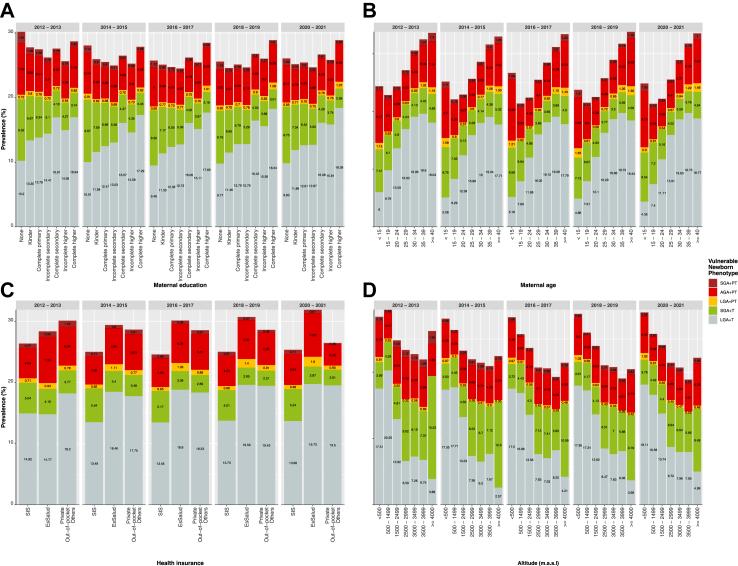
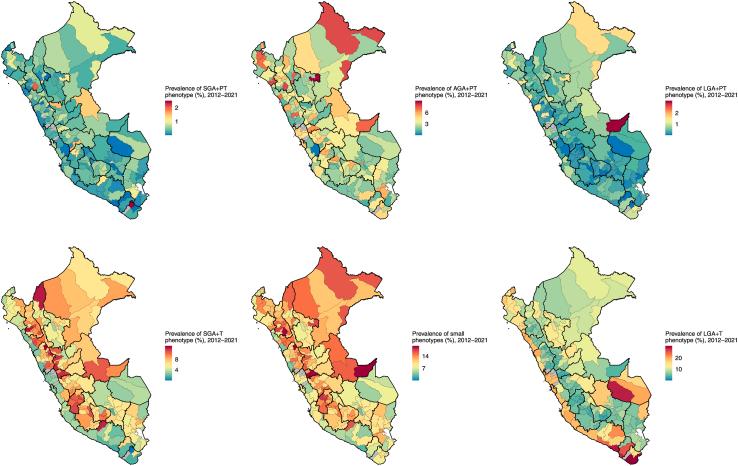
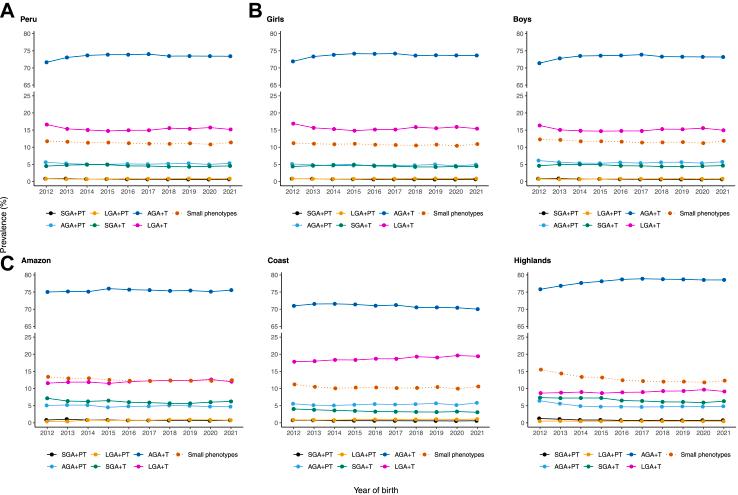
The prevalence of the five vulnerable newborn phenotypes for the study period was LGA+T (15.2%), AGA+PT (5.2%), SGA+T (4.6%), LGA+PT (0.8%), and SGA+PT (0.7%). The Coast had a higher prevalence of newborns with large phenotypes (19.4%) and the Highlands a higher prevalence of newborns with small phenotypes (12.5%). Mothers with poor socioeconomic status, extreme ages and living at high altitude had a higher prevalence of newborns with small phenotypes, and mothers who were wealthier, more educated, and older had a higher prevalence of infants with large phenotypes.
INTERPRETATION
Our findings cautiously suggest that socioeconomic and geographic disparities may play a crucial role in shaping vulnerable newborn phenotypes at national and subnational level in Peru. Further studies using longitudinal data are needed to corroborate our findings and to identify individual-level risk factors.
FUNDING
Ter Meulen Grant from the KNAW Medical Sciences Fund of the Royal Netherlands Academy of Arts and Sciences (KNAWWF/1085/TMB406, KNAWWF/1327/TMB202116), Fogarty Program (D43TW011502).
背景
我们旨在研究2012年至2021年秘鲁全国及各地区脆弱新生儿表型的患病率。
方法
根据孕周(早产[PT]、足月儿[T])、使用INTERGROWTH-21st标准的孕周别出生体重(小于胎龄儿[SGA]、适于胎龄儿[AGA]或大于胎龄儿[LGA])以及使用秘鲁国家出生登记处的出生体重(低出生体重[LBW]、非低出生体重)来定义新生儿表型,分为六种(不包括出生体重)和十种新生儿表型(使用所有三个指标)。进一步考虑小表型(至少有PT、SGA或LBW中的一种分类)。利用个体层面的数据,我们按母亲教育程度、母亲年龄、医疗保险、居住海拔和地理区域(海岸地区、安第斯地区和亚马逊地区)对表型进行分层。
研究结果
研究期间五种脆弱新生儿表型的患病率分别为LGA+T(15.2%)、AGA+PT(5.2%)、SGA+T(4.6%)、LGA+PT(0.8%)和SGA+PT(0.7%)。海岸地区大表型新生儿的患病率较高(19.4%),高地地区小表型新生儿的患病率较高(12.5%)。社会经济地位差、年龄极端以及居住在高海拔地区的母亲所生小表型新生儿的患病率较高,而较富裕、受教育程度较高和年龄较大的母亲所生大表型婴儿的患病率较高。
解读
我们的研究结果谨慎地表明,社会经济和地理差异可能在秘鲁全国及各地区塑造脆弱新生儿表型方面发挥关键作用。需要使用纵向数据进行进一步研究,以证实我们的发现并确定个体层面的风险因素。
资金来源
荷兰皇家艺术与科学院医学科学基金的特·梅伦奖(KNAWWF/1085/TMB406,KNAWWF/1327/TMB202116),福格蒂项目(D43TW011502)。
 Zotero 插件