
运动与关节内注射联合与单纯运动治疗膝关节骨关节炎的效果:证据的范围综述
The effects of exercise and intra-articular injections versus exercise alone for the treatment of knee osteoarthritis: A scoping review of the evidence.
作者信息
Liles Sydney C, Bley Bradley, White Daniel K
机构信息
Department of Physical Therapy, University of Delaware, Newark, DE, USA.
Delaware Sports Medicine, Wilmington, DE, USA.
出版信息
Osteoarthr Cartil Open. 2024 Mar 6;6(2):100456. doi: 10.1016/j.ocarto.2024.100456. eCollection 2024 Jun.
OBJECTIVE
Current treatment for knee Osteoarthritis (OA) includes exercise and intra-articular injections with corticosteroid (CS), hyaluronic acid (HA), etc., which address OA-related pain and functional limitation. While these interventions can be given together, little is known about the efficacy of a multi-modal approach. The purpose of this scoping review is to examine studies that compare combining exercise and intra-articular knee injections to exercise alone for the management of knee OA.
METHODS
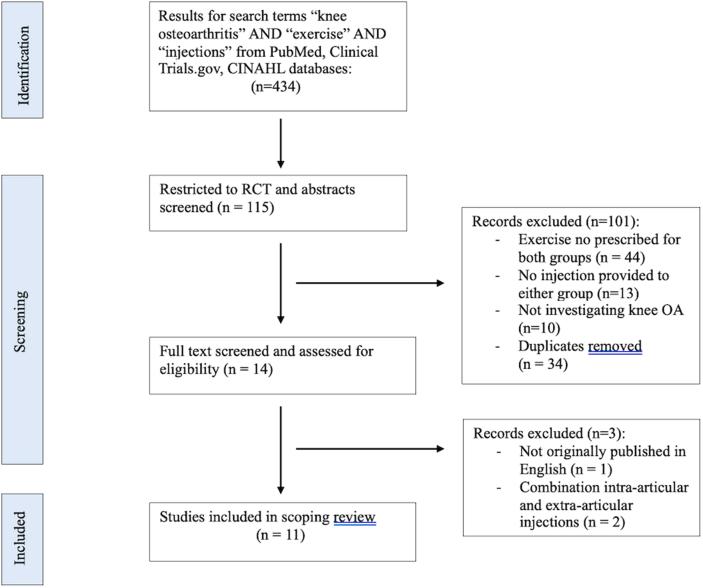
A search was performed using PubMed, CINAHL, and Clinicaltrials.gov with MeSH terms "knee osteoarthritis" AND "exercise" AND "injections". Abstracts were screened to meet inclusion criteria of both intervention groups including exercise and one group receiving an injection for treatment of knee OA. Full text articles were screened to meet inclusion criteria and rated using the Pedro Scale.
RESULTS
11 studies that met inclusion criteria. The included studies utilized CS, hyaluronic acid (HA), and Bone Marrow Concentrate (BMC), botulinum toxin A, or a combination of dextrose and lidocaine injections. Most studies included supervised exercise interventions with all studies including strengthening of the quadriceps. CS and exercise compared to exercise alone showed similar improvements in pain. The HA injection studies yielded mixed results with two studies finding HA and exercise was not superior than exercise alone while two other studies found that HA and exercise were superior.
CONCLUSION
There was a paucity of literature investigating multimodal approaches. Most of the included studies did not find superior effects of adding a knee injection to exercise compared to exercise alone for knee OA.
目的
目前膝关节骨关节炎(OA)的治疗方法包括运动以及关节内注射皮质类固醇(CS)、透明质酸(HA)等,这些方法可缓解与OA相关的疼痛和功能受限。虽然这些干预措施可以联合使用,但对于多模式方法的疗效知之甚少。本范围综述的目的是研究比较将运动与膝关节内注射联合使用和单独运动治疗膝关节OA的研究。
方法
使用PubMed、CINAHL和Clinicaltrials.gov进行检索,检索词为医学主题词“膝关节骨关节炎”、“运动”和“注射”。筛选摘要以符合两个干预组的纳入标准,包括运动组和一组接受注射治疗膝关节OA的组。筛选全文以符合纳入标准,并使用佩德罗量表进行评分。
结果
有11项研究符合纳入标准。纳入的研究使用了CS、透明质酸(HA)、骨髓浓缩物(BMC)、肉毒杆菌毒素A,或葡萄糖和利多卡因注射的组合。大多数研究包括有监督的运动干预,所有研究都包括股四头肌强化训练。与单独运动相比,CS与运动联合使用在疼痛改善方面显示出相似的效果。HA注射研究结果不一,两项研究发现HA与运动联合使用并不优于单独运动,而另外两项研究发现HA与运动联合使用更具优势。
结论
研究多模式方法的文献较少。大多数纳入的研究没有发现,对于膝关节OA,在运动基础上增加膝关节注射比单独运动有更显著的效果。
 Zotero 插件