
展望小儿脑肿瘤诊断分子时代的第1年之后:对肿瘤测序中发现的种系变异进行确证性检测。
Looking beyond year 1 in the molecular era of pediatric brain tumor diagnosis: confirmatory testing of germline variants found on tumor sequencing.
作者信息
Greene Brittany L, Stasi Shannon M, Ting Michelle A, Waligorski Natalie, Cole Bonnie L, Lockwood Christina M, Paulson Vera A, Buchan Jillian G, Lee Amy, Ojemann Jeffrey G, Ellenbogen Richard G, Stevens Jeffrey, Leary Sarah E S
机构信息
Ben Towne Center for Childhood Cancer Research, Seattle Children's Research Institute, Seattle, WA, United States.
Department of Pediatrics, University of Washington, Seattle, WA, United States.
出版信息
Front Oncol. 2024 Mar 6;14:1338022. doi: 10.3389/fonc.2024.1338022. eCollection 2024.
PURPOSE
Somatic molecular profiling of pediatric brain tumors aids with the diagnosis and treatment of patients with a variety of high- and low-grade central nervous system neoplasms. Here, we report follow-up targeted germline evaluation for patients with possible germline variants following tumor only testing in the initial year in which somatic molecular testing was implemented at a single institution.
PATIENTS AND METHODS
Somatic testing was completed for all tumors of the central nervous system (CNS) undergoing diagnostic workup at Seattle Children's Hospital during the study period of November 2015 to November 2016. Sequencing was performed in a College of American Pathologists-accredited, Clinical Laboratory Improvements Amendments-certified laboratory using UW-OncoPlex™ assay (version 5), a DNA-based targeted next generation sequencing panel validated to detect genetic alterations in 262 cancer-related genes. We tracked subsequent clinical evaluation and testing on a subgroup of this cohort found to have potential germline variants of interest.
RESULTS
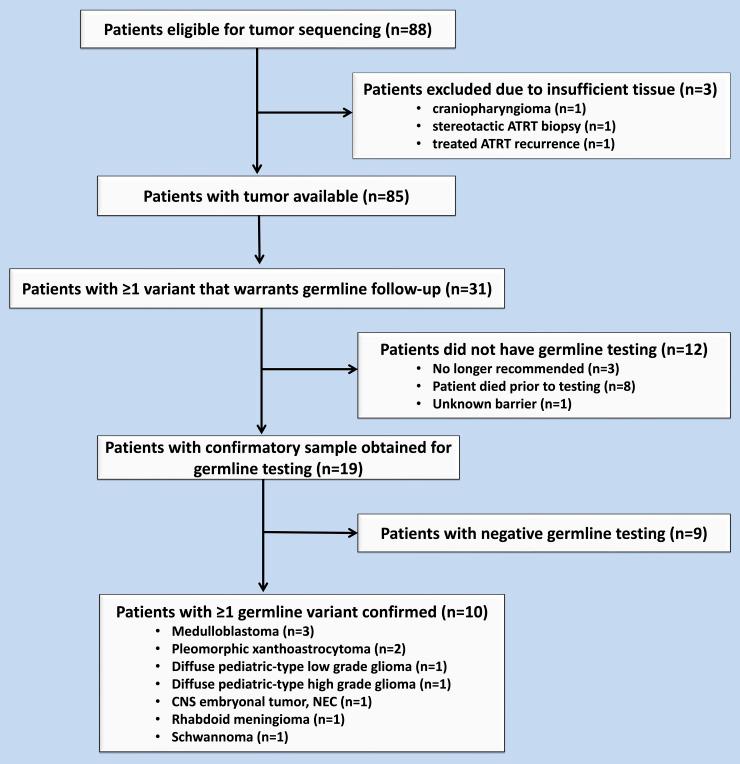
Molecular sequencing of 88 patients' tumors identified 31 patients with variants that warranted consideration of germline testing. To date, 19 (61%) patients have been tested. Testing confirmed germline variants for ten patients (31% of those identified for testing), one with two germline variants ( and mosaic ). Eight (26%) patients died before germline testing was sent. One patient (13%) has not yet had testing.
CONCLUSION
Clinically validated molecular profiling of pediatric brain tumors identifies patients who warrant further germline evaluation. Despite this, only a subset of these patients underwent the indicated confirmatory sequencing. Further work is needed to identify barriers and facilitators to this testing, including the role of genetic counseling and consideration of upfront paired somatic-germline testing.
目的
儿童脑肿瘤的体细胞分子分析有助于诊断和治疗各种高低级别中枢神经系统肿瘤患者。在此,我们报告了在一家机构实施体细胞分子检测的第一年,仅对肿瘤进行检测后,对可能存在种系变异的患者进行的后续靶向种系评估。
患者与方法
在2015年11月至2016年11月的研究期间,对西雅图儿童医院所有接受诊断检查的中枢神经系统(CNS)肿瘤进行了体细胞检测。测序在一家获得美国病理学家协会认可、符合临床实验室改进修正案认证的实验室中进行,使用UW-OncoPlex™检测法(第5版),这是一种基于DNA的靶向新一代测序面板,经验证可检测262个癌症相关基因中的基因改变。我们跟踪了该队列中一个亚组的后续临床评估和检测情况,该亚组被发现具有潜在的种系变异。
结果
对88例患者的肿瘤进行分子测序,确定31例患者的变异值得考虑进行种系检测。迄今为止,19例(61%)患者已接受检测。检测确认10例患者存在种系变异(占接受检测患者的31%),其中1例有两个种系变异(和嵌合体)。8例(26%)患者在种系检测送检前死亡。1例患者(13%)尚未进行检测。
结论
经临床验证的儿童脑肿瘤分子分析可识别出需要进一步进行种系评估的患者。尽管如此,这些患者中只有一部分接受了指定的验证性测序。需要进一步开展工作,以确定此项检测的障碍和促进因素,包括遗传咨询的作用以及对前期配对体细胞-种系检测的考虑。
 Zotero 插件