
急性呼吸窘迫综合征患儿机械通气时的俯卧位:一项系统评价和荟萃分析。
Prone position in the mechanical ventilation of acute respiratory distress syndrome children: a systematic review and meta-analysis.
作者信息
Qin Wen, Mao Lei, Shen Yue, Zhao Li
机构信息
Department of Emergency, Children's Hospital of Nanjing Medical University, Nanjing, Jiangsu, China.
PICU, Children's Hospital of Nanjing Medical University, Nanjing, Jiangsu, China.
出版信息
Front Pediatr. 2024 Mar 7;12:1293453. doi: 10.3389/fped.2024.1293453. eCollection 2024.
BACKGROUND
Prone position has been well recognized for the treatment of adult acute respiratory distress syndrome (ARDS). We aimed to evaluate the role of prone position in the mechanical ventilation in children with ARDS, to provide evidence to the treatment and care of children with ARDS.
METHODS
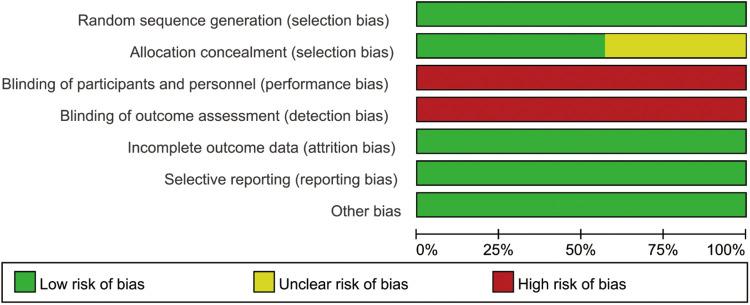
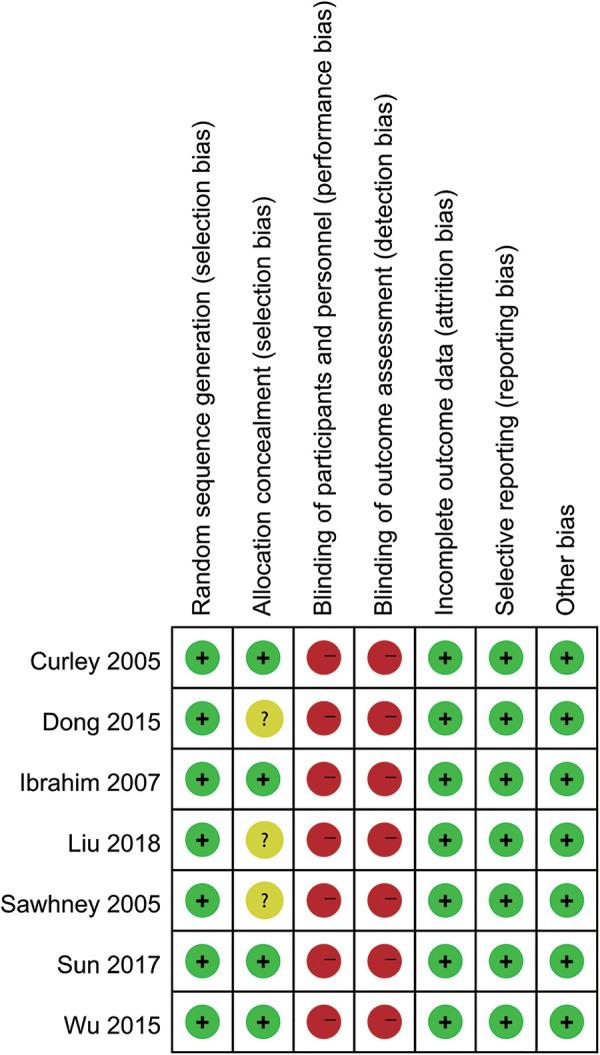
We searched the Pubmed et al. databases by computer until January 23, 2024 for randomized controlled trials (RCTs) on the role of prone position in the mechanical ventilation in children with ARDS. We evaluated the quality of included studies according to the quality evaluation criteria recommended by the Cochrane library. RevMan 5.3 software was used for meta-analysis.
RESULTS
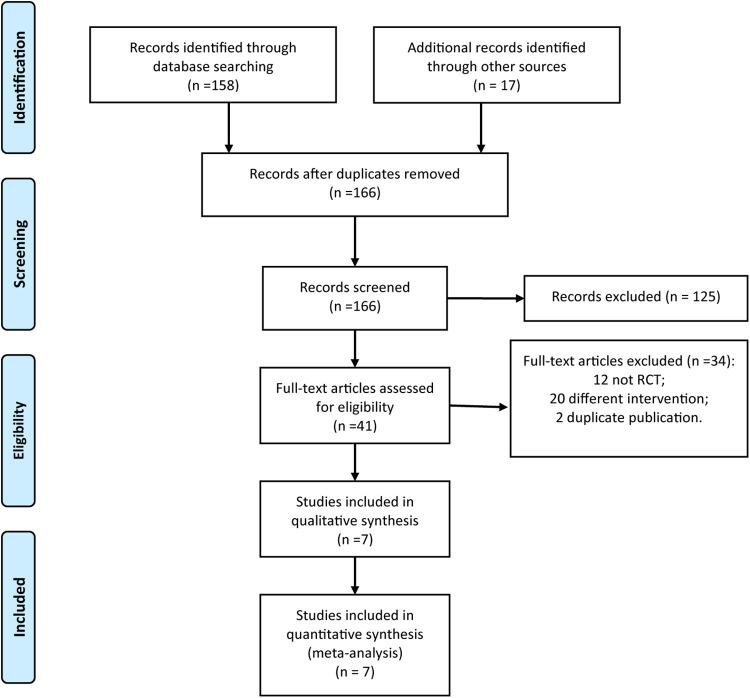
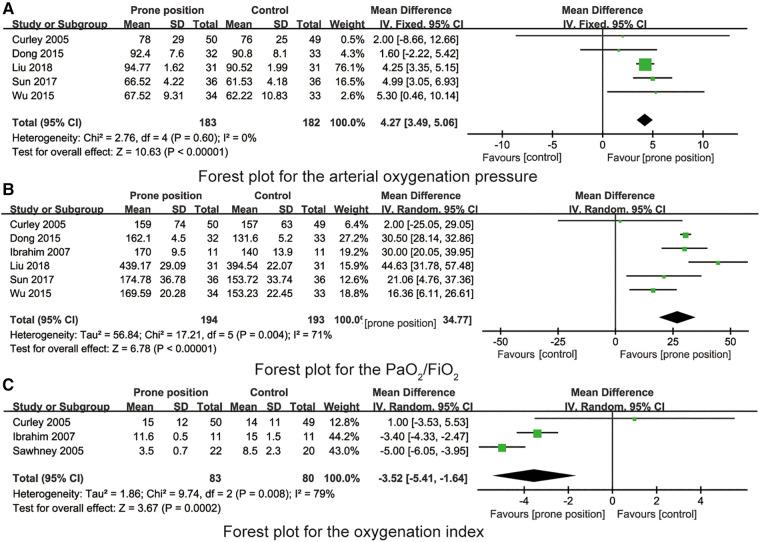
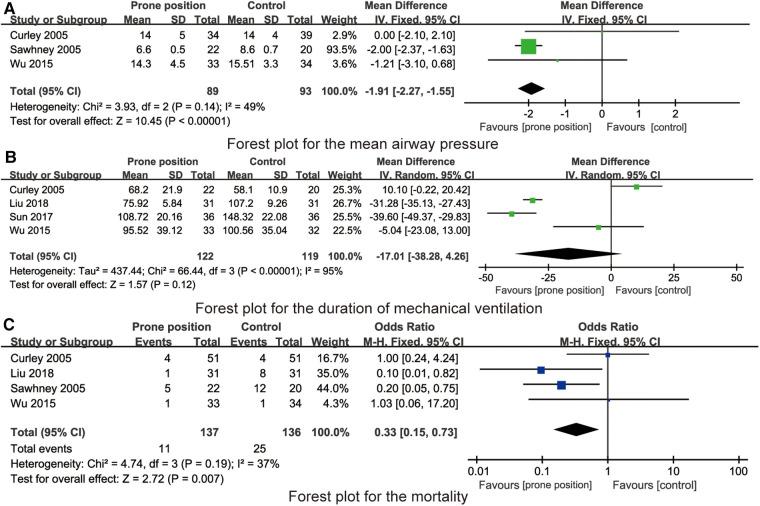
7 RCTs involving 433 children with ARDS were included. Meta-analysis indicated that prone position is beneficial to improve the arterial oxygenation pressure [MD = 4.27 mmHg, 95% CI (3.49, 5.06)], PaO/FiO [MD = 26.97, 95% CI (19.17, 34.77)], reduced the oxygenation index [MD = -3.52, 95% CI (-5.41, -1.64)], mean airway pressure [MD = -1.91 cmHO, 95% CI (-2.27, -1.55)] and mortality [OR = 0.33, 95% CI (0.15, 0.73), all < 0.05]. There were no statistical differences in the duration of mechanical ventilation between the prone position group and control group [MD = -17.01, 97.27, 95% CI (-38.28, 4.26), = 0.12]. Egger test results showed that no significant publication bias was found (all > 0.05).
CONCLUSIONS
Prone position ventilation has obvious advantages in improving oxygenation, but there is no significant improvement in the time of mechanical ventilation in the treatment of children with ARDS. In the future, more large-sample, high-quality RCTs are still needed to further analyze the role of prone position in the mechanical ventilation in children with ARDS.
背景
俯卧位已被广泛认可用于治疗成人急性呼吸窘迫综合征(ARDS)。我们旨在评估俯卧位在儿童ARDS机械通气中的作用,为儿童ARDS的治疗和护理提供依据。
方法
通过计算机检索Pubmed等数据库至2024年1月23日,查找关于俯卧位在儿童ARDS机械通气中作用的随机对照试验(RCT)。根据Cochrane图书馆推荐的质量评估标准评估纳入研究的质量。使用RevMan 5.3软件进行荟萃分析。
结果
纳入7项涉及433例儿童ARDS的RCT。荟萃分析表明,俯卧位有利于提高动脉氧分压[MD = 4.27 mmHg,95%CI(3.49,5.06)]、PaO/FiO[MD = 26.97,95%CI(19.17,34.77)],降低氧合指数[MD = -3.52,95%CI(-5.41,-1.64)]、平均气道压[MD = -1.91 cmH₂O,95%CI(-2.27,-1.55)]和死亡率[OR = 0.33,95%CI(0.15,0.73),均P < 0.05]。俯卧位组与对照组机械通气时间无统计学差异[MD = -17.01,97.27,95%CI(-38.28,4.26),P = 0.12]。Egger检验结果显示未发现明显的发表偏倚(均P > 0.05)。
结论
俯卧位通气在改善氧合方面有明显优势,但在儿童ARDS治疗中机械通气时间无显著改善。未来仍需要更多大样本、高质量的RCT进一步分析俯卧位在儿童ARDS机械通气中的作用。

 Zotero 插件