
基于结构的工程设计和分子模拟,以设计针对 aP2 抗原的强效单克隆抗体,以引发针对 2 型糖尿病的适应性免疫反应。
Structure-guided engineering and molecular simulations to design a potent monoclonal antibody to target aP2 antigen for adaptive immune response instigation against type 2 diabetes.
机构信息
Department of Pharmaceutical Sciences, College of Pharmacy, QU Health, Qatar University, Doha, Qatar.
Department of Biochemistry and Molecular Biology, Dasman Diabetes Institute, Kuwait City, Kuwait.
出版信息
Front Immunol. 2024 Mar 8;15:1357342. doi: 10.3389/fimmu.2024.1357342. eCollection 2024.
INTRODUCTION
Diabetes mellitus (DM) is recognized as one of the oldest chronic diseases and has become a significant public health issue, necessitating innovative therapeutic strategies to enhance patient outcomes. Traditional treatments have provided limited success, highlighting the need for novel approaches in managing this complex disease.
METHODS
In our study, we employed graph signature-based methodologies in conjunction with molecular simulation and free energy calculations. The objective was to engineer the CA33 monoclonal antibody for effective targeting of the aP2 antigen, aiming to elicit a potent immune response. This approach involved screening a mutational landscape comprising 57 mutants to identify modifications that yield significant enhancements in binding efficacy and stability.
RESULTS
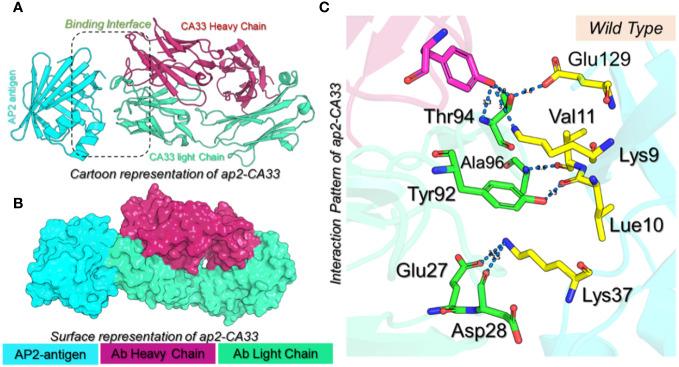
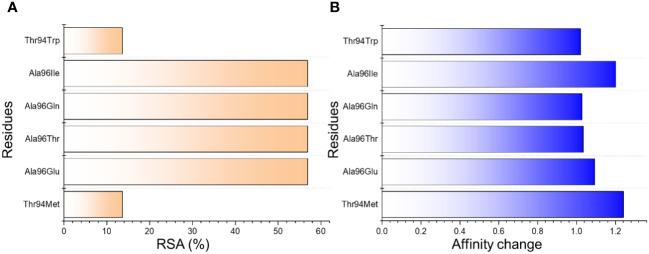
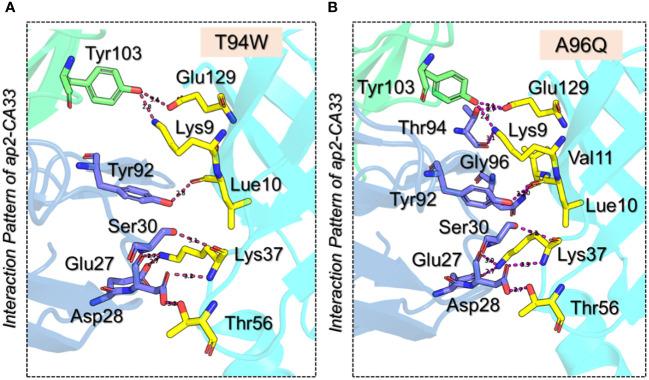
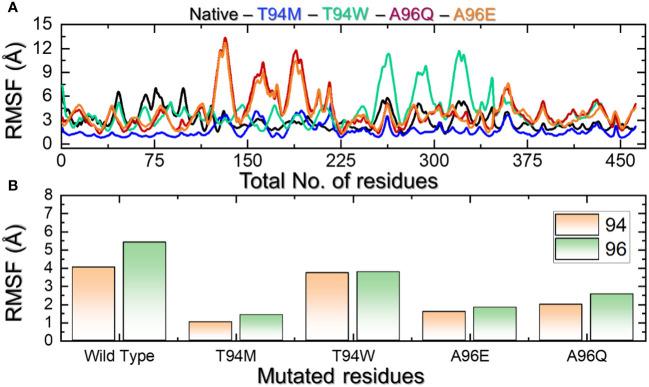
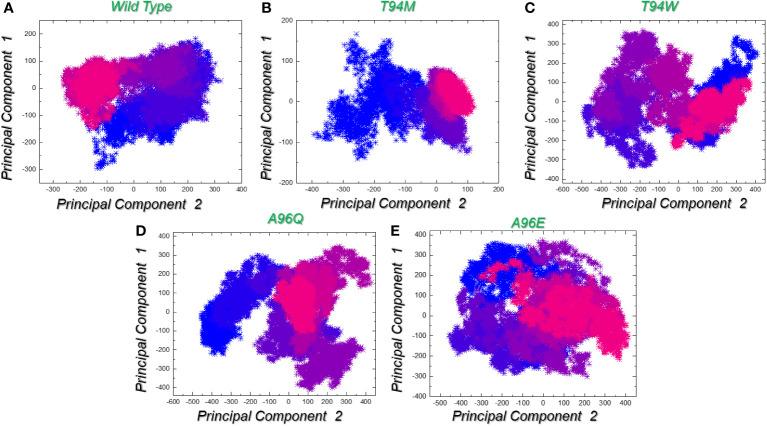
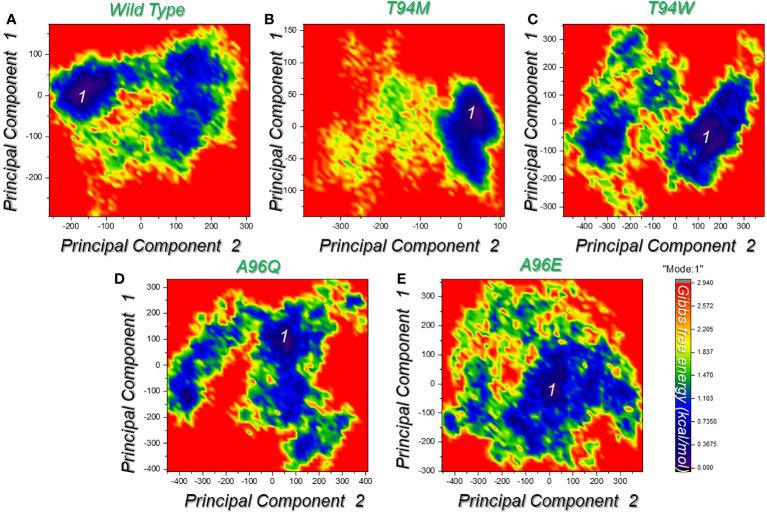
Analysis of the mutational landscape revealed that only five substitutions resulted in noteworthy improvements. Among these, mutations T94M, A96E, A96Q, and T94W were identified through molecular docking experiments to exhibit higher docking scores compared to the wild-type. Further validation was provided by calculating the dissociation constant (K), which showed a similar trend in favor of these mutations. Molecular simulation analyses highlighted T94M as the most stable complex, with reduced internal fluctuations upon binding. Principal components analysis (PCA) indicated that both the wild-type and T94M mutant displayed similar patterns of constrained and restricted motion across principal components. The free energy landscape analysis underscored a single metastable state for all complexes, indicating limited structural variability and potential for high therapeutic efficacy against aP2. Total binding free energy (TBE) calculations further supported the superior performance of the T94M mutation, with TBE values demonstrating the enhanced binding affinity of selected mutants over the wild-type.
DISCUSSION
Our findings suggest that the T94M substitution, along with other identified mutations, significantly enhances the therapeutic potential of the CA33 antibody against DM by improving its binding affinity and stability. These results not only contribute to a deeper understanding of antibody-antigen interactions in the context of DM but also provide a valuable framework for the rational design of antibodies aimed at targeting this disease more effectively.
简介
糖尿病(DM)被认为是最古老的慢性疾病之一,已成为重大的公共卫生问题,需要创新的治疗策略来改善患者的预后。传统的治疗方法取得的效果有限,这突显了在管理这种复杂疾病方面需要新的方法。
方法
在我们的研究中,我们结合分子模拟和自由能计算使用基于图特征的方法。目标是对 CA33 单克隆抗体进行工程改造,以有效靶向 aP2 抗原,从而引发有效的免疫反应。该方法涉及筛选包含 57 个突变体的突变景观,以鉴定可显著提高结合效力和稳定性的修饰。
结果
突变景观分析表明,只有五个取代产生了显著的改进。其中,通过分子对接实验鉴定出 T94M、A96E、A96Q 和 T94W 突变体的对接得分高于野生型。进一步通过计算解离常数(K)进行验证,结果也表明这些突变体具有相似的趋势。分子模拟分析表明 T94M 是最稳定的复合物,结合时内部波动较小。主成分分析(PCA)表明,野生型和 T94M 突变体在主成分上都表现出相似的受限和受限运动模式。自由能景观分析表明所有复合物都只有一个亚稳态,表明结构变异性有限,针对 aP2 具有潜在的高效治疗效果。总结合自由能(TBE)计算进一步支持 T94M 突变的优越性能,TBE 值表明所选突变体与野生型相比具有增强的结合亲和力。
讨论
我们的研究结果表明,与其他鉴定的突变一起,T94M 取代显著提高了 CA33 抗体针对糖尿病的治疗潜力,提高了其结合亲和力和稳定性。这些结果不仅有助于更深入地了解糖尿病背景下抗体-抗原相互作用,而且为更有效地靶向这种疾病的抗体的合理设计提供了有价值的框架。




 Zotero 插件