
[Lu]Lu-桑托替肽四嗪在进展性神经内分泌肿瘤患者中的剂量学和药代动力学。
Dosimetry and pharmacokinetics of [Lu]Lu-satoreotide tetraxetan in patients with progressive neuroendocrine tumours.
机构信息
Department of Nuclear Medicine, University Hospital Würzburg, Würzburg, Germany.
CHU Nantes, Nantes Université, Médecine Nucléaire, Nantes, France.
出版信息
Eur J Nucl Med Mol Imaging. 2024 Jul;51(8):2428-2441. doi: 10.1007/s00259-024-06682-1. Epub 2024 Mar 26.
PURPOSE
To evaluate the dosimetry and pharmacokinetics of the novel radiolabelled somatostatin receptor antagonist [Lu]Lu-satoreotide tetraxetan in patients with advanced neuroendocrine tumours (NETs).
METHODS
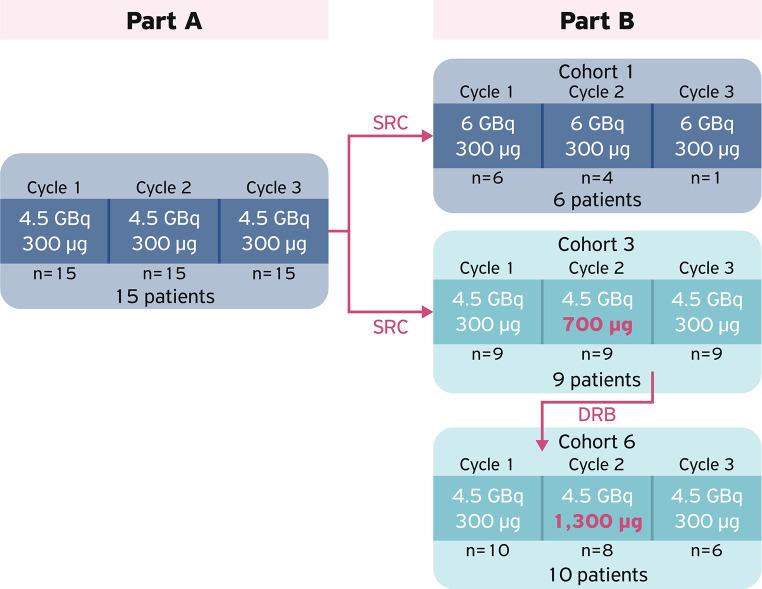
This study was part of a phase I/II trial of [Lu]Lu-satoreotide tetraxetan, administered at a median cumulative activity of 13.0 GBq over three planned cycles (median activity/cycle: 4.5 GBq), in 40 patients with progressive NETs. Organ absorbed doses were monitored at each cycle using patient-specific dosimetry; the cumulative absorbed-dose limits were set at 23.0 Gy for the kidneys and 1.5 Gy for bone marrow. Absorbed dose coefficients (ADCs) were calculated using both patient-specific and model-based dosimetry for some patients.
RESULTS
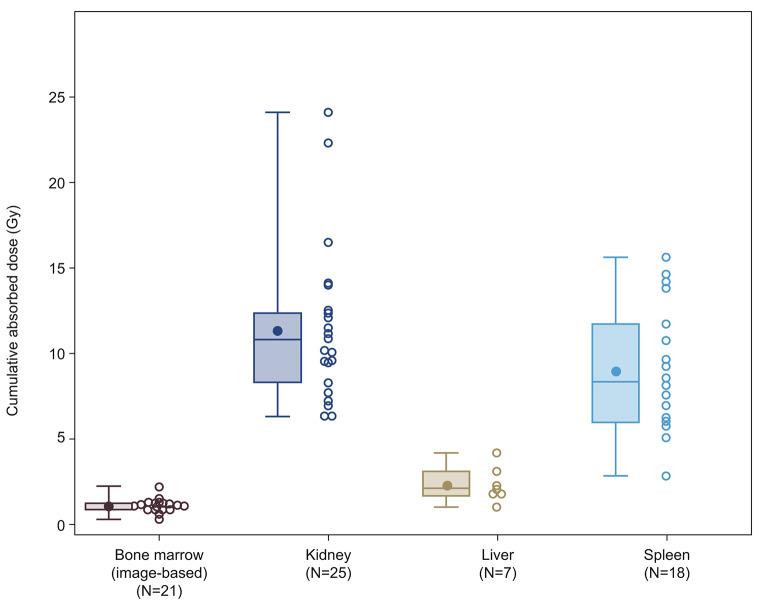
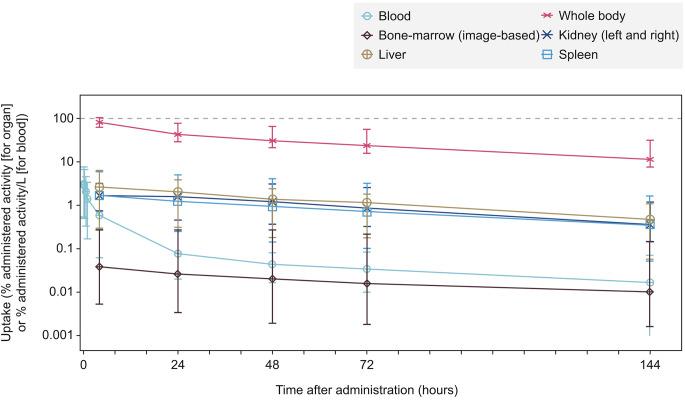
In all evaluated organs, maximum [Lu]Lu-satoreotide tetraxetan uptake was observed at the first imaging timepoint (4 h after injection), followed by an exponential decrease. Kidneys were the main route of elimination, with a cumulative excretion of 57-66% within 48 h following the first treatment cycle. At the first treatment cycle, [Lu]Lu-satoreotide tetraxetan showed a median terminal blood half-life of 127 h and median ADCs of [Lu]Lu-satoreotide tetraxetan were 5.0 Gy/GBq in tumours, 0.1 Gy/GBq in the bone marrow, 0.9 Gy/GBq in kidneys, 0.2 Gy/GBq in the liver and 0.8 Gy/GBq in the spleen. Using image-based dosimetry, the bone marrow and kidneys received median cumulative absorbed doses of 1.1 and 10.8 Gy, respectively, after three cycles.
CONCLUSION
[Lu]Lu-satoreotide tetraxetan showed a favourable dosimetry profile, with high and prolonged tumour uptake, supporting its acceptable safety profile and promising efficacy.
TRIAL REGISTRATION
NCT02592707. Registered October 30, 2015.
目的
评估新型放射性标记生长抑素受体拮抗剂[Lu]Lu-生长抑素四肽在晚期神经内分泌肿瘤(NETs)患者中的剂量学和药代动力学。
方法
本研究是[Lu]Lu-生长抑素四肽的 I/II 期试验的一部分,该试验在 40 名进展性 NETs 患者中进行,中位累积活性为 13.0GBq,分三个计划周期给药(中位周期活性:4.5GBq)。使用患者特异性剂量测定法在每个周期监测器官吸收剂量;将肾脏的累积吸收剂量限制设定为 23.0Gy,骨髓为 1.5Gy。对于一些患者,使用患者特异性和基于模型的剂量测定法计算了吸收剂量系数(ADCs)。
结果
在所有评估的器官中,[Lu]Lu-生长抑素四肽的最大摄取量在第一次成像时间点(注射后 4 小时)观察到,随后呈指数下降。肾脏是主要的排泄途径,在第一个治疗周期后 48 小时内累计排泄 57-66%。在第一个治疗周期,[Lu]Lu-生长抑素四肽的中位末端血液半衰期为 127 小时,肿瘤的中位 ADCs 为[Lu]Lu-生长抑素四肽 5.0Gy/GBq,骨髓为 0.1Gy/GBq,肾脏为 0.9Gy/GBq,肝脏为 0.2Gy/GBq,脾脏为 0.8Gy/GBq。使用基于图像的剂量测定法,在三个周期后,骨髓和肾脏分别接受了中位数累积吸收剂量 1.1 和 10.8Gy。
结论
[Lu]Lu-生长抑素四肽显示出良好的剂量学特征,具有高且持久的肿瘤摄取,支持其可接受的安全性特征和有前途的疗效。
试验注册
NCT02592707。于 2015 年 10 月 30 日注册。
 Zotero 插件