
基于血液蛋白的表观遗传评分作为一般认知功能和大脑健康的生物标志物。
Epigenetic scores of blood-based proteins as biomarkers of general cognitive function and brain health.
机构信息
Centre for Genomic and Experimental Medicine, Institute of Genetics and Cancer, University of Edinburgh, Edinburgh, UK.
Lothian Birth Cohorts, Department of Psychology, University of Edinburgh, Edinburgh, UK.
出版信息
Clin Epigenetics. 2024 Mar 25;16(1):46. doi: 10.1186/s13148-024-01661-7.
BACKGROUND
Epigenetic Scores (EpiScores) for blood protein levels have been associated with disease outcomes and measures of brain health, highlighting their potential usefulness as clinical biomarkers. They are typically derived via penalised regression, whereby a linear weighted sum of DNA methylation (DNAm) levels at CpG sites are predictive of protein levels. Here, we examine 84 previously published protein EpiScores as possible biomarkers of cross-sectional and longitudinal measures of general cognitive function and brain health, and incident dementia across three independent cohorts.
RESULTS
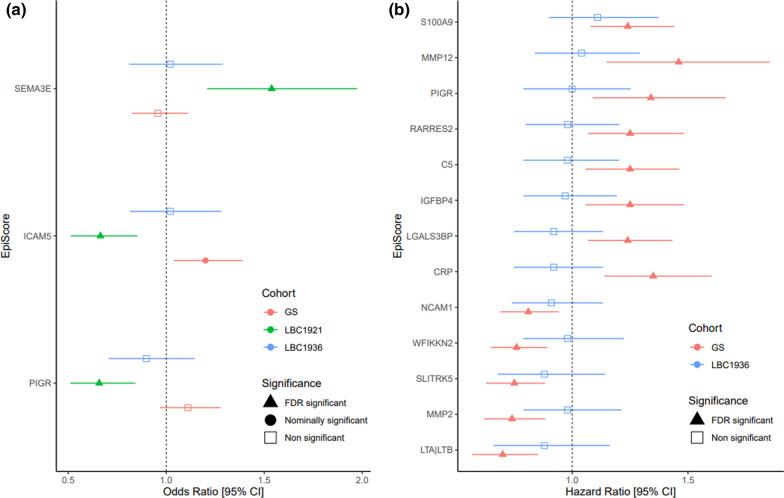
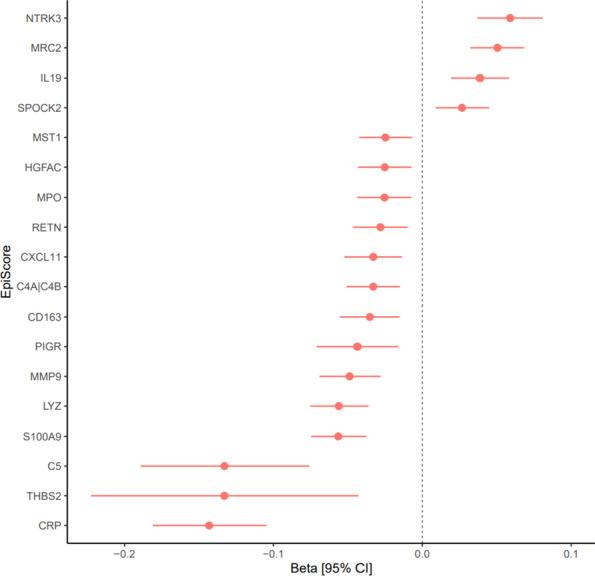
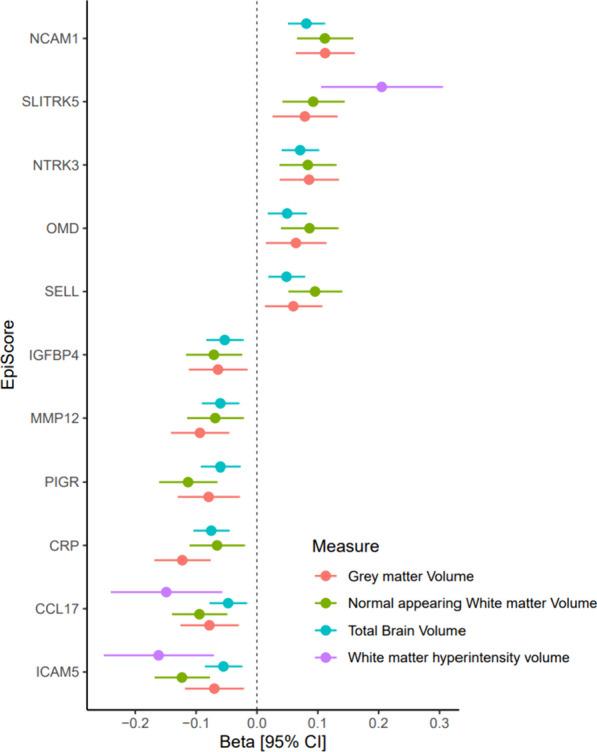
Using 84 protein EpiScores as candidate biomarkers, associations with general cognitive function (both cross-sectionally and longitudinally) were tested in three independent cohorts: Generation Scotland (GS), and the Lothian Birth Cohorts of 1921 and 1936 (LBC1921 and LBC1936, respectively). A meta-analysis of general cognitive functioning results in all three cohorts identified 18 EpiScore associations (absolute meta-analytic standardised estimates ranged from 0.03 to 0.14, median of 0.04, P < 0.05). Several associations were also observed between EpiScores and global brain volumetric measures in the LBC1936. An EpiScore for the S100A9 protein (a known Alzheimer disease biomarker) was associated with general cognitive functioning (meta-analytic standardised beta: - 0.06, P = 1.3 × 10), and with time-to-dementia in GS (Hazard ratio 1.24, 95% confidence interval 1.08-1.44, P = 0.003), but not in LBC1936 (Hazard ratio 1.11, P = 0.32).
CONCLUSIONS
EpiScores might make a contribution to the risk profile of poor general cognitive function and global brain health, and risk of dementia, however these scores require replication in further studies.
背景
血液蛋白水平的表观遗传评分(EpiScores)与疾病结局和大脑健康指标相关,这突出了它们作为临床生物标志物的潜在用途。它们通常通过惩罚回归来推导,其中 CpG 位点的 DNA 甲基化(DNAm)水平的线性加权和可预测蛋白质水平。在这里,我们在三个独立的队列中检查了 84 个先前发表的蛋白质 EpiScores,作为横断面和纵向衡量一般认知功能和大脑健康以及痴呆发病的潜在生物标志物。
结果
使用 84 个蛋白质 EpiScores 作为候选生物标志物,在三个独立的队列中测试了它们与一般认知功能(包括横断面和纵向)的关联:苏格兰一代(GS)和 1921 年和 1936 年的洛锡安出生队列(LBC1921 和 LBC1936)。对所有三个队列的一般认知功能结果进行的荟萃分析确定了 18 个 EpiScore 关联(绝对荟萃分析标准化估计值范围为 0.03 至 0.14,中位数为 0.04,P < 0.05)。在 LBC1936 中还观察到 EpiScores 与全球脑容积测量之间的一些关联。S100A9 蛋白的 EpiScore(一种已知的阿尔茨海默病生物标志物)与一般认知功能相关(荟萃分析标准化β:-0.06,P = 1.3 × 10),与 GS 中的痴呆时间相关(风险比 1.24,95%置信区间 1.08-1.44,P = 0.003),但在 LBC1936 中没有(风险比 1.11,P = 0.32)。
结论
EpiScores 可能对一般认知功能和大脑整体健康状况不佳以及痴呆风险的风险状况做出贡献,但这些评分需要在进一步的研究中进行复制。

 Zotero 插件