
无证据表明Modic改变或椎间盘退变与五种循环炎症蛋白之间存在关联。
No evidence of association between either Modic change or disc degeneration and five circulating inflammatory proteins.
作者信息
Compte Roger, Freidin Maxim B, Granville Smith Isabelle, Le Maitre Christine L, Vaitkute Dovile, Nessa Ayrun, Lachance Genevieve, Williams Frances M K
机构信息
Department of Twin Research and Genetic Epidemiology King's College London London UK.
Department of Biology, School of Biological and Behavioural Sciences Queen Mary University of London London UK.
出版信息
JOR Spine. 2024 Mar 25;7(1):e1323. doi: 10.1002/jsp2.1323. eCollection 2024 Mar.
INTRODUCTION
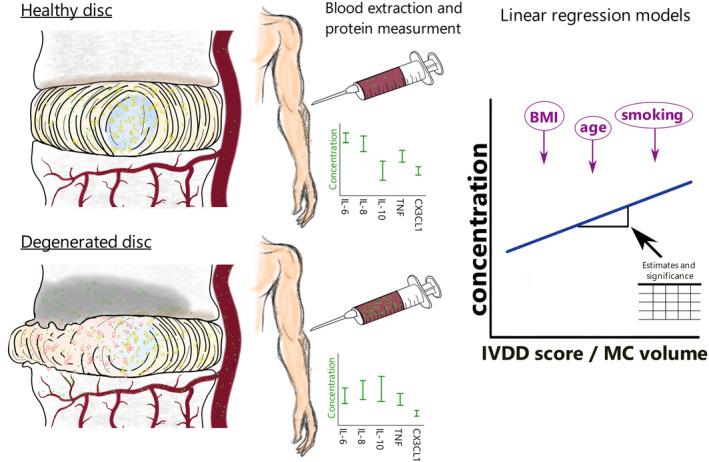
Intervertebral disc degeneration and Modic change are the main spinal structural changes associated with chronic low back pain (LBP). Both conditions are thought to manifest local inflammation and if inflammatory proteins translocate to the blood circulation could be detected systemically. The work here assesses whether the presence of disc degeneration is associated with detectable blood level changes of five inflammatory markers and whether chronic LBP is associated with these changes.
MATERIALS AND METHODS
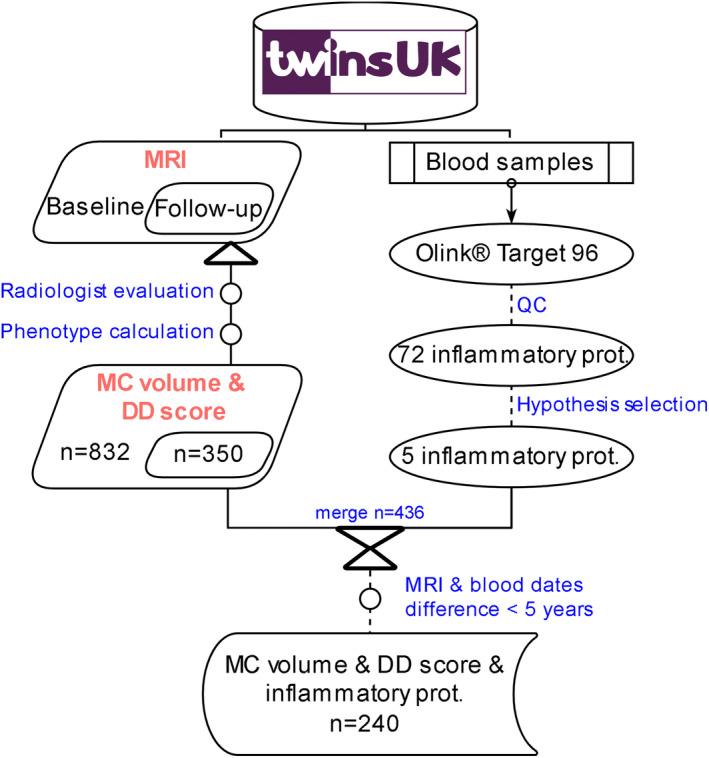
Two hundred and forty TwinsUK cohort participants with both MRI disc degeneration grade and Modic change extent, and IL-6, IL-8, IL-8 TNF, and CX3CL1 protein blood concentration measurements were included in this work. Linear mixed effects models were used to test the association of blood cytokine concentration with disc degeneration score and Modic change volumetric score. Association of chronic LBP status from questionnaires with disc degeneration, Modic change, and cytokine blood concentration was also tested.
RESULTS
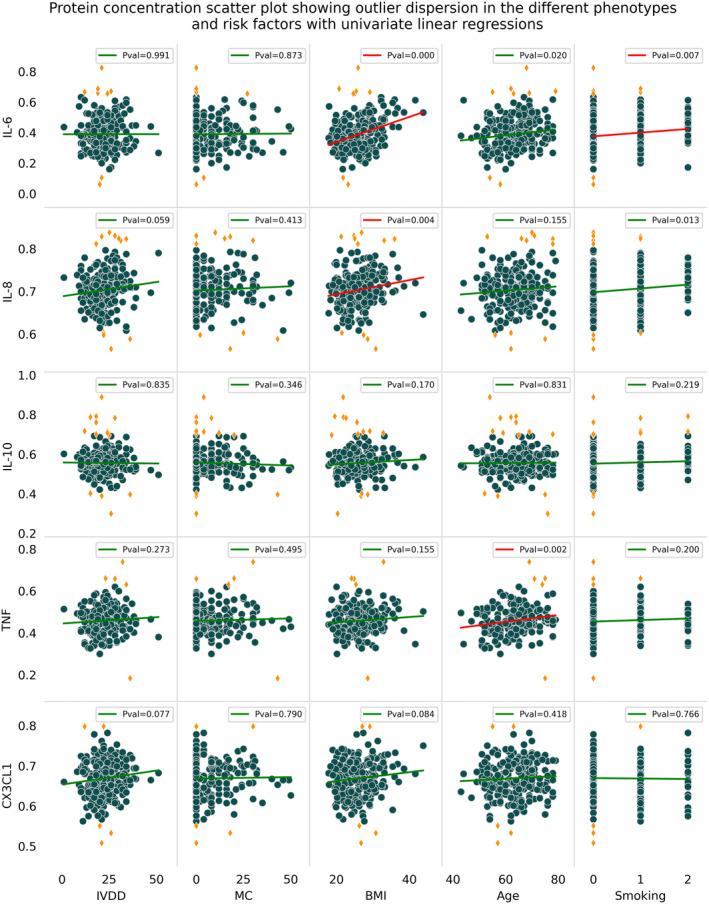
No statistically significant association between disc degeneration or Modic change with cytokine blood concentration was found. Instead, regression analysis pointed strong association between cytokine blood concentration with body mass index for IL-6 and with age for IL-6 and TNF. Mild association was found between IL-8 blood concentration and body mass index. Additionally, LBP status was associated with Modic change volumetric score but not associated with any cytokine concentration.
CONCLUSIONS
We found no evidence that Modic change and disc degeneration are able to produce changes in tested blood cytokine concentration. However, age and body mass index have strong influence on cytokine concentration and both are associated with the conditions studied which may confound associations found in the literature. It is then unlikely that cytokines produced in the disc or vertebral bone marrow induce chronic LBP.
引言
椎间盘退变和Modic改变是与慢性下腰痛(LBP)相关的主要脊柱结构变化。这两种情况都被认为会表现出局部炎症,并且如果炎症蛋白转移到血液循环中,则可以在全身检测到。本文的研究评估了椎间盘退变的存在是否与五种炎症标志物的可检测血液水平变化相关,以及慢性LBP是否与这些变化相关。
材料与方法
本研究纳入了240名英国双胞胎队列参与者,他们既有MRI椎间盘退变分级和Modic改变程度的数据,也有白细胞介素-6(IL-6)、白细胞介素-8(IL-8)、肿瘤坏死因子(TNF)和CX3CL1蛋白的血液浓度测量值。使用线性混合效应模型来测试血液细胞因子浓度与椎间盘退变评分和Modic改变体积评分之间的关联。还测试了问卷中慢性LBP状态与椎间盘退变、Modic改变和细胞因子血液浓度之间的关联。
结果
未发现椎间盘退变或Modic改变与细胞因子血液浓度之间存在统计学上的显著关联。相反,回归分析表明,IL-6的血液细胞因子浓度与体重指数之间存在强关联,IL-6和TNF的血液细胞因子浓度与年龄之间存在强关联。发现IL-8血液浓度与体重指数之间存在轻度关联。此外,LBP状态与Modic改变体积评分相关,但与任何细胞因子浓度均无关联。
结论
我们没有发现证据表明Modic改变和椎间盘退变能够引起所测试的血液细胞因子浓度变化。然而,年龄和体重指数对细胞因子浓度有很大影响,并且两者都与所研究的情况相关,这可能会混淆文献中发现的关联。因此,椎间盘或椎体骨髓中产生的细胞因子不太可能诱发慢性LBP。
 Zotero 插件