
新冠疫情对斯洛文尼亚一家三级医疗中心多重耐药菌的影响
The Impact of COVID-19 on Multidrug-Resistant Bacteria at a Slovenian Tertiary Medical Center.
作者信息
Mrvič Tatjana, Stevanoska Sintija, Beović Bojana, Logar Mateja, Gregorčič Sergeja, Žnidaršič Benica, Seme Katja, Velimirović Ivana, Švent Kučina Nataša, Maver Vodičar Polona, Križan Hergouth Veronika, Džeroski Sašo, Pirs Mateja
机构信息
Infection Prevention and Control Unit, University Medical Centre Ljubljana, 1000 Ljubljana, Slovenia.
Department of Infectious Diseases, University Medical Centre Ljubljana, 1000 Ljubljana, Slovenia.
出版信息
Antibiotics (Basel). 2024 Feb 23;13(3):214. doi: 10.3390/antibiotics13030214.
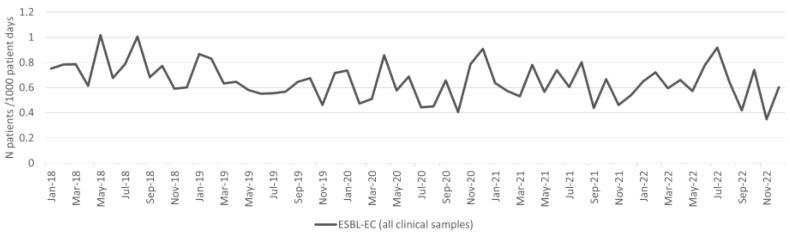
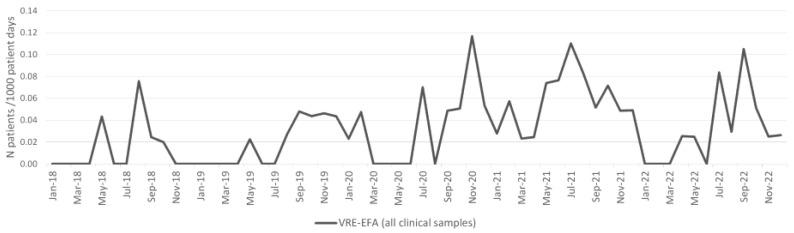
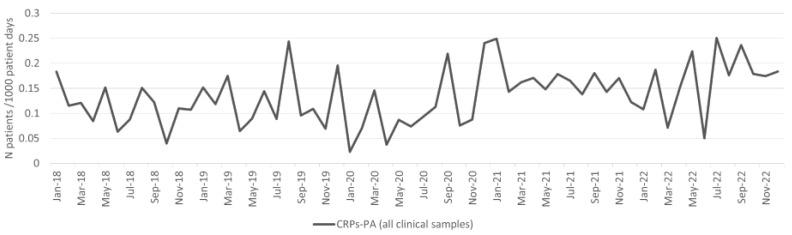
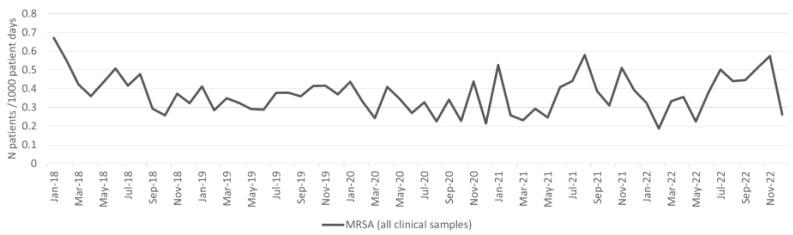
The COVID-19 pandemic has strained healthcare systems globally. Shortages of hospital beds, reassignment of healthcare workers to COVID-19-dedicated wards, an increased workload, and evolving infection prevention and control measures have potentially contributed to the spread of multidrug-resistant bacteria (MDRB). To determine the impact of the COVID-19 pandemic at the University Medical Center Ljubljana, a tertiary teaching hospital, we analyzed the monthly incidence of select bacterial species per patient from 2018 to 2022. The analysis was performed for all isolates and for MDRB isolates. The data were analyzed separately for isolates from all clinical samples, from blood culture only, and from clinical and surveillance samples. Our findings revealed an increased incidence density of patients with , , , and isolates from clinical samples during the COVID-19 period in the studied hospital. Notably, the incidence density of MDRB isolates-vancomycin-resistant , extended-spectrum betalactamase-producing , and betalactam-resistant -from clinical samples increased during the COVID-19 period. There were no statistically significant differences in the incidence density of patients with blood culture MDRB isolates. We observed an increase in the overall MDRB burden (patients with MDRB isolates from both clinical and surveillance samples per 1000 patient days) in the COVID-19 period in the studied hospital for vancomycin-resistant , carbapenem-resistant and betalactam-resistant and a decrease in the methicillin-resistant burden.
新冠疫情使全球医疗系统不堪重负。医院床位短缺、医护人员被重新分配到新冠专用病房、工作量增加以及不断演变的感染预防和控制措施,都可能促使了多重耐药菌(MDRB)的传播。为了确定新冠疫情对卢布尔雅那大学医学中心(一家三级教学医院)的影响,我们分析了2018年至2022年期间每位患者特定细菌种类的月度发病率。对所有分离株和多重耐药菌分离株都进行了分析。分别对来自所有临床样本、仅血培养样本以及临床和监测样本的分离株数据进行了分析。我们的研究结果显示,在研究医院的新冠疫情期间,临床样本中携带[具体细菌种类1]、[具体细菌种类2]、[具体细菌种类3]和[具体细菌种类4]分离株的患者发病率密度有所增加。值得注意的是,新冠疫情期间临床样本中多重耐药菌分离株——耐万古霉素[具体细菌种类5]、产超广谱β-内酰胺酶[具体细菌种类6]和耐β-内酰胺[具体细菌种类7]——的发病率密度增加。血培养多重耐药菌分离株患者的发病率密度没有统计学上的显著差异。我们观察到,在研究医院的新冠疫情期间,耐万古霉素[具体细菌种类5]、耐碳青霉烯[具体细菌种类8]和耐β-内酰胺[具体细菌种类7]的总体多重耐药菌负担(每1000个患者日中来自临床和监测样本的多重耐药菌分离株患者数)有所增加,而耐甲氧西林[具体细菌种类9]的负担有所下降。




 Zotero 插件