
铜转运 P 型 ATP 酶的金属结合域的多种功能和转运机制。
Diverse roles of the metal binding domains and transport mechanism of copper transporting P-type ATPases.
机构信息
Department of Biomedical Sciences, Copenhagen University, Copenhagen, Denmark.
Department of Chemistry, Umeå University, Umeå, Sweden.
出版信息
Nat Commun. 2024 Mar 27;15(1):2690. doi: 10.1038/s41467-024-47001-4.
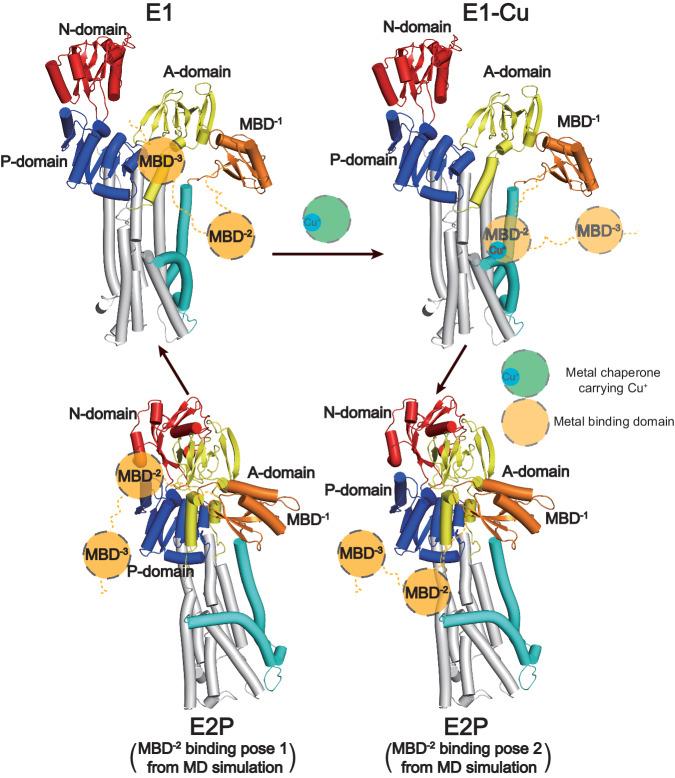
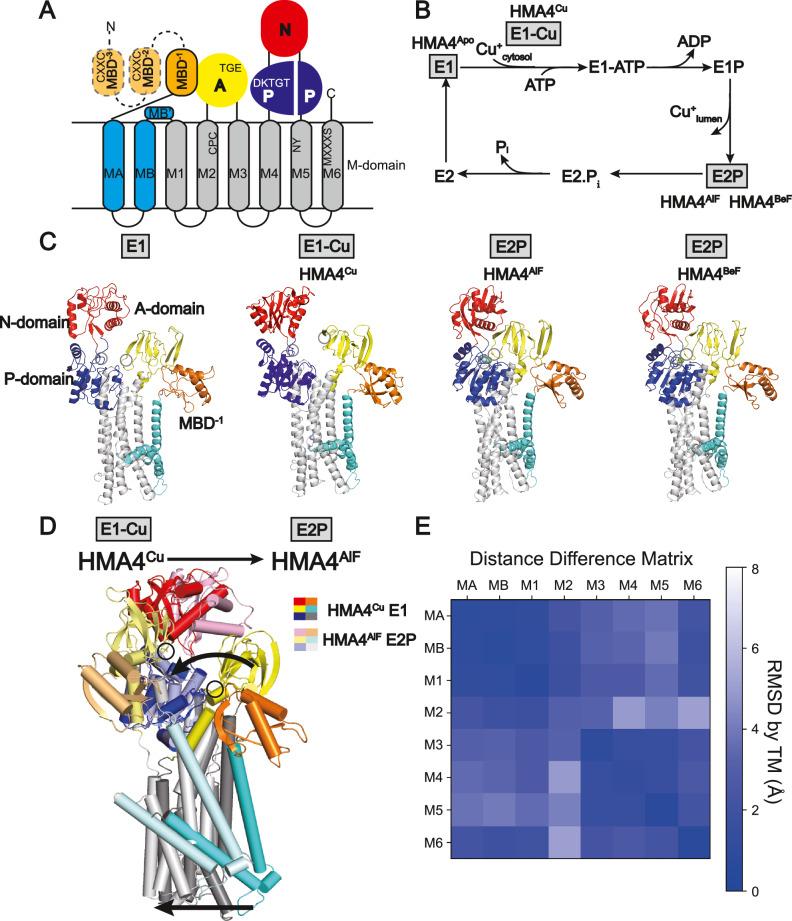
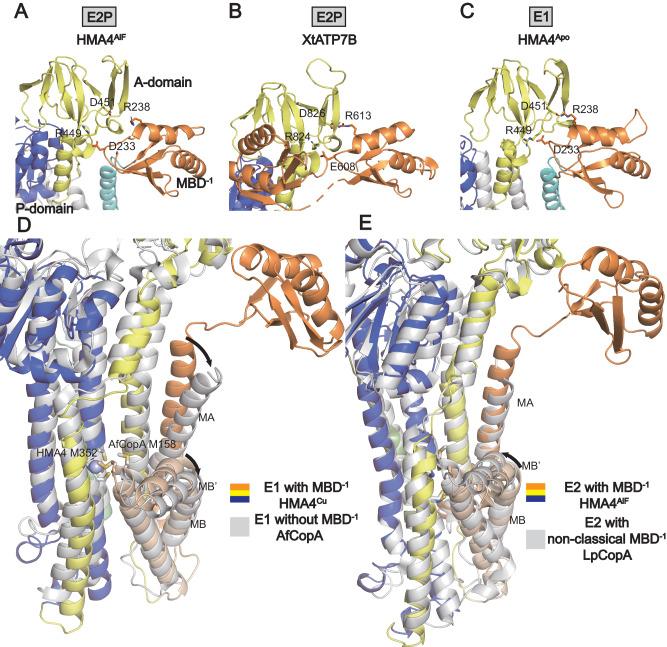
Copper transporting P-type (P-) ATPases are essential for cellular homeostasis. Nonetheless, the E1-E1P-E2P-E2 states mechanism of P-ATPases remains poorly understood. In particular, the role of the intrinsic metal binding domains (MBDs) is enigmatic. Here, four cryo-EM structures and molecular dynamics simulations of a P-ATPase are combined to reveal that in many eukaryotes the MBD immediately prior to the ATPase core, MBD, serves a structural role, remodeling the ion-uptake region. In contrast, the MBD prior to MBD, MBD, likely assists in copper delivery to the ATPase core. Invariant Tyr, Asn and Ser residues in the transmembrane domain assist in positioning sulfur-providing copper-binding amino acids, allowing for copper uptake, binding and release. As such, our findings unify previously conflicting data on the transport and regulation of P-ATPases. The results are critical for a fundamental understanding of cellular copper homeostasis and for comprehension of the molecular bases of P-disorders and ongoing clinical trials.
铜转运 P 型(P-)ATP 酶对于细胞内稳态至关重要。尽管如此,P-ATP 酶的 E1-E1P-E2P-E2 状态机制仍知之甚少。特别是,内在金属结合结构域(MBDs)的作用仍不清楚。在此,我们将 P-ATP 酶的四个冷冻电镜结构和分子动力学模拟结合起来,揭示了在许多真核生物中,MBD 之前的固有 MBD(MBD)充当结构角色,重塑了离子摄取区域。相比之下,MBD 之前的 MBD(MBD)可能有助于将铜递送到 ATP 酶核心。跨膜结构域中的不变 Tyr、Asn 和 Ser 残基有助于定位提供硫的铜结合氨基酸,从而允许铜摄取、结合和释放。因此,我们的发现统一了先前关于 P-ATP 酶运输和调节的相互矛盾的数据。这些结果对于深入了解细胞内铜稳态以及理解 P 疾病的分子基础和正在进行的临床试验至关重要。


 Zotero 插件