
遗传生物标志物及外源性抗氧化剂补充在保护哺乳动物细胞免受热诱导氧化应激和细胞凋亡方面的进展
Advancements in Genetic Biomarkers and Exogenous Antioxidant Supplementation for Safeguarding Mammalian Cells against Heat-Induced Oxidative Stress and Apoptosis.
作者信息
Khan Muhammad Zahoor, Khan Adnan, Chen Wenting, Chai Wenqiong, Wang Changfa
机构信息
Liaocheng Research Institute of Donkey High-Efficiency Breeding and Ecological Feeding, Liaocheng University, Liaocheng 522000, China.
Genome Analysis Laboratory of the Ministry of Agriculture, Agricultural Genomics Institute at Shenzhen, Chinese Academy of Agricultural Sciences, Shenzhen 511464, China.
出版信息
Antioxidants (Basel). 2024 Feb 20;13(3):258. doi: 10.3390/antiox13030258.
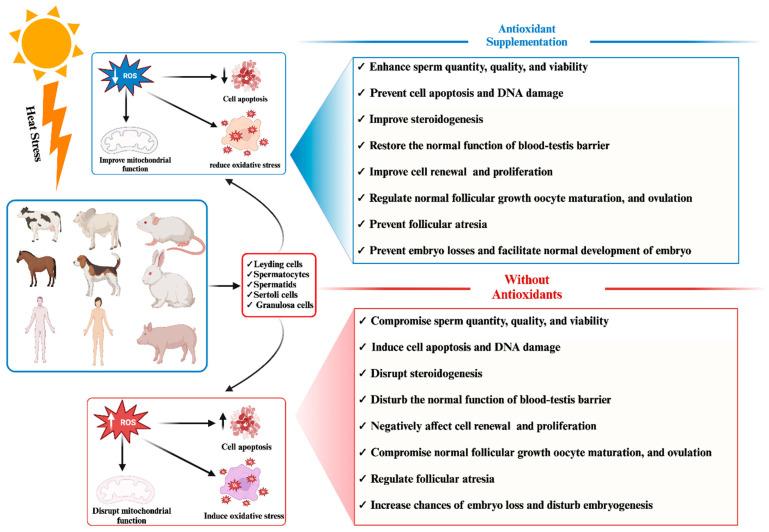
Heat stress represents a pervasive global concern with far-reaching implications for the reproductive efficiency of both animal and human populations. An extensive body of published research on heat stress effects utilizes controlled experimental environments to expose cells and tissues to heat stress and its disruptive influence on the physiological aspects of reproductive phenotypic traits, encompassing parameters such as sperm quality, sperm motility, viability, and overall competence. Beyond these immediate effects, heat stress has been linked to embryo losses, compromised oocyte development, and even infertility across diverse species. One of the primary mechanisms underlying these adverse reproductive outcomes is the elevation of reactive oxygen species (ROS) levels precipitating oxidative stress and apoptosis within mammalian reproductive cells. Oxidative stress and apoptosis are recognized as pivotal biological factors through which heat stress exerts its disruptive impact on both male and female reproductive cells. In a concerted effort to mitigate the detrimental consequences of heat stress, supplementation with antioxidants, both in natural and synthetic forms, has been explored as a potential intervention strategy. Furthermore, reproductive cells possess inherent self-protective mechanisms that come into play during episodes of heat stress, aiding in their survival. This comprehensive review delves into the multifaceted effects of heat stress on reproductive phenotypic traits and elucidates the intricate molecular mechanisms underpinning oxidative stress and apoptosis in reproductive cells, which compromise their normal function. Additionally, we provide a succinct overview of potential antioxidant interventions and highlight the genetic biomarkers within reproductive cells that possess self-protective capabilities, collectively offering promising avenues for ameliorating the negative impact of heat stress by restraining apoptosis and oxidative stress.
热应激是一个普遍存在的全球性问题,对动物和人类种群的繁殖效率都有着深远影响。大量已发表的关于热应激影响的研究利用受控实验环境,使细胞和组织暴露于热应激及其对生殖表型特征生理方面的破坏影响,包括精子质量、精子活力、生存能力和整体功能等参数。除了这些直接影响外,热应激还与胚胎损失、卵母细胞发育受损以及不同物种的不育有关。这些不良生殖结果的主要潜在机制之一是活性氧(ROS)水平升高,引发哺乳动物生殖细胞内的氧化应激和细胞凋亡。氧化应激和细胞凋亡被认为是热应激对雄性和雌性生殖细胞产生破坏影响的关键生物学因素。为了共同减轻热应激的有害后果,已探索补充天然和合成形式的抗氧化剂作为一种潜在的干预策略。此外,生殖细胞具有内在的自我保护机制,在热应激期间发挥作用,帮助它们存活。这篇综述深入探讨了热应激对生殖表型特征的多方面影响,并阐明了生殖细胞中氧化应激和细胞凋亡的复杂分子机制,这些机制损害了它们的正常功能。此外,我们简要概述了潜在的抗氧化剂干预措施,并强调了生殖细胞中具有自我保护能力的遗传生物标志物,共同为通过抑制细胞凋亡和氧化应激来减轻热应激的负面影响提供了有希望的途径。


 Zotero 插件