
蛋鸡的昼夜皮质酮谱()。
Circadian Corticosterone Profile in Laying Hens ().
作者信息
Hillebrecht Theresa, Korbel Rüdiger, Rinder Monika, Gahr Manfred
机构信息
Clinic for Birds, Small Mammals, Reptiles and Ornamental Fish, Ludwig-Maximilians-Universität München, 85764 Oberschleißheim, Germany.
Max Planck Institute for Biological Intelligence, 82319 Starnberg, Germany.
出版信息
Animals (Basel). 2024 Mar 12;14(6):873. doi: 10.3390/ani14060873.
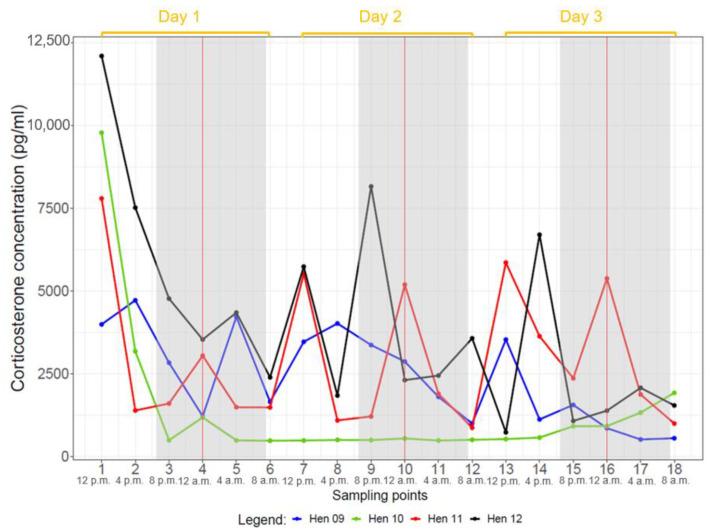
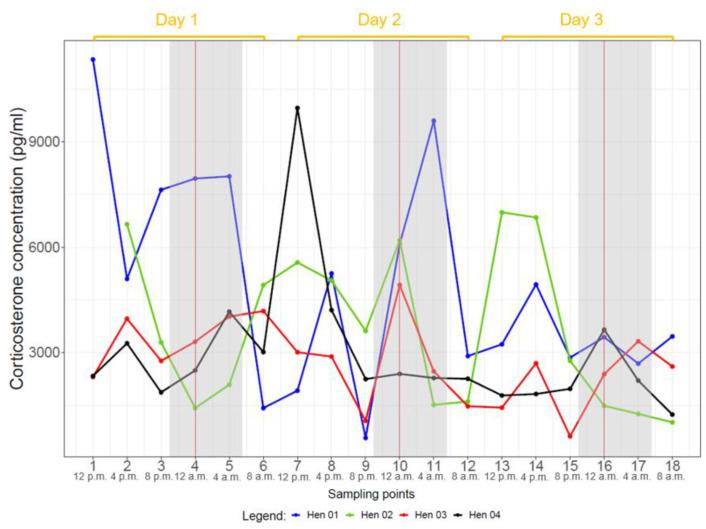
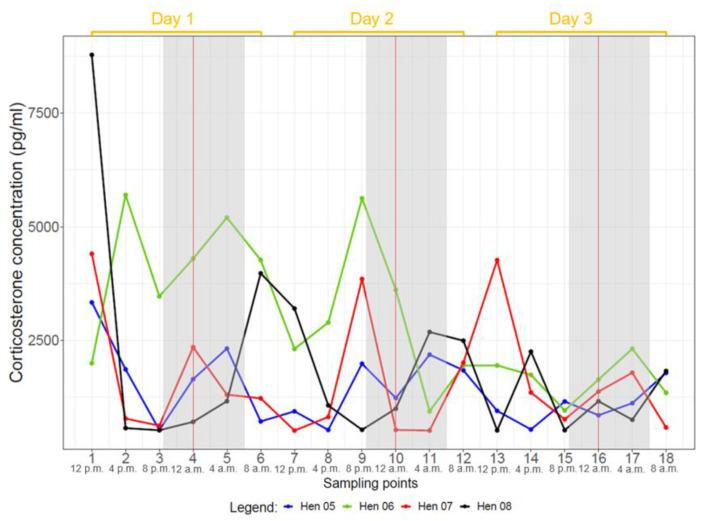
Measurement of blood corticosterone concentrations has been established as an indicator for assessment of acute distress. Therefore, knowledge on physiological fluctuations is required, but previous studies allow little conclusion on daily fluctuations in domestic chickens (). To verify the presence of a circadian corticosterone rhythm in socialized chickens, blood samples were taken at four-hour intervals from 12 laying hens kept in groups of four over three days, each. Prior to experiments, hens were adapted to repeated handling for stress reduction. Corticosterone concentration was determined using radioimmunoassay. Blood sampling time and duration were recorded, and audio and video recordings were analyzed to assess the impact of behavior on corticosterone concentrations. Despite individual fluctuations, most hens showed a circadian course with two peaks per day. Statistics revealed a significant peak during the day (between 12:00 p.m. and 04:00 p.m.) and a tendency for a second peak at night (12:00 a.m.). The daily corticosterone peak was not explained by daytime social stress and needs to be seen as an endophenotype. The role of nightly corticosterone production has to be investigated in further studies. There might be a relation between corticosterone and reproduction since the only hen not showing peaks was not laying eggs.
血液皮质酮浓度的测量已被确立为评估急性应激的一项指标。因此,需要了解其生理波动情况,但以往的研究几乎无法得出关于家鸡每日波动情况的结论。为了验证群居鸡是否存在昼夜皮质酮节律,对12只蛋鸡进行分组,每组4只,在三天内每隔4小时采集一次血样。实验前,让母鸡适应反复处理以减轻应激。使用放射免疫分析法测定皮质酮浓度。记录采血时间和时长,并分析音频和视频记录,以评估行为对皮质酮浓度的影响。尽管存在个体波动,但大多数母鸡呈现出昼夜节律,每天有两个峰值。统计数据显示白天(下午12:00至下午04:00)有一个显著峰值,夜间(凌晨12:00)有出现第二个峰值的趋势。白天的皮质酮峰值无法用白天的社会应激来解释,应被视为一种内表型。夜间皮质酮分泌的作用有待进一步研究。由于唯一未出现峰值的母鸡不产蛋,因此皮质酮与繁殖之间可能存在关联。

 Zotero 插件