
超越反密码子:tRNA 核心修饰及其对结构、翻译和应激适应的影响。
Beyond the Anticodon: tRNA Core Modifications and Their Impact on Structure, Translation and Stress Adaptation.
机构信息
Expression Génétique Microbienne, Université Paris Cité, CNRS, Institut de Biologie Physico-Chimique, F-75005 Paris, France.
出版信息
Genes (Basel). 2024 Mar 19;15(3):374. doi: 10.3390/genes15030374.
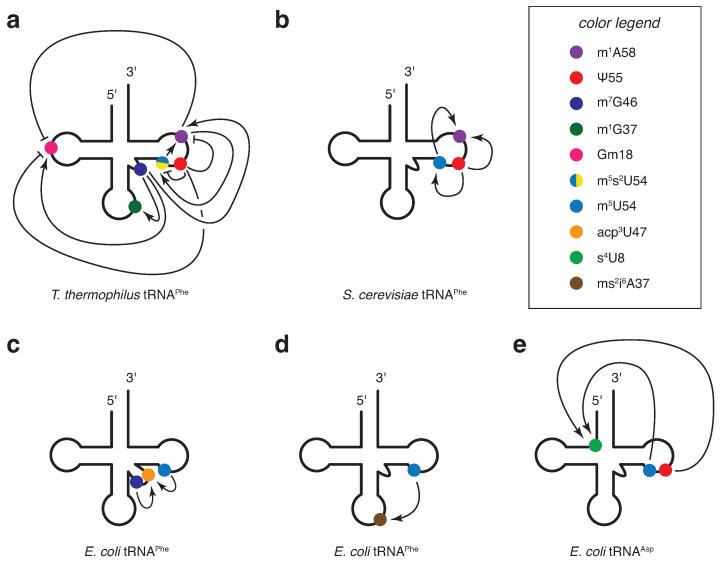
Transfer RNAs (tRNAs) are heavily decorated with post-transcriptional chemical modifications. Approximately 100 different modifications have been identified in tRNAs, and each tRNA typically contains 5-15 modifications that are incorporated at specific sites along the tRNA sequence. These modifications may be classified into two groups according to their position in the three-dimensional tRNA structure, i.e., modifications in the tRNA core and modifications in the anticodon-loop (ACL) region. Since many modified nucleotides in the tRNA core are involved in the formation of tertiary interactions implicated in tRNA folding, these modifications are key to tRNA stability and resistance to RNA decay pathways. In comparison to the extensively studied ACL modifications, tRNA core modifications have generally received less attention, although they have been shown to play important roles beyond tRNA stability. Here, we review and place in perspective selected data on tRNA core modifications. We present their impact on tRNA structure and stability and report how these changes manifest themselves at the functional level in translation, fitness and stress adaptation.
转移 RNA(tRNA) 经过大量的转录后化学修饰。tRNA 中已鉴定出约 100 种不同的修饰,每种 tRNA 通常包含 5-15 种修饰,这些修饰位于 tRNA 序列的特定位置。这些修饰可根据其在三维 tRNA 结构中的位置分为两类,即 tRNA 核心修饰和反密码子环(ACL)区域修饰。由于 tRNA 核心中的许多修饰核苷酸参与了涉及 tRNA 折叠的三级相互作用的形成,因此这些修饰是 tRNA 稳定性和抵抗 RNA 降解途径的关键。与广泛研究的 ACL 修饰相比,tRNA 核心修饰通常受到较少关注,尽管它们的作用已超出 tRNA 稳定性。在这里,我们回顾并从不同角度来看待选定的 tRNA 核心修饰数据。我们介绍了它们对 tRNA 结构和稳定性的影响,并报告了这些变化如何在翻译、适应性和应激反应等功能水平上表现出来。


 Zotero 插件