
对继发性急性髓系白血病进展认识的最新进展
Recent Advances towards the Understanding of Secondary Acute Myeloid Leukemia Progression.
作者信息
Auerbach Scott, Puka Beana, Golla Upendarrao, Chachoua Ilyas
机构信息
Department of Molecular Biology and Genetics, Bilkent University, Ankara 06800, Türkiye.
Department of Medicine, Division of Hematology and Oncology, Pennsylvania State University College of Medicine, Hershey, PA 17033, USA.
出版信息
Life (Basel). 2024 Feb 27;14(3):309. doi: 10.3390/life14030309.
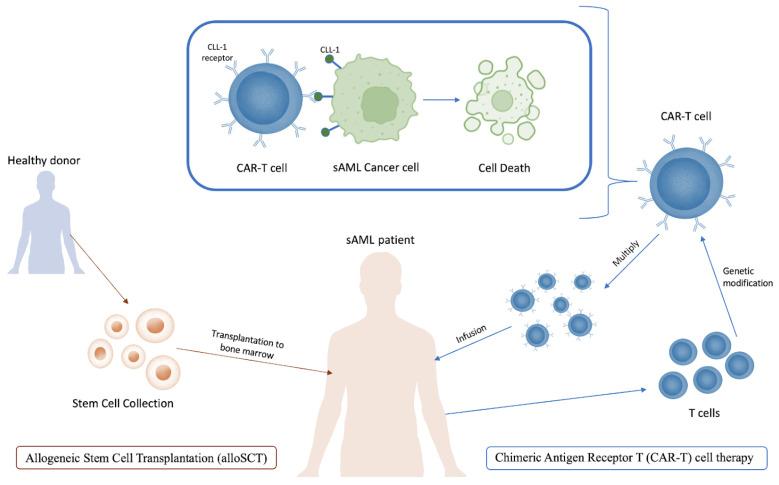
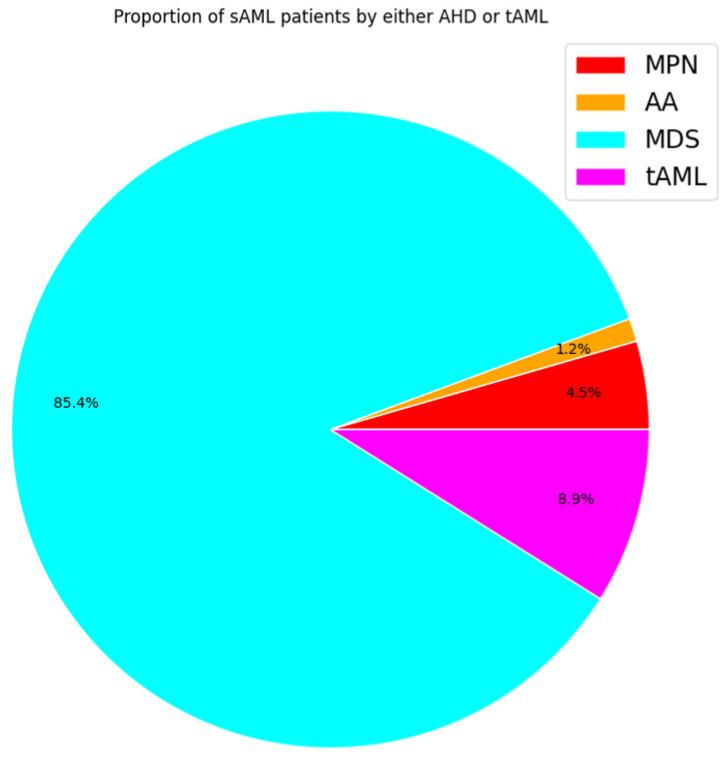
Secondary acute myeloid leukemia (sAML) is a heterogeneous malignant hematopoietic disease that arises either from an antecedent hematologic disorder (AHD) including myelodysplastic syndromes (MDS), myeloproliferative neoplasms (MPN), aplastic anemia (AA), or as a result of exposure to genotoxic chemotherapeutic agents or radiotherapy (therapy related AML, tAML). sAML is diagnosed when the number of blasts is ≥20% in the bone marrow or peripheral blood, and it is characterized by poor prognosis, resistance to therapy and low overall survival rate. With the recent advances in next generation sequencing technologies, our understanding of the molecular events associated with sAML evolution has significantly increased and opened new perspectives for the development of novel therapies. The genetic aberrations that are associated with sAML affect genes involved in processes such as splicing, chromatin modification and genome integrity. Moreover, non-coding RNAs' emerged as an important contributing factor to leukemogenesis. For decades, the standard treatment for secondary AML has been the 7 + 3 regimen of cytarabine and daunorubicin which prolongs survival for several months, but modifications in either dosage or delivery has significantly extended that time. Apart from traditional chemotherapy, hematopoietic stem cell transplantation, CAR-T cell therapy and small molecule inhibitors have also emerged to treat sAML.
继发性急性髓系白血病(sAML)是一种异质性恶性血液病,它要么起源于包括骨髓增生异常综合征(MDS)、骨髓增殖性肿瘤(MPN)、再生障碍性贫血(AA)在内的前驱血液系统疾病(AHD),要么是由于接触基因毒性化疗药物或放疗(治疗相关AML,tAML)所致。当骨髓或外周血中原始细胞数量≥20%时,即可诊断为sAML,其特点是预后不良、对治疗耐药且总生存率低。随着下一代测序技术的最新进展,我们对与sAML演变相关的分子事件的理解有了显著提高,并为新型疗法的开发开辟了新的前景。与sAML相关的基因畸变会影响参与剪接、染色质修饰和基因组完整性等过程的基因。此外,非编码RNA已成为白血病发生的一个重要促成因素。几十年来,继发性AML的标准治疗方法一直是阿糖胞苷和柔红霉素的7 + 3方案,该方案可延长生存期数月,但在剂量或给药方式上的改进已显著延长了这一时间。除了传统化疗外,造血干细胞移植、嵌合抗原受体T细胞(CAR-T)疗法和小分子抑制剂也已出现用于治疗sAML。


 Zotero 插件