
采样部位、自行采样及食物摄入对新型冠状病毒2型RNA检测的影响
Impact of Swabbing Location, Self-Swabbing, and Food Intake on SARS-CoV-2 RNA Detection.
作者信息
Dräger Sarah, Bruni Flavio, Bernasconi Melina, Hammann-Hänni Anya, Jirasko Vlastimil, Tanno Alexander, Blickenstorfer Yves, Leuzinger Karoline, Hirsch Hans H, Osthoff Michael
机构信息
Division of Internal Medicine, University Hospital Basel, 4031 Basel, Switzerland.
Department of Clinical Research, University of Basel, 4031 Basel, Switzerland.
出版信息
Microorganisms. 2024 Mar 15;12(3):591. doi: 10.3390/microorganisms12030591.
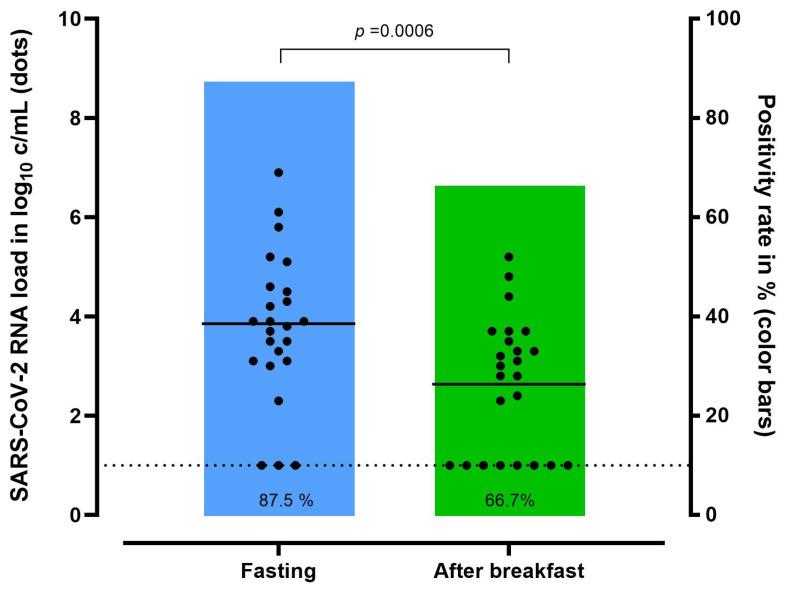
This study compared SARS-CoV-2 RNA loads at different anatomical sites, and the impact of self-swabbing and food intake. Adult symptomatic patients with SARS-CoV-2 or non-SARS-CoV-2 respiratory tract infection were included between 2021 and 2022. Patients performed a nasal and buccal swab before a professionally collected nasopharyngeal/oropharyngeal swab (NOPS). Buccal swabs were collected fasting and after breakfast in a subgroup of patients. SARS-CoV-2 RNA loads were determined by nucleic acid testing. Swabbing convenience was evaluated using a survey. The median age of 199 patients was 54 years (interquartile range 38-68); 42% were female and 52% tested positive for SARS-CoV-2. The majority of patients (70%) were hospitalized. The mean SARS-CoV-2 RNA load was 6.6 log copies/mL (standard deviation (SD), ±1.5), 5.6 log copies/mL (SD ± 1.9), and 3.4 log copies/mL (SD ± 1.9) in the professionally collected NOPS, and self-collected nasal and buccal swabs, respectively ( < 0.0001). Sensitivity was 96.1% (95% CI 90.4-98.9) and 75.3% (95% CI 63.9-81.8) for the nasal and buccal swabs, respectively. After food intake, SARS-CoV-2 RNA load decreased ( = 0.0006). Buccal swabbing was the preferred sampling procedure for the patients. In conclusion, NOPS yielded the highest SARS-CoV-2 RNA loads. Nasal self-swabbing emerged as a reliable alternative in contrast to buccal swabs. If buccal swabs are used, they should be performed before food intake.
本研究比较了严重急性呼吸综合征冠状病毒2(SARS-CoV-2)在不同解剖部位的RNA载量,以及自行采样和食物摄入的影响。纳入了2021年至2022年间出现症状的成年SARS-CoV-2或非SARS-CoV-2呼吸道感染患者。患者在专业人员采集鼻咽/口咽拭子(NOPS)之前先进行鼻腔和口腔拭子采样。在一部分患者中,口腔拭子在空腹时和早餐后采集。通过核酸检测确定SARS-CoV-2 RNA载量。使用一项调查评估采样的便利性。199名患者的中位年龄为54岁(四分位间距38 - 68岁);42%为女性,52%的患者SARS-CoV-2检测呈阳性。大多数患者(70%)住院治疗。在专业采集的NOPS、自行采集的鼻腔拭子和口腔拭子中,SARS-CoV-2的平均RNA载量分别为6.6 log拷贝/毫升(标准差(SD),±1.5)、5.6 log拷贝/毫升(SD ± 1.9)和3.4 log拷贝/毫升(SD ± 1.9)(<0.0001)。鼻腔拭子和口腔拭子的敏感性分别为96.1%(95%置信区间90.4 - 98.9)和75.3%(95%置信区间63.9 - 81.8)。食物摄入后,SARS-CoV-2 RNA载量下降(P = 0.0006)。口腔拭子采样是患者首选的采样方法。总之,NOPS的SARS-CoV-2 RNA载量最高。与口腔拭子相比,鼻腔自行采样是一种可靠的替代方法。如果使用口腔拭子,应在进食前进行。


 Zotero 插件