
PYCR1通过调节死亡受体的重新分布来调节非小细胞肺癌细胞中的TRAIL抗性。
PYCR1 regulates TRAIL‑resistance in non‑small cell lung cancer cells by regulating the redistribution of death receptors.
作者信息
You Chengcheng, He Jinlan, Cao Chunyu, Sheng Deqiao, Wang Lin, Huang Zhixian, Zhang Xiaoling, Yi Changjun, Sun Yingming, Huang Yiling
机构信息
Hubei Key Laboratory of Tumor Microenvironment and Immunotherapy, China Three Gorges University, Yichang, Hubei 443002, P.R. China.
Department of Pathology, College of Basic Medical Science, China Three Gorges University, Yichang, Hubei 443002, P.R. China.
出版信息
Oncol Lett. 2024 Mar 19;27(5):216. doi: 10.3892/ol.2024.14349. eCollection 2024 May.
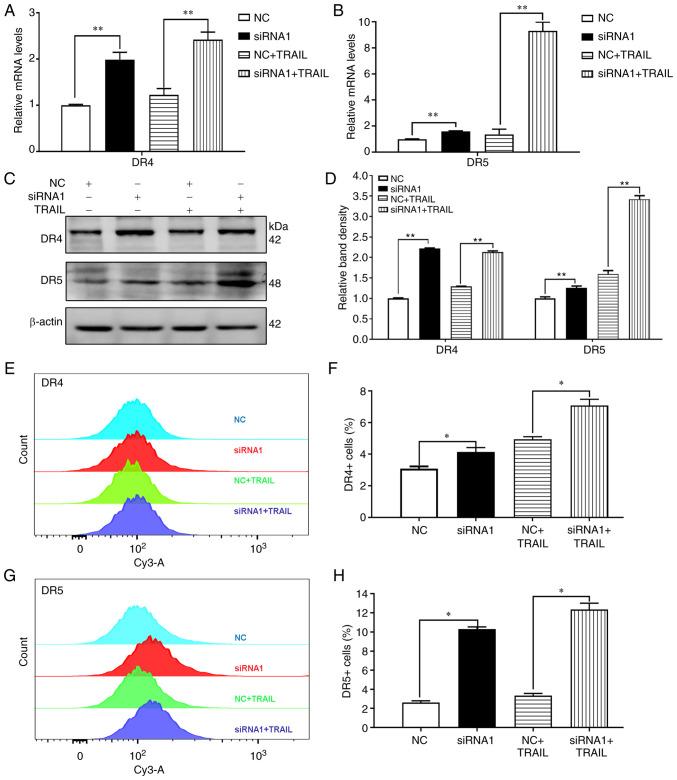
Although recombinant human TNF-related apoptosis-inducing ligand (TRAIL) protein exhibits antitumor activity in a number of lung and liver cancer cells and tumor-bearing animals, TRAIL resistance has substantially restricted its clinical application. Pyrroline-5-carboxylate reductase 1 (PYCR1) is a key enzyme in the regulation of proline synthesis. PYCR1 is highly expressed in various types of malignant tumor, in which it has been implicated in 5-fluorouracil resistance. However, the possible relationship between PYCR1 and TRAIL resistance remains unclear. In the present study, both reverse transcription-quantitative PCR and western blotting were performed. The results indicated that H1299 cells had higher PYCR1 expression levels and were less sensitive to TRAIL compared with the TRAIL-sensitive cell line, H460. PYCR1 knockdown in H1299 cells increased TRAIL sensitivity, increased the localization of death receptors (DRs) on the cell surface and activated Caspase-3/8. By contrast, overexpression of PYCR1 in H1299 cells decreased TRAIL sensitivity, reduced the distribution of DRs on the cell surface and suppressed the activation of Caspase-3/8. Taken together, these results suggested that PYCR1 promoted TRAIL resistance in the non-small cell lung cancer cell line, H1299, by preventing redistribution of DRs to the plasma membrane. This in turn inhibited TRAIL-mediated cell apoptosis by reducing the activation of Caspase-3/8.
尽管重组人肿瘤坏死因子相关凋亡诱导配体(TRAIL)蛋白在多种肺癌和肝癌细胞以及荷瘤动物中表现出抗肿瘤活性,但TRAIL耐药性严重限制了其临床应用。吡咯啉-5-羧酸还原酶1(PYCR1)是脯氨酸合成调控中的关键酶。PYCR1在各种类型的恶性肿瘤中高表达,并且与5-氟尿嘧啶耐药有关。然而,PYCR1与TRAIL耐药性之间的潜在关系仍不清楚。在本研究中,进行了逆转录定量PCR和蛋白质印迹分析。结果表明,与TRAIL敏感细胞系H460相比,H1299细胞具有更高的PYCR1表达水平,并且对TRAIL不太敏感。敲低H1299细胞中的PYCR1可增加TRAIL敏感性,增加死亡受体(DRs)在细胞表面的定位并激活Caspase-3/8。相反,在H1299细胞中过表达PYCR1可降低TRAIL敏感性,减少DRs在细胞表面的分布并抑制Caspase-3/8的激活。综上所述,这些结果表明,PYCR1通过阻止DRs重新分布到质膜,促进了非小细胞肺癌细胞系H1299中的TRAIL耐药性。这反过来通过降低Caspase-3/8的激活来抑制TRAIL介导的细胞凋亡。


 Zotero 插件