
生成用户驱动的患者角色,以支持农村独居患者的预防保健活动。
Generating user-driven patient personas to support preventive health care activities of rural-living unattached patients.
作者信息
Burton Lindsay, Rush Kathy L, Seaton Cherisse L, Li Eric P H, Corman Kendra, Ronquillo Charlene E, Davis Selena, Smith Mindy A
机构信息
School of Nursing, University of British Columbia, Okanagan, Kelowna, BC V1V 1V7, Canada.
Faculty of Management and Principal's Research Chair (Tier 2) in Social Innovation for Health Equity and Food Security, University of British Columbia, Okanagan, Kelowna, BC V1V 1V7, Canada.
出版信息
PEC Innov. 2024 Mar 13;4:100274. doi: 10.1016/j.pecinn.2024.100274. eCollection 2024 Dec.
OBJECTIVE
This study created personas using quantitative segmentation and knowledge user enhancement to inform intervention and service design for rural patients to encourage preventive care uptake.
METHODS
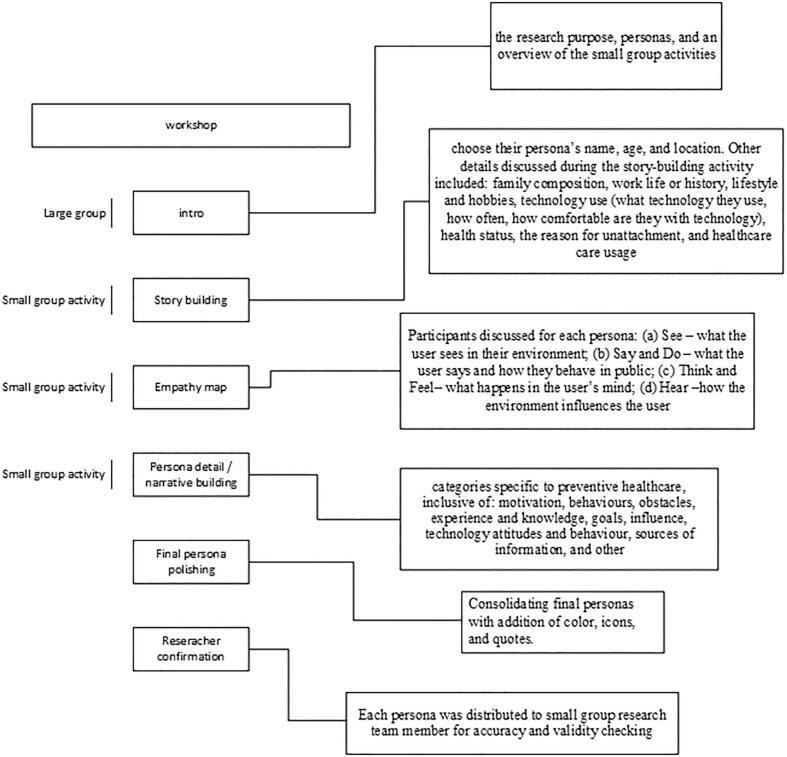
This study comprised a cross-sectional survey of rural unattached patients and a co-design workshop for persona development. Cross-sectional survey data were analyzed for meaningful subgroups based on quartiles of preventive care completion. These quartiles informed "relevant user segments" grouped according to demographics (age, sex), length of unattachment, percentage of up-to-date preventive activities, health care visit frequency, preventive priorities, communication confidence with providers, and chronic health conditions, which were then used in the workshop to build the final personas.
RESULTS
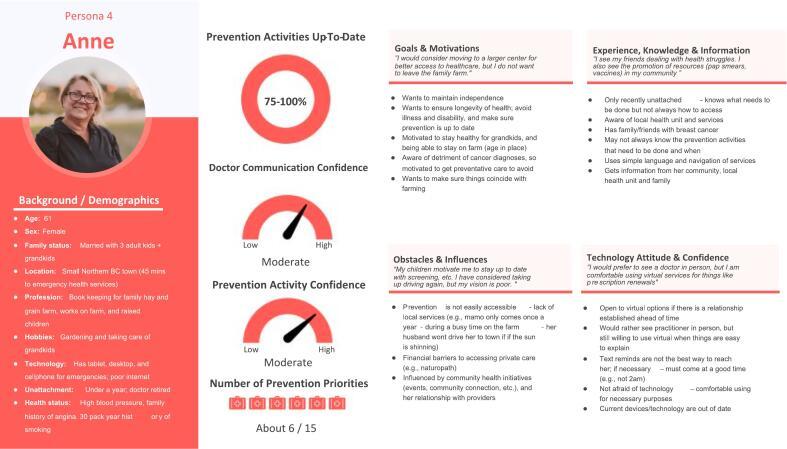
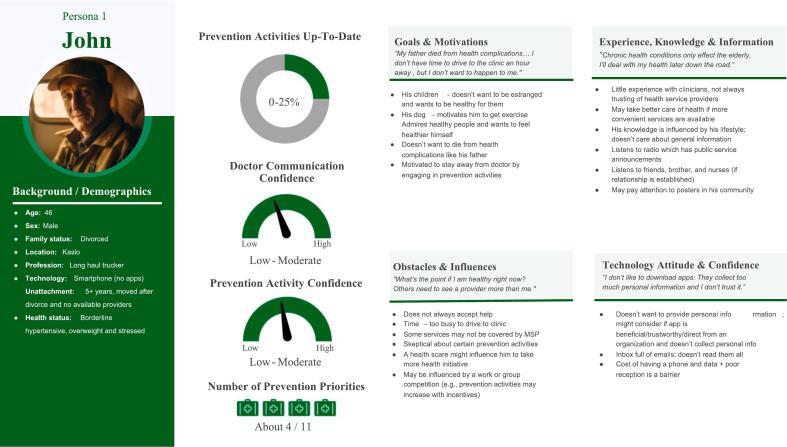
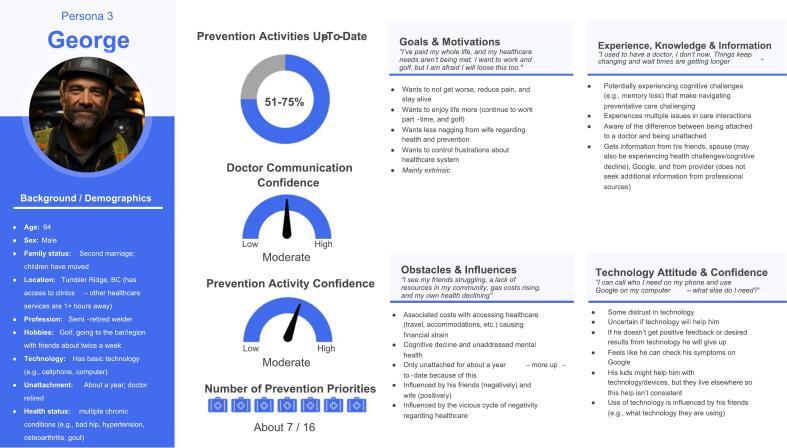
207 responses informed persona user segments, and five health care providers and 13 patients attended the workshop. The resulting four personas, included John (not up-to-date on preventive care activities), Terrance (few up-to-date preventive care activities), George (moderately up-to-date preventive care activities), and Anne (mostly up-to-date preventive care activities).
CONCLUSION
Quantitative persona development with integrated knowledge user co-design/enhancement elevated and enriched final personas that achieved robust profiles for intervention design.
INNOVATION
This project's use of a progressive methodology to build robust personas coupled with participant feedback on the co-design process offers a replicable approach for health researchers.
目的
本研究通过定量细分和知识用户增强来创建人物角色,为农村患者的干预措施和服务设计提供参考,以鼓励他们接受预防性护理。
方法
本研究包括对农村无依无靠患者的横断面调查以及一个用于人物角色开发的协同设计研讨会。根据预防性护理完成情况的四分位数,对横断面调查数据进行分析,以找出有意义的亚组。这些四分位数为根据人口统计学特征(年龄、性别)、无依无靠时间长度、最新预防性活动的百分比、医疗就诊频率、预防重点、与医疗服务提供者沟通的信心以及慢性健康状况进行分组的“相关用户群体”提供了依据,然后在研讨会上利用这些依据构建最终的人物角色。
结果
207份回复为人物角色用户群体提供了信息,5名医疗服务提供者和13名患者参加了研讨会。最终形成了四个人物角色,分别是约翰(未及时进行预防性护理活动)、特伦斯(很少进行最新的预防性护理活动)、乔治(适度进行最新的预防性护理活动)和安妮(大部分进行了最新的预防性护理活动)。
结论
通过整合知识用户协同设计/增强进行的定量人物角色开发提升并丰富了最终的人物角色,为干预设计提供了完善的概况。
创新点
该项目采用渐进式方法构建完善的人物角色,并结合参与者对协同设计过程的反馈,为健康研究人员提供了一种可复制的方法。

 Zotero 插件