
小胶质细胞/巨噬细胞极化在眼内疾病中的作用(综述)。
Role of microglia/macrophage polarisation in intraocular diseases (Review).
机构信息
School of Opthalmology, Chengdu University of Traditional Chinese Medicine, Chengdu, Sichuan 610072, P.R. China.
出版信息
Int J Mol Med. 2024 May;53(5). doi: 10.3892/ijmm.2024.5369. Epub 2024 Mar 29.
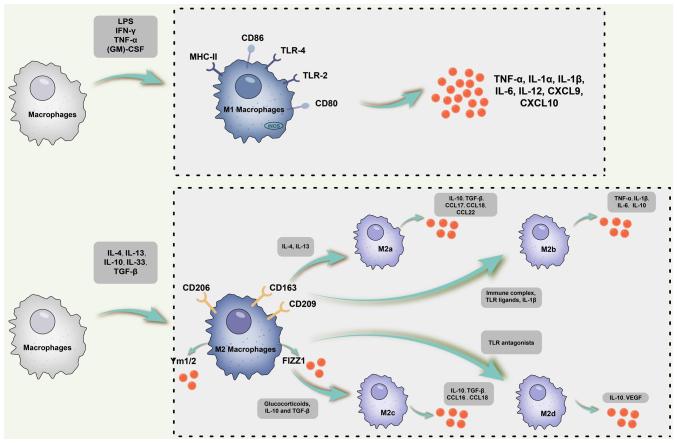
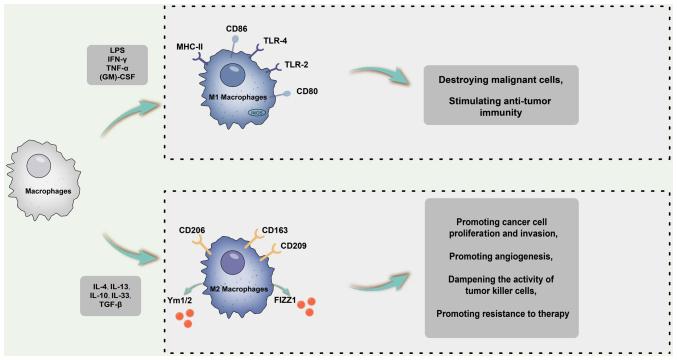
Macrophages form a crucial component of the innate immune system, and their activation is indispensable for various aspects of immune and inflammatory processes, tissue repair, and maintenance of the balance of the body's state. Macrophages are found in all ocular tissues, spanning from the front surface, including the cornea, to the posterior pole, represented by the choroid/sclera. The neural retina is also populated by specialised resident macrophages called microglia. The plasticity of microglia/macrophages allows them to adopt different activation states in response to changes in the tissue microenvironment. When exposed to various factors, microglia/macrophages polarise into distinct phenotypes, each exhibiting unique characteristics and roles. Furthermore, extensive research has indicated a close association between microglia/macrophage polarisation and the development and reversal of various intraocular diseases. The present article provides a review of the recent findings on the association between microglia/macrophage polarisation and ocular pathological processes (including autoimmune uveitis, optic neuritis, sympathetic ophthalmia, retinitis pigmentosa, glaucoma, proliferative vitreoretinopathy, subretinal fibrosis, uveal melanoma, ischaemic optic neuropathy, retinopathy of prematurity and choroidal neovascularization). The paradoxical role of microglia/macrophage polarisation in retinopathy of prematurity is also discussed. Several studies have shown that microglia/macrophages are involved in the pathology of ocular diseases. However, it is required to further explore the relevant mechanisms and regulatory processes. The relationship between the functional diversity displayed by microglia/macrophage polarisation and intraocular diseases may provide a new direction for the treatment of intraocular diseases.
巨噬细胞是先天免疫系统的重要组成部分,其激活对于免疫和炎症过程、组织修复以及维持身体平衡的各个方面都是不可或缺的。巨噬细胞存在于所有眼部组织中,从前表面(包括角膜)到后极(由脉络膜/巩膜代表)。神经视网膜也存在称为小胶质细胞的特化常驻巨噬细胞。小胶质细胞/巨噬细胞的可塑性使它们能够根据组织微环境的变化采用不同的激活状态。当暴露于各种因素时,小胶质细胞/巨噬细胞会极化为不同的表型,每种表型都具有独特的特征和作用。此外,大量研究表明小胶质细胞/巨噬细胞极化与各种眼内疾病的发生和逆转密切相关。本文综述了小胶质细胞/巨噬细胞极化与眼部病理过程(包括自身免疫性葡萄膜炎、视神经炎、交感性眼炎、色素性视网膜炎、青光眼、增生性玻璃体视网膜病变、视网膜下纤维化、脉络膜黑色素瘤、缺血性视神经病变、早产儿视网膜病变和脉络膜新生血管形成)之间关联的最新发现。早产儿视网膜病变中小胶质细胞/巨噬细胞极化的矛盾作用也进行了讨论。多项研究表明,小胶质细胞/巨噬细胞参与了眼部疾病的病理过程。然而,需要进一步探索相关的机制和调节过程。小胶质细胞/巨噬细胞极化显示出的功能多样性与眼内疾病之间的关系,可能为眼内疾病的治疗提供新的方向。



 Zotero 插件