
GD2 靶向嵌合抗原受体 T 细胞疗法用于 GD2+髓母细胞瘤患者。
GD2-Targeting CAR T-cell Therapy for Patients with GD2+ Medulloblastoma.
机构信息
Department of Onco-Haematology and Cell and Gene Therapy, Bambino Gesù Children's Hospital, IRCCS, Rome, Italy.
Department of Clinical Medicine and Surgery, Federico II University of Naples, Naples, Italy.
出版信息
Clin Cancer Res. 2024 Jun 3;30(11):2545-2557. doi: 10.1158/1078-0432.CCR-23-1880.
PURPOSE
Medulloblastoma (MB), the most common childhood malignant brain tumor, has a poor prognosis in about 30% of patients. The current standard of care, which includes surgery, radiation, and chemotherapy, is often responsible for cognitive, neurologic, and endocrine side effects. We investigated whether chimeric antigen receptor (CAR) T cells directed toward the disialoganglioside GD2 can represent a potentially more effective treatment with reduced long-term side effects.
EXPERIMENTAL DESIGN
GD2 expression was evaluated on primary tumor biopsies of MB children by flow cytometry. GD2 expression in MB cells was also evaluated in response to an EZH2 inhibitor (tazemetostat). In in vitro and in vivo models, GD2+ MB cells were targeted by a CAR-GD2.CD28.4-1BBζ (CAR.GD2)-T construct, including the suicide gene inducible caspase-9.
RESULTS
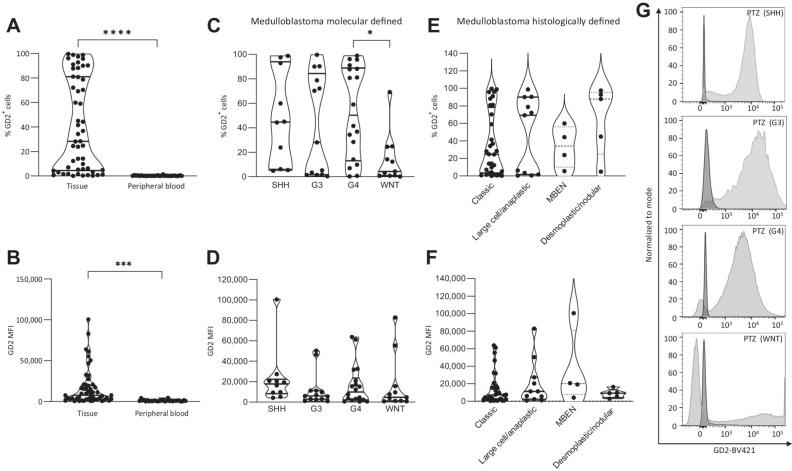
GD2 was expressed in 82.68% of MB tumors. The SHH and G3-G4 subtypes expressed the highest levels of GD2, whereas the WNT subtype expressed the lowest. In in vitro coculture assays, CAR.GD2 T cells were able to kill GD2+ MB cells. Pretreatment with tazemetostat upregulated GD2 expression, sensitizing GD2dimMB cells to CAR.GD2 T cells cytotoxic activity. In orthotopic mouse models of MB, intravenously injected CAR.GD2 T cells significantly controlled tumor growth, prolonging the overall survival of treated mice. Moreover, the dimerizing drug AP1903 was able to cross the murine blood-brain barrier and to eliminate both blood-circulating and tumor-infiltrating CAR.GD2 T cells.
CONCLUSIONS
Our experimental data indicate the potential efficacy of CAR.GD2 T-cell therapy. A phase I/II clinical trial is ongoing in our center (NCT05298995) to evaluate the safety and therapeutic efficacy of CAR.GD2 therapy in high-risk MB patients.
目的
成神经管细胞瘤(MB)是最常见的儿童恶性脑肿瘤,约 30%的患者预后不良。目前的治疗标准包括手术、放疗和化疗,这些治疗方法常常会导致认知、神经和内分泌方面的副作用。我们研究了针对二唾液酸神经节苷脂 GD2 的嵌合抗原受体(CAR)T 细胞是否可以作为一种潜在的更有效的治疗方法,同时减少长期的副作用。
实验设计
通过流式细胞术评估 MB 患儿的原发性肿瘤活检中的 GD2 表达。还评估了 EZH2 抑制剂(他泽司他)对 MB 细胞中 GD2 表达的影响。在体外和体内模型中,通过 CAR-GD2.CD28.4-1BBζ(CAR.GD2)-T 构建体靶向 GD2+ MB 细胞,该构建体包括诱导型半胱天冬酶-9 的自杀基因。
结果
GD2 在 82.68%的 MB 肿瘤中表达。SHH 和 G3-G4 亚型表达的 GD2 水平最高,而 WNT 亚型表达的 GD2 水平最低。在体外共培养实验中,CAR.GD2 T 细胞能够杀死 GD2+ MB 细胞。用他泽司他预处理可上调 GD2 表达,使 GD2dimMB 细胞对 CAR.GD2 T 细胞的细胞毒性作用敏感。在 MB 的原位小鼠模型中,静脉注射的 CAR.GD2 T 细胞显著控制了肿瘤生长,延长了接受治疗的小鼠的总生存期。此外,二聚化药物 AP1903 能够穿过小鼠血脑屏障,并消除循环血中和肿瘤浸润的 CAR.GD2 T 细胞。
结论
我们的实验数据表明 CAR.GD2 T 细胞治疗具有潜在的疗效。我们中心正在进行一项 I/II 期临床试验(NCT05298995),以评估 CAR.GD2 疗法在高危 MB 患者中的安全性和治疗效果。



 Zotero 插件