
饮食诱导的高同型半胱氨酸血症会导致后代肌肉组织和脑功能出现性别依赖性缺陷。
Diet-induced hyperhomocysteinemia causes sex-dependent deficiencies in offspring musculature and brain function.
作者信息
Suszyńska-Zajczyk Joanna, Witucki Łukasz, Perła-Kaján Joanna, Jakubowski Hieronim
机构信息
Department of Biochemistry and Biotechnology, Poznań University of Life Sciences, Poznań, Poland.
Department of Microbiology, Biochemistry & Molecular Genetics, Rutgers University, New Jersey Medical School, International Center for Public Health, Newark, NJ, United States.
出版信息
Front Cell Dev Biol. 2024 Mar 15;12:1322844. doi: 10.3389/fcell.2024.1322844. eCollection 2024.
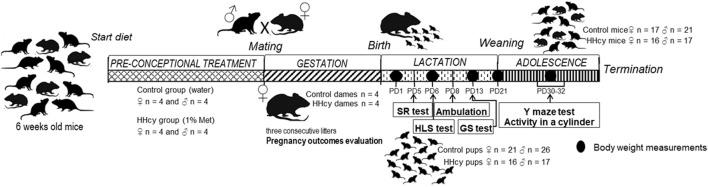
Hyperhomocysteinemia (HHcy), characterized by elevated homocysteine (Hcy) levels, is a known risk factor for cardiovascular, renal, and neurological diseases, as well as pregnancy complications. Our study aimed to investigate whether HHcy induced by a high-methionine (high-Met) diet exacerbates cognitive and behavioral deficits in offspring and leads to other breeding problems. Dietary HHcy was induced four weeks before mating and continued throughout gestation and post-delivery. A battery of behavioral tests was conducted on offspring between postnatal days (PNDs) 5 and 30 to assess motor function/activity and cognition. The results were correlated with brain morphometric measurements and quantitative analysis of mammalian target of rapamycin (mTOR)/autophagy markers. The high-Met diet significantly increased parental and offspring urinary tHcy levels and influenced offspring behavior in a sex-dependent manner. Female offspring exhibited impaired cognition, potentially related to morphometric changes observed exclusively in HHcy females. Male HHcy pups demonstrated muscle weakness, evidenced by slower surface righting, reduced hind limb suspension (HLS) hanging time, weaker grip strength, and decreased activity in the beaker test. Western blot analyses indicated the downregulation of autophagy and the upregulation of mTOR activity in HHcy cortexes. HHcy also led to breeding impairments, including reduced breeding rate, in-utero fetal death, lower pups' body weight, and increased mortality, likely attributed to placental dysfunction associated with HHcy. In conclusion, a high-Met diet impairs memory and cognition in female juveniles and weakens muscle strength in male pups. These effects may stem from abnormal placental function affecting early neurogenesis, the dysregulation of autophagy-related pathways in the cortex, or epigenetic mechanisms of gene regulation triggered by HHcy during embryonic development.
高同型半胱氨酸血症(HHcy)的特征是同型半胱氨酸(Hcy)水平升高,它是心血管疾病、肾脏疾病、神经系统疾病以及妊娠并发症的已知风险因素。我们的研究旨在调查高蛋氨酸(高Met)饮食诱导的HHcy是否会加剧后代的认知和行为缺陷,并导致其他繁殖问题。在交配前四周诱导饮食性HHcy,并在整个妊娠期和产后持续。在出生后第5天至30天对后代进行一系列行为测试,以评估运动功能/活动和认知。结果与脑形态测量以及雷帕霉素哺乳动物靶标(mTOR)/自噬标志物的定量分析相关。高Met饮食显著提高了亲代和后代的尿总Hcy水平,并以性别依赖的方式影响后代行为。雌性后代表现出认知受损,这可能与仅在HHcy雌性中观察到的形态变化有关。雄性HHcy幼崽表现出肌肉无力,表现为翻正反射减慢、后肢悬挂(HLS)悬挂时间缩短、握力减弱以及在烧杯试验中的活动减少。蛋白质免疫印迹分析表明HHcy皮质中自噬下调和mTOR活性上调。HHcy还导致繁殖障碍,包括繁殖率降低、宫内胎儿死亡、幼崽体重降低和死亡率增加,这可能归因于与HHcy相关的胎盘功能障碍。总之,高Met饮食损害雌性幼崽的记忆和认知,并削弱雄性幼崽的肌肉力量。这些影响可能源于影响早期神经发生的异常胎盘功能、皮质中自噬相关途径的失调,或胚胎发育期间HHcy触发的基因调控表观遗传机制。

 Zotero 插件