
外核组学时代癌症环境流行病学的地理空间科学
Geospatial Science for the Environmental Epidemiology of Cancer in the Exposome Era.
机构信息
Epidemiology Program, Public Health Sciences Division, Fred Hutchinson Cancer Center, Seattle, Washington.
Department of Epidemiology, University of Washington, Seattle, Washington.
出版信息
Cancer Epidemiol Biomarkers Prev. 2024 Apr 3;33(4):451-460. doi: 10.1158/1055-9965.EPI-23-1237.
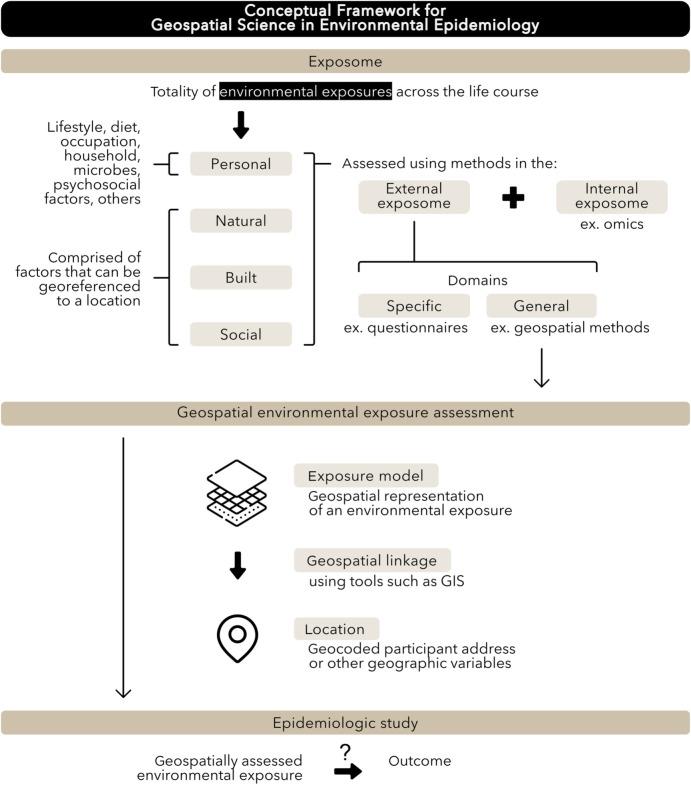
Geospatial science is the science of location or place that harnesses geospatial tools, such as geographic information systems (GIS), to understand the features of the environment according to their locations. Geospatial science has been transformative for cancer epidemiologic studies through enabling large-scale environmental exposure assessments. As the research paradigm for the exposome, or the totality of environmental exposures across the life course, continues to evolve, geospatial science will serve a critical role in determining optimal practices for how to measure the environment as part of the external exposome. The objectives of this article are to provide a summary of key concepts, present a conceptual framework that illustrates how geospatial science is applied to environmental epidemiology in practice and through the lens of the exposome, and discuss the following opportunities for advancing geospatial science in cancer epidemiologic research: enhancing spatial and temporal resolutions and extents for geospatial data; geospatial methodologies to measure climate change factors; approaches facilitating the use of patient addresses in epidemiologic studies; combining internal exposome data and geospatial exposure models of the external exposome to provide insights into biological pathways for environment-disease relationships; and incorporation of geospatial data into personalized cancer screening policies and clinical decision making.
地理空间科学是一门研究位置或地点的科学,它利用地理空间工具,如地理信息系统 (GIS),根据位置来了解环境特征。地理空间科学通过实现大规模的环境暴露评估,为癌症流行病学研究带来了变革。随着暴露组学(或整个生命过程中环境暴露的总和)的研究范式不断发展,地理空间科学将在确定如何测量环境作为外部暴露组学的一部分的最佳实践方面发挥关键作用。本文的目的是提供关键概念的摘要,展示如何通过暴露组学的视角来应用地理空间科学来进行环境流行病学研究的概念框架,并讨论在癌症流行病学研究中推进地理空间科学的以下机会:提高地理空间数据的空间和时间分辨率和范围;测量气候变化因素的地理空间方法;促进在流行病学研究中使用患者地址的方法;将内部暴露组数据和外部暴露组学的地理空间暴露模型相结合,以深入了解环境-疾病关系的生物学途径;以及将地理空间数据纳入个性化癌症筛查政策和临床决策制定。
 Zotero 插件