
新型冠状病毒肺炎合并感染的临床和免疫学特征及潜在的中医药治疗。
Clinical and immunologic features of co-infection in COVID-19 patients, along with potential traditional Chinese medicine treatments.
机构信息
Department of Clinical Laboratory, Ninth Hospital of Xi'an, Xi'an, Shannxi, China.
Xianyang Center for Disease Control and Prevention, Xianyang, Shannxi, China, China.
出版信息
Front Immunol. 2024 Mar 21;15:1357638. doi: 10.3389/fimmu.2024.1357638. eCollection 2024.
OBJECTIVES
With the increasing number of people worldwide infected with SARS-CoV-2, the likelihood of co-infection and/or comorbidities is rising. The impact of these co-infections on the patient's immune system remains unclear. This study aims to investigate the immunological characteristics of secondary infections in hospitalized COVID-19 patients, and preliminarily predict potential therapeutic effects of traditional Chinese medicine and their derivatives for the treatment of co-infections.
METHODS
In this retrospective cohort study, we included 131 hospitalized patients with laboratory-confirmed COVID-19, of whom there were 64 mild and 67 severe cases. We analyzed clinical characteristics and immunologic data, including circulating immune cell numbers, levels of inflammatory factors and viral load, comparing COVID-19 patients with and without co-infection.
RESULTS
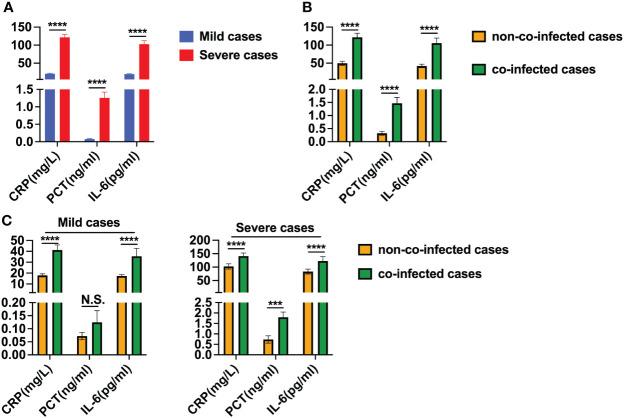
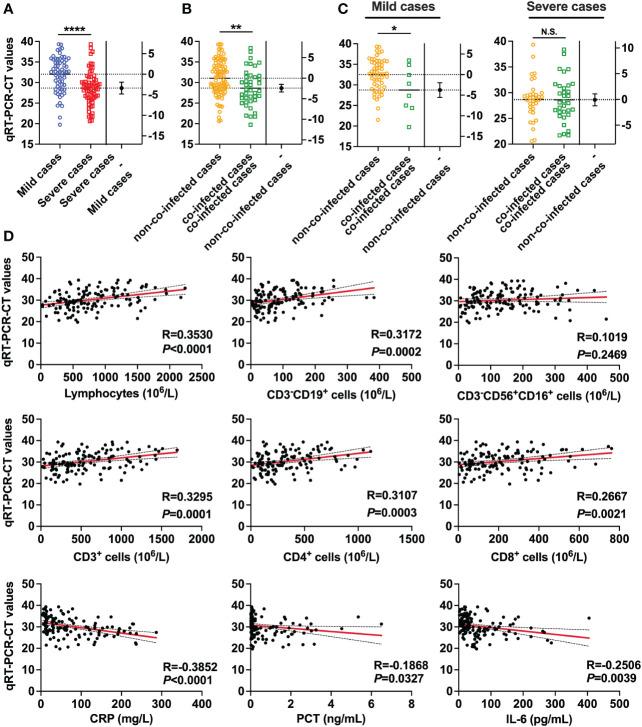
Among 131 hospitalized COVID-19 patients, 41 (31.3%) were co-infection positive, with 33 (80.5%) having severe disease and 14 (34.1%) of them resulting in fatalities. Co-infected patients exhibited significantly higher severity and mortality rates compared to non-co-infected counterparts. Co-infected patients had significantly lower absolute counts of lymphocytes, total T lymphocytes, CD4 T cells, CD8 T cells and B lymphocytes, while levels of hs-CRP, PCT and IL-6 were significantly elevated compared to non-co-infected patients. Additionally, the viral load of co-infected patients was significantly higher than non-co-infected patients.
CONCLUSION
Co-infection emerges as a dangerous factor for COVID-19 patients, elevating the risk of severe pneumonia and mortality. Co-infection suppresses the host's immune response by reducing the number of lymphocytes and increasing inflammation, thereby diminishing the antiviral and anti-infective effects of the immune system, which promotes the severity of the disease. Therefore, it is crucial to implement infection prevention measures to minimize the spread of co-infections among COVID-19 hospitalized patients. Additionally, changes in these biomarkers provide a theoretical basis for the effective treatment of co-infections with traditional Chinese medicine.
目的
随着全球感染 SARS-CoV-2 的人数不断增加,合并感染和/或合并症的可能性也在增加。这些合并感染对患者免疫系统的影响尚不清楚。本研究旨在探讨住院 COVID-19 患者继发感染的免疫学特征,并初步预测中药及其衍生物治疗合并感染的潜在疗效。
方法
在这项回顾性队列研究中,我们纳入了 131 例经实验室确诊的 COVID-19 住院患者,其中轻症 64 例,重症 67 例。我们分析了临床特征和免疫数据,包括循环免疫细胞数量、炎症因子和病毒载量水平,比较了 COVID-19 患者有无合并感染。
结果
在 131 例住院 COVID-19 患者中,41 例(31.3%)为合并感染阳性,其中 33 例(80.5%)为重症,14 例(34.1%)死亡。合并感染患者的严重程度和死亡率明显高于未合并感染患者。合并感染患者的淋巴细胞、总 T 淋巴细胞、CD4 T 细胞、CD8 T 细胞和 B 淋巴细胞绝对计数明显降低,hs-CRP、PCT 和 IL-6 水平明显升高。此外,合并感染患者的病毒载量明显高于未合并感染患者。
结论
合并感染是 COVID-19 患者的一个危险因素,增加了重症肺炎和死亡的风险。合并感染通过降低淋巴细胞数量和增加炎症反应来抑制宿主的免疫反应,从而降低免疫系统的抗病毒和抗感染作用,促进疾病的严重程度。因此,实施感染预防措施对于减少 COVID-19 住院患者合并感染的传播至关重要。此外,这些生物标志物的变化为中药有效治疗合并感染提供了理论依据。

 Zotero 插件