
菲律宾两个不同地理区域甲型肝炎病毒感染的血清流行率及流行特征变化
Seroprevalence and Shifting Endemicities of Hepatitis A Virus Infection in Two Different Geographical Areas in the Philippines.
作者信息
Carlos Josefina C, Quinones Vinna Marie T, Adversario Maria Peñafrancia L, Nailes Jennifer M, Songco Jangail C, Garcia Donaliz R, Cacayorin Michelle G, Cero May Priscilla V, Benedicto-Delfin Maria Paula Aleta, Blanco Ma Christina C, Natividad Nadjah S, Bernabe Jacqueline D, Chacon Hyacinth Claire T, Ascue Ronald Alvin C, Paggao Jayme Natasha K, Comendador Lous Ohsana P, Hernandez-Suarez Gustavo, Guzman-Holst Adriana
机构信息
University of the East Ramon Magsaysay Memorial Medical Center, Quezon City, Philippines.
GSK, Avenue Fleming 20, Wavre, Belgium.
出版信息
Infect Dis Ther. 2024 May;13(5):1019-1035. doi: 10.1007/s40121-024-00955-w. Epub 2024 Apr 5.
INTRODUCTION
Infection with hepatitis A virus (HAV) is often asymptomatic in young children, but most adolescents and adults will have symptoms ranging from nausea and tiredness to acute liver failure and even death. The risk of severe disease is higher in older adults and people with pre-existing liver disease. Immunization is recommended in regions with low HAV endemicity levels, i.e., where people get infected later in life. In the Philippines, recent epidemiologic data on HAV infection are lacking. The objective of this study was to assess age-specific seroprevalence and evaluate risk factors associated with HAV seropositivity.
METHODS
People from two geographic areas (urban and rural) were recruited/enrolled and stratified by age group. HAV-specific immunoglobulin G (IgG) antibodies were measured with a chemiluminescent microparticle immunoassay. Sociodemographic parameters, hepatitis medical history, disease knowledge, hygiene measures and sanitation were assessed via a purpose-made questionnaire. Age at midpoint of population immunity (AMPI) was estimated using Kaplan-Meier curves. Logistic regression analyses were carried out to determine factors that were statistically significantly associated (p < 0.05) with HAV seropositivity.
RESULTS
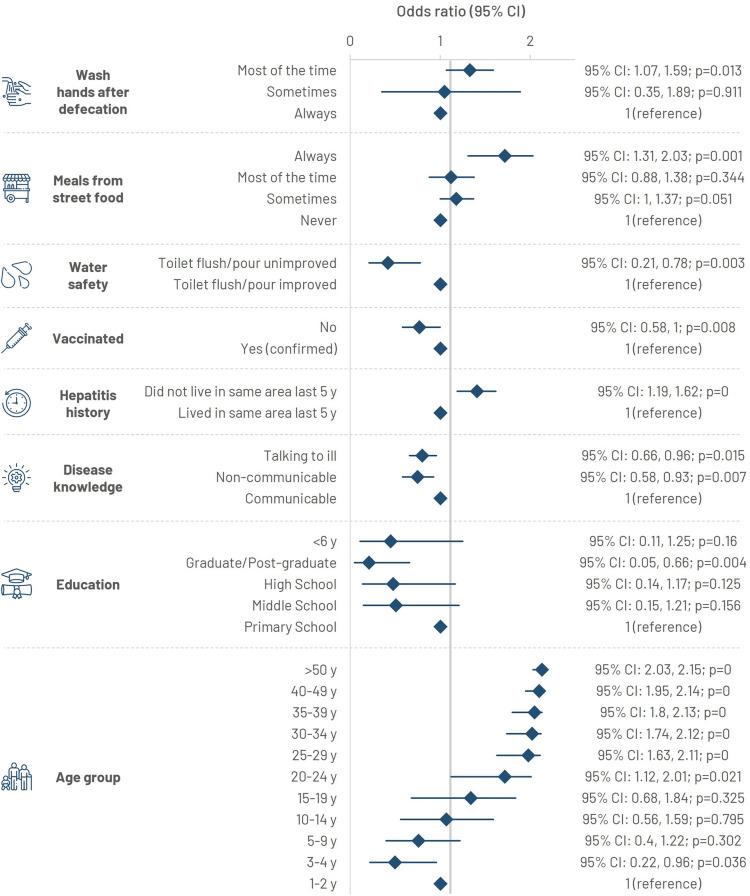
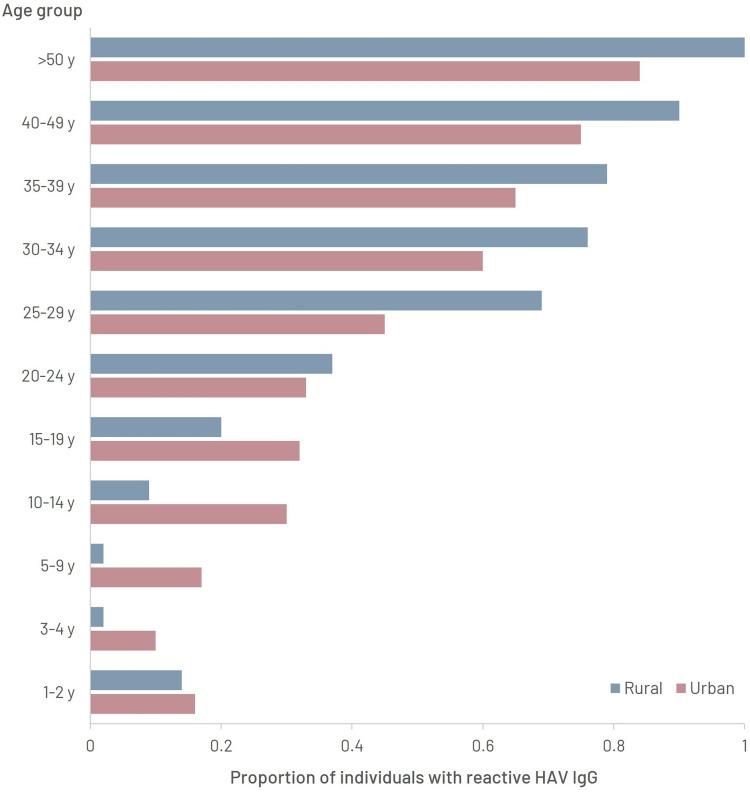
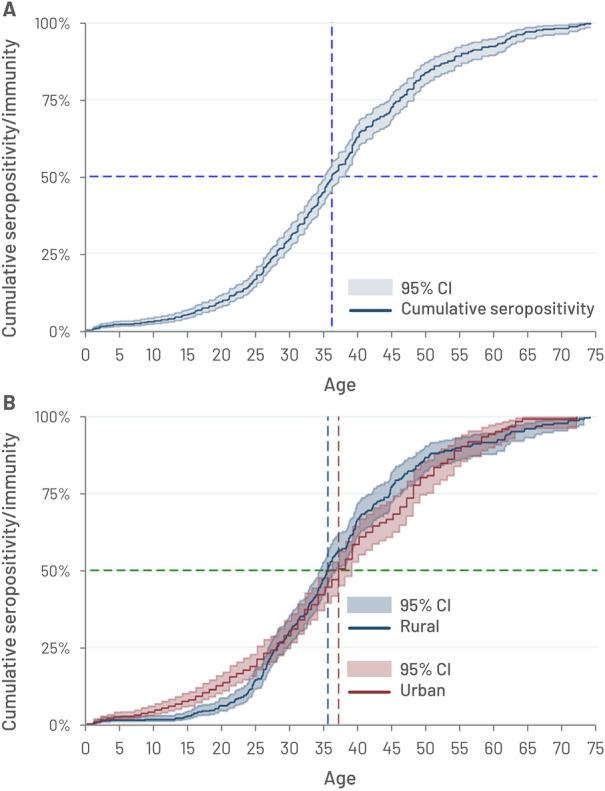
Overall, 1242 participants were included in the analysis; 250/602 (41.5%) participants from urban regions and 283/640 (44.2%) participants from rural regions tested positive for HAV IgG antibodies. AMPI was 35 and 37 years for the rural and urban region, respectively. Higher education was associated with lower HAV seropositivity prevalence ratios, while not living in the same region for the last 5 years, regularly consuming street food and lack of handwashing after defecation were associated with a higher likelihood of HAV seropositivity.
CONCLUSION
Results suggest that HAV endemicity is low in the Philippines. Factors associated with HAV seropositivity were traveling, consuming street food and lack of basic hygienic gestures. Immunization might be an option to protect vulnerable populations against severe hepatitis A disease.
引言
甲型肝炎病毒(HAV)感染在幼儿中通常无症状,但大多数青少年和成年人会出现从恶心、疲倦到急性肝衰竭甚至死亡等一系列症状。老年人和已有肝病的人患重症的风险更高。在甲型肝炎流行率较低的地区,即人们在生命后期才会感染的地区,建议进行免疫接种。在菲律宾,缺乏关于甲型肝炎病毒感染的最新流行病学数据。本研究的目的是评估特定年龄的血清阳性率,并评估与甲型肝炎病毒血清阳性相关的风险因素。
方法
招募了来自两个地理区域(城市和农村)的人群,并按年龄组进行分层。采用化学发光微粒子免疫分析法检测甲型肝炎病毒特异性免疫球蛋白G(IgG)抗体。通过一份特制问卷评估社会人口统计学参数、肝炎病史、疾病知识、卫生措施和环境卫生状况。使用Kaplan-Meier曲线估计群体免疫中点年龄(AMPI)。进行逻辑回归分析以确定与甲型肝炎病毒血清阳性有统计学显著关联(p < 0.05)的因素。
结果
总体而言,1242名参与者纳入分析;城市地区250/602(41.5%)的参与者和农村地区283/640(44.2%)的参与者甲型肝炎病毒IgG抗体检测呈阳性。农村和城市地区的群体免疫中点年龄分别为35岁和37岁。受教育程度较高与甲型肝炎病毒血清阳性患病率较低相关,而过去5年未居住在同一地区、经常食用街头食品以及便后不洗手与甲型肝炎病毒血清阳性的可能性较高相关。
结论
结果表明菲律宾的甲型肝炎流行率较低。与甲型肝炎病毒血清阳性相关的因素包括出行、食用街头食品和缺乏基本卫生习惯。免疫接种可能是保护易感人群免受严重甲型肝炎疾病侵害的一种选择。
 Zotero 插件