
重新审视瘦型多囊卵巢综合征 LH/FSH 比值升高的机制:路径分析。
Mechanism of elevated LH/FSH ratio in lean PCOS revisited: a path analysis.
机构信息
Department of Obstetrics and Gynecology, Faculty of Medicine Universitas Indonesia, Dr. Cipto Mangunkusumo General Hospital, Jakarta, Indonesia.
Cluster of Human Reproduction, Infertility and Family Planning, Indonesian Medical Education and Research Institute (IMERI), Faculty of Medicine Universitas Indonesia, Jakarta, Indonesia.
出版信息
Sci Rep. 2024 Apr 8;14(1):8229. doi: 10.1038/s41598-024-58064-0.
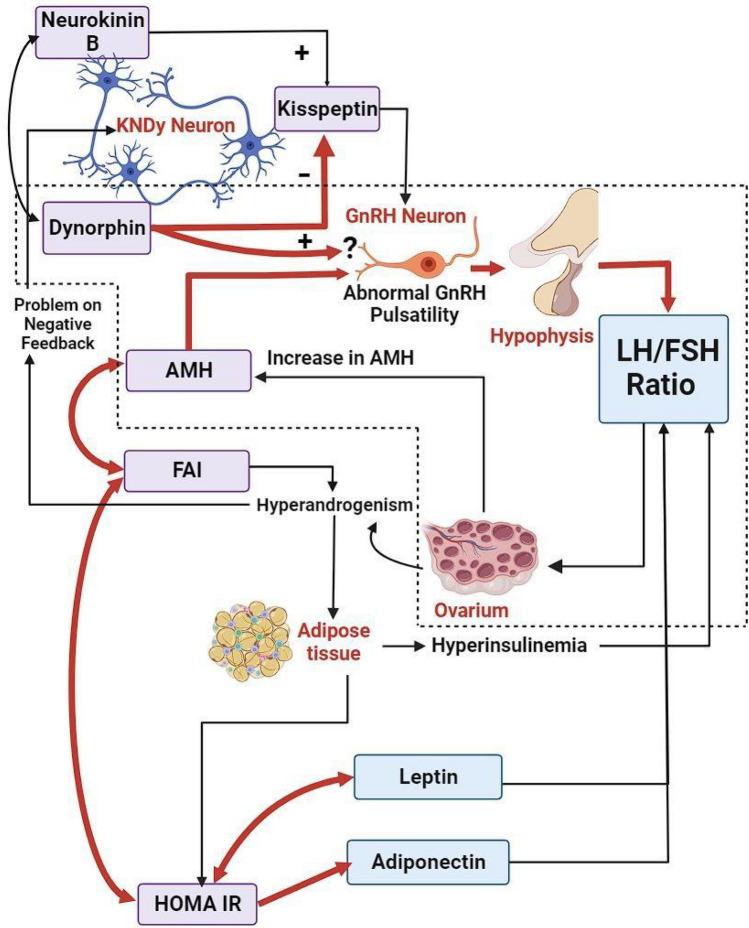
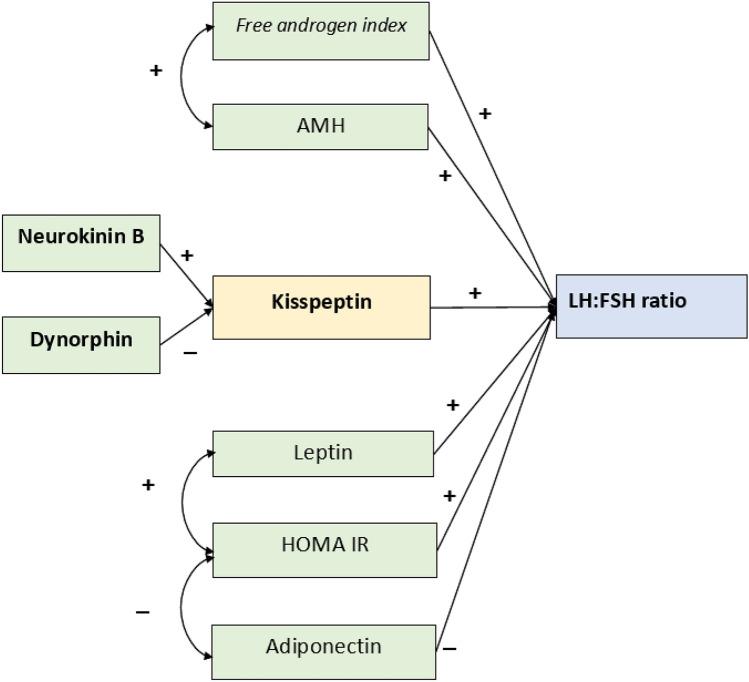
Polycystic ovary syndrome (PCOS) is the most common endocrine disorder affecting 5-20% of reproductive-age women. However, the treatment of PCOS is mainly based on symptoms and not on its pathophysiology. Neuroendocrine disturbance, as shown by an elevated LH/FSH ratio in PCOS patients, was thought to be the central mechanism of the syndrome, especially in lean PCOS. LH and FSH secretion are influenced by GnRH pulsatility of GnRH neurons in the hypothalamus. Kisspeptin is the main regulator of GnRH secretion, whereas neurokinin B (NKB) and dynorphin regulate kisspeptin secretion in KNDy neurons. This study aims to deepen the understanding of the neuroendocrine disorder in lean PCOS patients and its potential pathophysiology-based therapy. A cross-sectional study was performed at Dr. Cipto Mangunkusumo Kencana Hospital and the IMERI UI HRIFP cluster with 110 lean PCOS patients as subjects. LH, FSH, LH/FSH ratio, kisspeptin, NKB, dynorphin, leptin, adiponectin, AMH, fasting blood glucose, fasting insulin, HOMA-IR, testosterone, and SHBG were measured. Bivariate and path analyses were performed to determine the relationship between variables. There was a negative association between dynorphin and kisspeptin, while NKB levels were not associated with kisspeptin. There was no direct association between kisspeptin and the LH/FSH ratio; interestingly, dynorphin was positively associated with the LH/FSH ratio in both bivariate and pathway analyses. AMH was positively correlated with the LH/FSH ratio in both analyses. Path analysis showed an association between dynorphin and kisspeptin levels in lean PCOS, while NKB was not correlated with kisspeptin. Furthermore, there was a correlation between AMH and the LH/FSH ratio, but kisspeptin levels did not show a direct significant relationship with the LH/FSH ratio. HOMA-IR was negatively associated with adiponectin levels and positively associated with leptin and FAI levels. In conclusion, AMH positively correlates with FAI levels and is directly associated with the LH/FSH ratio, showing its important role in neuroendocrinology in lean PCOS. From the path analysis, AMH was also an intermediary variable between HOMA-IR and FAI with the LH/FSH ratio. Interestingly, this study found a direct positive correlation between dynorphin and the LH/FSH ratio, while no association between kisspeptin and the LH/FSH ratio was found. Further research is needed to investigate AMH and dynorphin as potential therapeutic targets in the management of lean PCOS patients.
多囊卵巢综合征(PCOS)是影响 5-20%育龄妇女的最常见内分泌疾病。然而,PCOS 的治疗主要基于症状,而不是其病理生理学。神经内分泌紊乱,如 PCOS 患者 LH/FSH 比值升高,被认为是该综合征的中心机制,尤其是在瘦型 PCOS 中。LH 和 FSH 的分泌受下丘脑 GnRH 神经元的 GnRH 脉冲的影响。促性腺激素释放激素(Kisspeptin)是 GnRH 分泌的主要调节剂,而神经激肽 B(NKB)和强啡肽调节 KNDy 神经元中的 Kisspeptin 分泌。本研究旨在深入了解瘦型 PCOS 患者的神经内分泌紊乱及其潜在的基于病理生理学的治疗方法。这项横断面研究在 Dr. Cipto Mangunkusumo Kencana 医院和 IMERI UI HRIFP 集群进行,共纳入 110 名瘦型 PCOS 患者作为研究对象。测量了 LH、FSH、LH/FSH 比值、Kisspeptin、NKB、强啡肽、瘦素、脂联素、AMH、空腹血糖、空腹胰岛素、HOMA-IR、睾酮和 SHBG。进行了双变量和路径分析以确定变量之间的关系。强啡肽与 Kisspeptin 呈负相关,而 NKB 水平与 Kisspeptin 无关。Kisspeptin 与 LH/FSH 比值之间没有直接关联;有趣的是,在双变量和路径分析中,强啡肽与 LH/FSH 比值呈正相关。AMH 在两种分析中均与 LH/FSH 比值呈正相关。路径分析显示,瘦型 PCOS 中存在 Dynorphin 和 Kisspeptin 水平之间的关联,而 NKB 与 Kisspeptin 无关。此外,AMH 与 LH/FSH 比值之间存在相关性,但 Kisspeptin 水平与 LH/FSH 比值之间没有直接显著关系。HOMA-IR 与脂联素水平呈负相关,与瘦素和 FAI 水平呈正相关。总之,AMH 与 FAI 水平呈正相关,与 LH/FSH 比值直接相关,表明其在瘦型 PCOS 的神经内分泌学中具有重要作用。从路径分析来看,AMH 也是 HOMA-IR 和 FAI 与 LH/FSH 比值之间的中介变量。有趣的是,本研究发现 Dynorphin 与 LH/FSH 比值之间存在直接正相关,而 Kisspeptin 与 LH/FSH 比值之间不存在关联。需要进一步研究以探讨 AMH 和 Dynorphin 作为瘦型 PCOS 患者管理的潜在治疗靶点。

 Zotero 插件