
谷氨酸转运体的结构生物信息学研究及其 AlphaFold2 预测的水溶性 QTY 变体,并揭示 L->Q、I->T、F->Y 和 Q->L、T->I 和 Y->F 的自然突变。
Structural bioinformatics studies of glutamate transporters and their AlphaFold2 predicted water-soluble QTY variants and uncovering the natural mutations of L->Q, I->T, F->Y and Q->L, T->I and Y->F.
机构信息
Istanbul University Istanbul Medical Faculty, Istanbul, Turkey.
Laboratory for Computational and Systems Immunology, Department of Immunology, University of Oslo, Oslo University Hospital, Oslo, Norway.
出版信息
PLoS One. 2024 Apr 10;19(4):e0289644. doi: 10.1371/journal.pone.0289644. eCollection 2024.
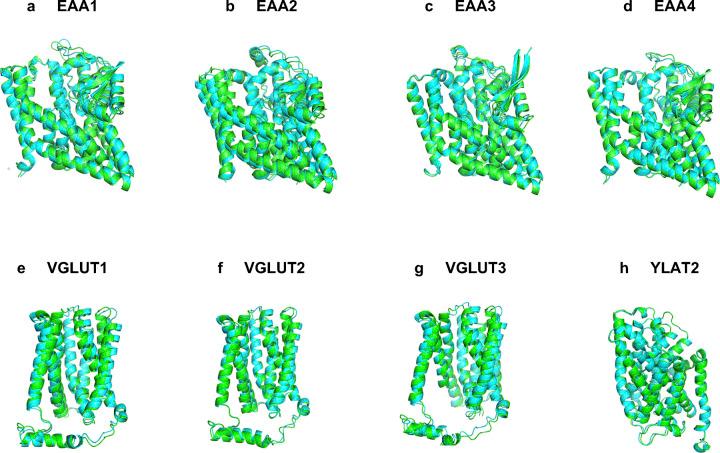
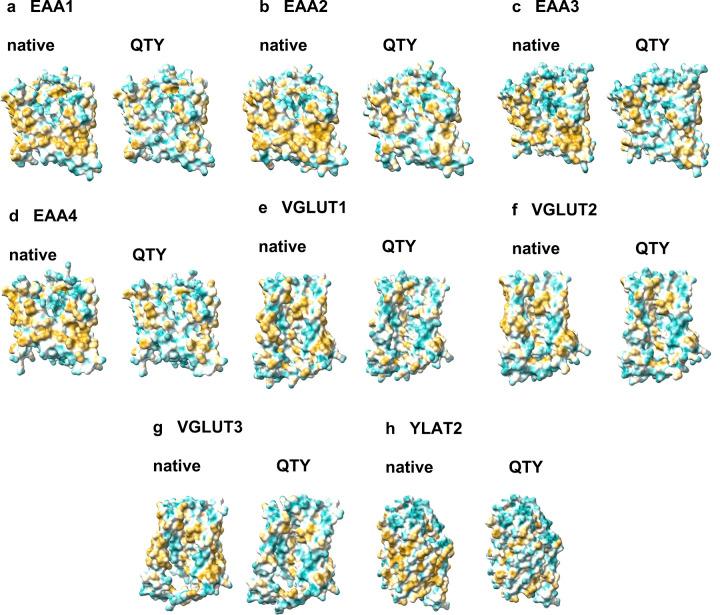
Glutamate transporters play key roles in nervous physiology by modulating excitatory neurotransmitter levels, when malfunctioning, involving in a wide range of neurological and physiological disorders. However, integral transmembrane proteins including the glutamate transporters remain notoriously difficult to study, due to their localization within the cell membrane. Here we present the structural bioinformatics studies of glutamate transporters and their water-soluble variants generated through QTY-code, a protein design strategy based on systematic amino acid substitutions. These include 2 structures determined by X-ray crystallography, cryo-EM, and 6 predicted by AlphaFold2, and their predicted water-soluble QTY variants. In the native structures of glutamate transporters, transmembrane helices contain hydrophobic amino acids such as leucine (L), isoleucine (I), and phenylalanine (F). To design water-soluble variants, these hydrophobic amino acids are systematically replaced by hydrophilic amino acids, namely glutamine (Q), threonine (T) and tyrosine (Y). The QTY variants exhibited water-solubility, with four having identical isoelectric focusing points (pI) and the other four having very similar pI. We present the superposed structures of the native glutamate transporters and their water-soluble QTY variants. The superposed structures displayed remarkable similarity with RMSD 0.528Å-2.456Å, despite significant protein transmembrane sequence differences (41.1%->53.8%). Additionally, we examined the differences of hydrophobicity patches between the native glutamate transporters and their QTY variants. Upon closer inspection, we discovered multiple natural variations of L->Q, I->T, F->Y and Q->L, T->I, Y->F in these transporters. Some of these natural variations were benign and the remaining were reported in specific neurological disorders. We further investigated the characteristics of hydrophobic to hydrophilic substitutions in glutamate transporters, utilizing variant analysis and evolutionary profiling. Our structural bioinformatics studies not only provided insight into the differences between the hydrophobic helices and hydrophilic helices in the glutamate transporters, but they are also expected to stimulate further study of other water-soluble transmembrane proteins.
谷氨酸转运体通过调节兴奋性神经递质水平在神经生理学中发挥关键作用,当它们发生故障时,会涉及到广泛的神经和生理紊乱。然而,包括谷氨酸转运体在内的完整跨膜蛋白由于其在细胞膜内的定位,仍然是非常难以研究的。在这里,我们展示了通过 QTY 码(一种基于系统氨基酸取代的蛋白质设计策略)生成的谷氨酸转运体及其水溶性变体的结构生物信息学研究。这些结构包括 2 个通过 X 射线晶体学、冷冻电镜确定的结构,和 6 个由 AlphaFold2 预测的结构,以及它们预测的水溶性 QTY 变体。在谷氨酸转运体的天然结构中,跨膜螺旋包含疏水性氨基酸,如亮氨酸(L)、异亮氨酸(I)和苯丙氨酸(F)。为了设计水溶性变体,这些疏水性氨基酸被系统地替换为亲水性氨基酸,即谷氨酰胺(Q)、苏氨酸(T)和酪氨酸(Y)。QTY 变体表现出水溶性,其中 4 种具有相同的等电聚焦点(pI),另外 4 种具有非常相似的 pI。我们展示了天然谷氨酸转运体及其水溶性 QTY 变体的叠加结构。尽管跨膜序列差异显著(41.1%-53.8%),但叠加结构显示出惊人的相似性,均方根偏差(RMSD)为 0.528Å-2.456Å。此外,我们还检查了天然谷氨酸转运体与其 QTY 变体之间疏水性斑块的差异。进一步研究发现,这些转运体中存在 L->Q、I->T、F->Y 和 Q->L、T->I、Y->F 的多种自然变异。其中一些自然变异是良性的,其余的则在特定的神经紊乱中被报道。我们进一步研究了谷氨酸转运体中疏水性到亲水性取代的特征,利用变体分析和进化分析。我们的结构生物信息学研究不仅提供了对谷氨酸转运体中疏水性螺旋和亲水性螺旋之间差异的深入了解,而且有望激发对其他水溶性跨膜蛋白的进一步研究。



 Zotero 插件