
司美格鲁肽对比内镜袖状胃成形术用于减重。
Semaglutide vs Endoscopic Sleeve Gastroplasty for Weight Loss.
机构信息
Division of Gastroenterology, Hepatology and Endoscopy, Brigham and Women's Hospital, Boston, Massachusetts.
Department of Gastroenterology, Hepatology and Nutrition, University of Pittsburgh Medical Center, Pittsburgh, Pennsylvania.
出版信息
JAMA Netw Open. 2024 Apr 1;7(4):e246221. doi: 10.1001/jamanetworkopen.2024.6221.
IMPORTANCE
Obesity is a disease with a large socioeconomic burden. Endoscopic sleeve gastroplasty (ESG) is a minimally invasive endoscopic bariatric procedure with wide global adoption. More recently, new weight-loss medications, such as glucagon-like peptide-1 receptor agonists (eg, semaglutide), have attracted increased attention due to their efficacy. However, their cost-effectiveness over an extended period compared with ESG is a critical gap that needs to be better explored for informed health care decision-making.
OBJECTIVE
To assess the cost-effectiveness of semaglutide compared with ESG over 5 years for individuals with class II obesity.
DESIGN, SETTING, AND PARTICIPANTS: This economic evaluation study, conducted from September 1, 2022, to May 31, 2023, used a Markov cohort model to compare ESG and semaglutide, with a no-treatment baseline strategy. The study comprised adult patients in the US health care system with class II obesity (body mass index [BMI] of 35-39.9). The base case was a 45-year-old patient with class II obesity (BMI of 37). Patients undergoing ESG were subjected to risks of perioperative mortality and adverse events with resultant costs and decrement in quality of life.
INTERVENTIONS
Strategies included treatment with semaglutide and ESG.
MAIN OUTCOMES AND MEASURES
Costs (2022 US dollars), quality-adjusted life-years (QALYs), and incremental cost-effectiveness ratio (ICER) with a willingness-to-pay threshold of $100 000/QALY. A 5-year time horizon with a cycle length of 1 month with a 3% discount rate was used. Probabilities, costs, and quality-of-life estimates of the model were derived from published literature. One-way, 2-way, and probabilistic sensitivity analyses were also performed.
RESULTS
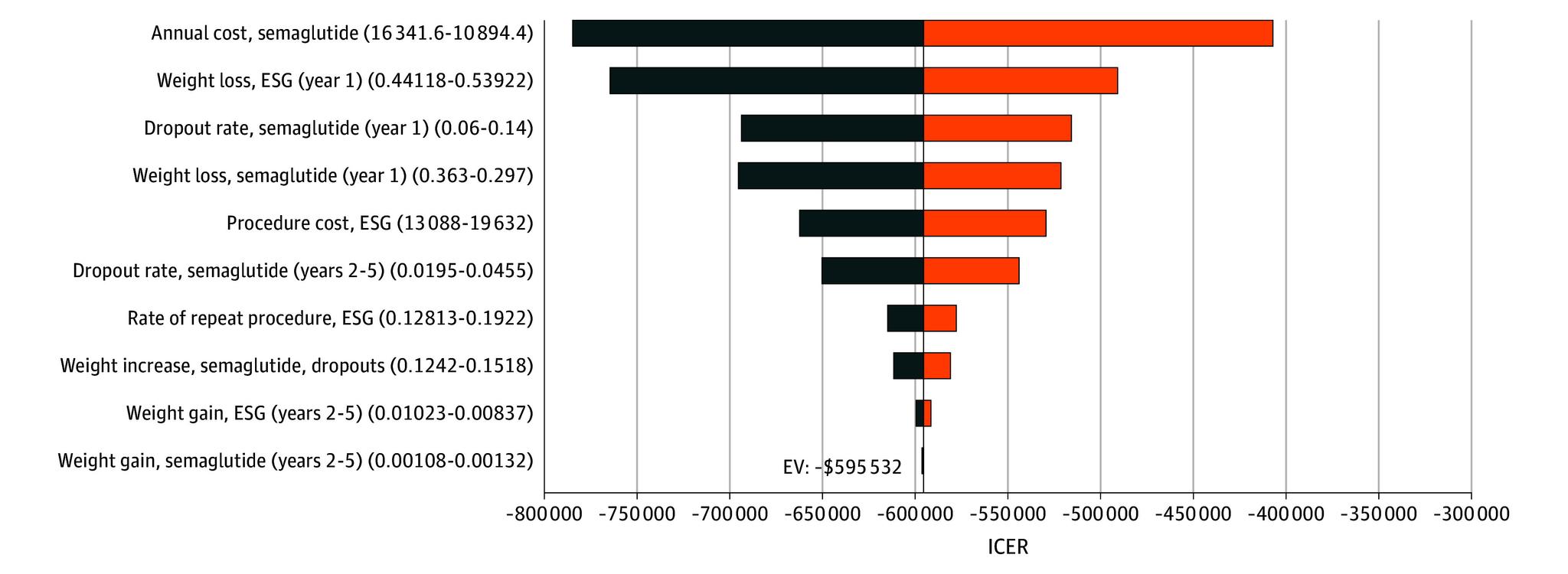
The model found that ESG was more cost-effective than semaglutide over a 5-year time horizon, with an ICER of -$595 532/QALY. Endoscopic sleeve gastroplasty added 0.06 QALYs and reduced total cost by $33 583 relative to semaglutide. The results remained robust on 1-way and probabilistic sensitivity analyses. Endoscopic sleeve gastroplasty sustained greater weight loss over 5 years vs semaglutide (BMI of 31.7 vs 33.0). To achieve nondominance, the annual price of semaglutide, currently $13 618, would need to be $3591.
CONCLUSIONS AND RELEVANCE
This study suggests that ESG is cost saving compared with semaglutide in the treatment of class II obesity. On price threshold analyses, a 3-fold decrease in the price of semaglutide is needed to achieve nondominance.
重要性
肥胖是一种具有巨大社会经济负担的疾病。内镜袖状胃切除术(ESG)是一种微创内镜减重手术,在全球范围内广泛采用。最近,新的减肥药物,如胰高血糖素样肽-1 受体激动剂(如司美格鲁肽),由于其疗效而引起了更多关注。然而,与 ESG 相比,它们在较长时间内的成本效益是一个亟待更好探索的关键差距,以便做出明智的医疗保健决策。
目的
评估在 5 年内,对于 II 类肥胖患者,司美格鲁肽相对于 ESG 的成本效益。
设计、设置和参与者:这项经济评估研究于 2022 年 9 月 1 日至 2023 年 5 月 31 日进行,使用马尔可夫队列模型比较 ESG 和司美格鲁肽,以及无治疗的基础策略。研究包括美国医疗保健系统中患有 II 类肥胖症(BMI 为 35-39.9)的成年患者。基础病例是一位 45 岁患有 II 类肥胖症(BMI 为 37)的患者。接受 ESG 的患者存在围手术期死亡率和不良事件的风险,从而导致成本和生活质量下降。
干预措施
策略包括司美格鲁肽和 ESG 的治疗。
主要结果和措施
成本(2022 年美元)、质量调整生命年(QALY)和增量成本效益比(ICER),以 100000 美元/QALY 为意愿支付阈值。使用 5 年时间范围,周期长度为 1 个月,贴现率为 3%。模型的概率、成本和生活质量估计值来自已发表的文献。还进行了单向、双向和概率敏感性分析。
结果
该模型发现,在 5 年时间范围内,ESG 比司美格鲁肽更具成本效益,ICER 为-595532 美元/QALY。与司美格鲁肽相比,ESG 增加了 0.06 QALY,并降低了 33583 美元的总成本。在单向和概率敏感性分析中,结果仍然稳健。ESG 在 5 年内维持的减重效果优于司美格鲁肽(BMI 为 31.7 与 33.0)。为了实现非主导地位,司美格鲁肽的年价格(目前为 13618 美元)需要降低到 3591 美元。
结论和相关性
本研究表明,在治疗 II 类肥胖症方面,ESG 相对于司美格鲁肽具有成本效益。在价格阈值分析中,需要将司美格鲁肽的价格降低 3 倍才能实现非主导地位。

 Zotero 插件