
验证 2022 年欧洲白血病网络急性髓细胞白血病风险分层。
Validation of the 2022 European LeukemiaNet risk stratification for acute myeloid leukemia.
机构信息
Department of Hematology-Oncology, Chonnam National University Hwasun Hospital, Chonnam National University Medical School, Gwangju, Jeollanam-Do, Republic of Korea.
Department of Medical Oncology and Hematology, Princess Margaret Cancer Centre, University of Toronto, Toronto, Canada.
出版信息
Sci Rep. 2024 Apr 12;14(1):8517. doi: 10.1038/s41598-024-57295-5.
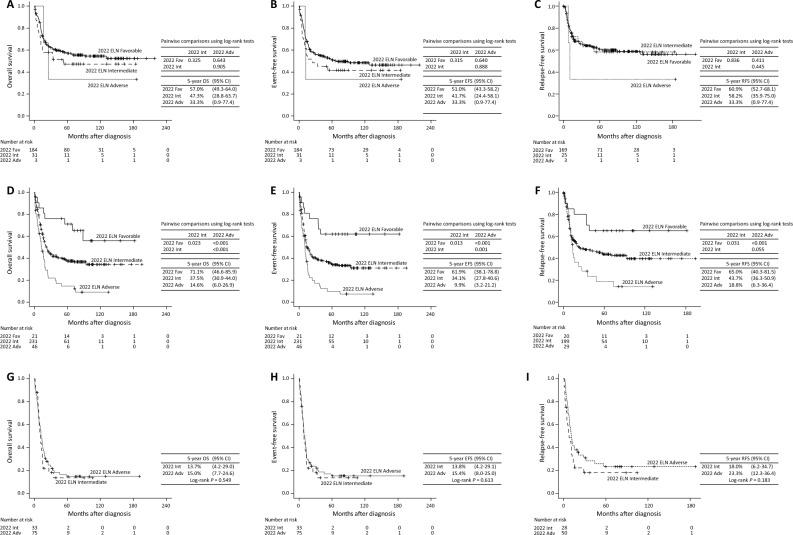
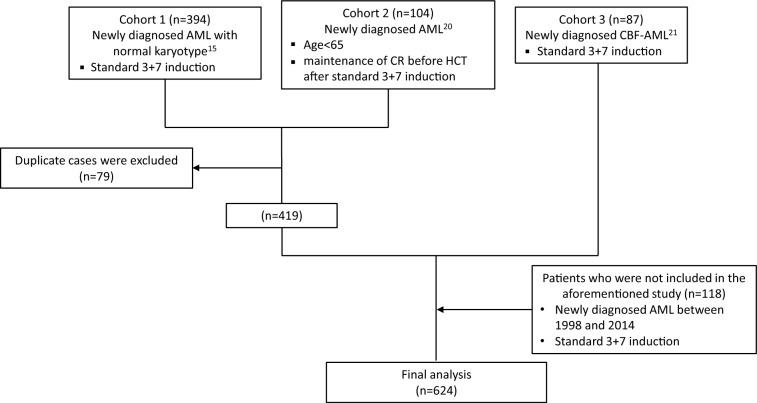
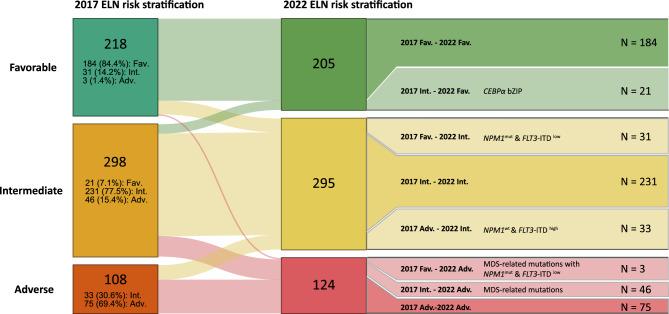
This study aimed to validate the 2022 European LeukemiaNet (ELN) risk stratification for acute myeloid leukemia (AML). A total of 624 newly diagnosed AML patients from 1998 to 2014 were included in the analysis. Genetic profiling was conducted using targeted deep sequencing of 45 genes based on recurrent driver mutations. In total, 134 (21.5%) patients had their risk classification reassessed according to the 2022 ELN risk stratification. Among those initially classified as having a favorable risk in 2017 (n = 218), 31 and 3 patients were reclassified as having intermediate risk or adverse risk, respectively. Among the three subgroups, the 2022 ELN favorable-risk group showed significantly longer survival outcomes than the other groups. Within the 2017 ELN intermediate-risk group (n = 298), 21 and 46 patients were reclassified as having favorable risk or adverse risk, respectively, and each group showed significant stratifications in survival outcomes. Some patients initially classified as having adverse risk in 2017 were reclassified into the intermediate-risk group (33 of 108 patients), but no prognostic improvements were observed in this group. A multivariable analysis identified the 2022 ELN risk stratification, age, and receiving allogeneic hematopoietic cell transplantation as significant prognostic factors for survival. The 2022 ELN risk stratification enables more precise decisions for proceeding with allogeneic hematopoietic cell transplantation for AML patients.
本研究旨在验证 2022 年欧洲白血病网络(ELN)急性髓系白血病(AML)风险分层。共纳入 1998 年至 2014 年间的 624 例新诊断 AML 患者进行分析。采用基于反复出现的驱动基因突变的靶向深度测序对 45 个基因进行遗传分析。根据 2022 年 ELN 风险分层,共有 134 例(21.5%)患者的风险分类进行了重新评估。在最初 2017 年被归类为低危的 218 例患者中,有 31 例和 3 例患者分别被重新归类为中危或高危。在这三个亚组中,2022 年 ELN 低危组的生存结局明显优于其他两组。在 2017 年 ELN 中危组(n=298)中,有 21 例和 46 例患者分别被重新归类为低危或高危,每个组的生存结局均有明显的分层。一些最初在 2017 年被归类为高危的患者被重新归类为中危组(108 例患者中的 33 例),但该组未观察到预后改善。多变量分析确定 2022 年 ELN 风险分层、年龄和接受异基因造血细胞移植是生存的显著预后因素。2022 年 ELN 风险分层使 AML 患者更准确地决定进行异基因造血细胞移植。
 Zotero 插件