
用于高效空气过滤和抑菌的金属有机框架修饰的聚乳酸@二氧化钛电纺膜的制备
Fabrication of Poly(Lactic Acid)@TiO Electrospun Membrane Decorated with Metal-Organic Frameworks for Efficient Air Filtration and Bacteriostasis.
作者信息
Lin Minggang, Shen Jinlin, Qian Qiaonan, Li Tan, Zhang Chuyang, Qi Huan
机构信息
Institute of Smart & Ecological Textile, Quanzhou Normal University, Quanzhou 362002, China.
College of Textile and Apparel, Xinjiang University, Urumqi 830046, China.
出版信息
Polymers (Basel). 2024 Mar 24;16(7):889. doi: 10.3390/polym16070889.
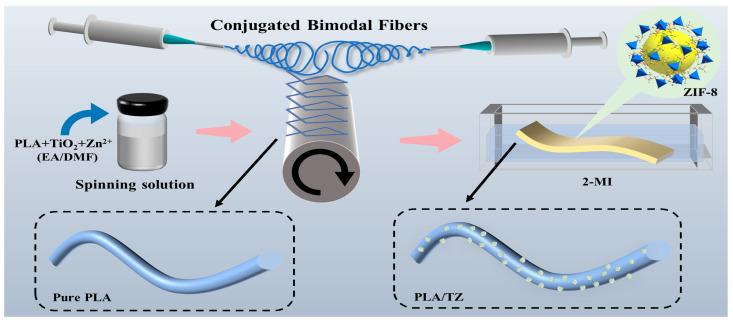
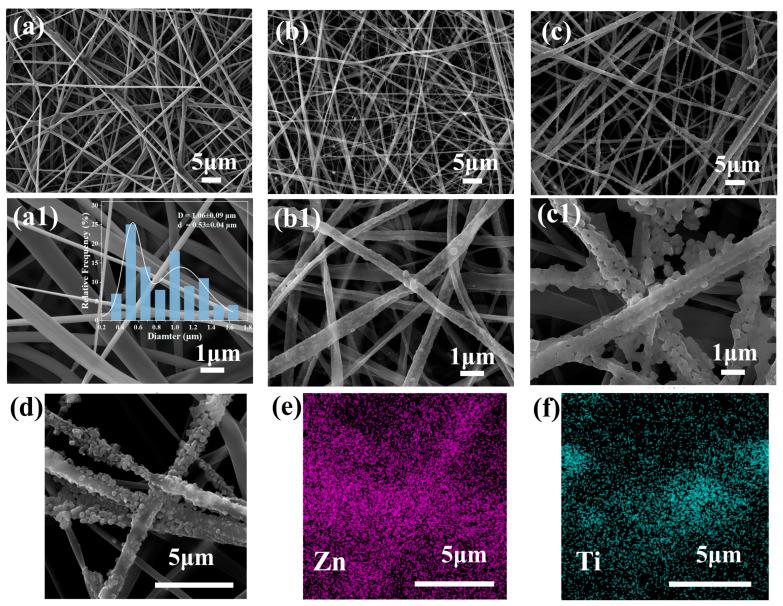
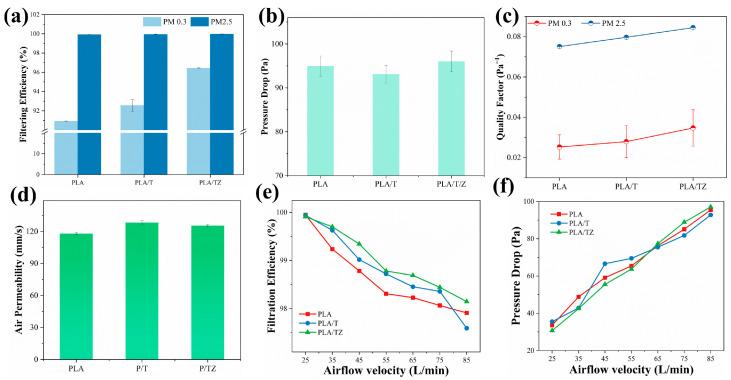
The development of high-performance filtration materials is essential for the effective removal of airborne particles, and metal-organic frameworks (MOFs) anchored to organic polymer matrices are considered to be one of the most promising porous adsorbents for air pollutants. Nowadays, most air filters are generally based on synthetic fiber polymers derived from petroleum residues and have limited functionality, so the use of MOFs in combination with nanofiber air filters has received a lot of attention. Here, a conjugated electrostatic spinning method is demonstrated for the one-step preparation of poly(lactic acid) (PLA) nanofibrous membranes with a bimodal diameter distribution and the anchoring of Zeolitic Imidazolate Framework-8 (ZIF-8) by the introduction of TiO and in situ generation to construct favorable multiscale fibers and rough structures. The prepared PLA/TZ maintained a good PM2.5 capture efficiency of 99.97%, a filtration efficiency of 96.43% for PM0.3, and a pressure drop of 96.0 Pa, with the highest quality factor being 0.08449 Pa. Additionally, ZIF-8 was uniformly generated on the surface of PLA and TiO nanofibers, obtaining a roughened structure and a larger specific surface area. An enhanced filtration retention effect and electrostatic interactions, as well as active free radicals, can be generated for the deep inactivation of bacteria. Compared with the unmodified membrane, PLA/TZ prepared antibacterial characteristics induced by photocatalysis and Zn release, with excellent bactericidal effects against and . Overall, this work may provide a promising approach for the development of efficient biomass-based filtration materials with antimicrobial properties.
高性能过滤材料的开发对于有效去除空气中的颗粒物至关重要,而锚定在有机聚合物基质上的金属有机框架(MOF)被认为是最有前途的空气污染物多孔吸附剂之一。如今,大多数空气过滤器通常基于源自石油残渣的合成纤维聚合物,功能有限,因此将MOF与纳米纤维空气过滤器结合使用受到了广泛关注。在此,展示了一种共轭静电纺丝方法,用于一步制备具有双峰直径分布的聚乳酸(PLA)纳米纤维膜,并通过引入TiO和原位生成来锚定沸石咪唑酯骨架-8(ZIF-8),以构建有利的多尺度纤维和粗糙结构。制备的PLA/TZ保持了99.97%的良好PM2.5捕获效率、96.43%的PM0.3过滤效率和96.0 Pa的压降,最高品质因数为0.08449 Pa。此外,ZIF-8均匀地生成在PLA和TiO纳米纤维表面,获得了粗糙化结构和更大的比表面积。可以产生增强的过滤保留效果和静电相互作用,以及活性自由基,用于细菌的深度灭活。与未改性的膜相比,PLA/TZ具有光催化和锌释放诱导的抗菌特性,对 和 具有优异的杀菌效果。总体而言,这项工作可能为开发具有抗菌性能的高效生物质基过滤材料提供一种有前途的方法。




 Zotero 插件