
绝经后疾病风险的异质性:为什么只有部分女性受到影响的原因可能是与青春期、月经周期、妊娠和哺乳以及最终的绝经相关的可逆表观遗传修饰系统?
The Heterogeneity of Post-Menopausal Disease Risk: Could the Basis for Why Only Subsets of Females Are Affected Be Due to a Reversible Epigenetic Modification System Associated with Puberty, Menstrual Cycles, Pregnancy and Lactation, and, Ultimately, Menopause?
机构信息
Department of Surgery, Faculty of Kinesiology, and McCaig Institute for Bone and Joint Health, University of Calgary, Calgary, AB T2N 4N1, Canada.
出版信息
Int J Mol Sci. 2024 Mar 30;25(7):3866. doi: 10.3390/ijms25073866.
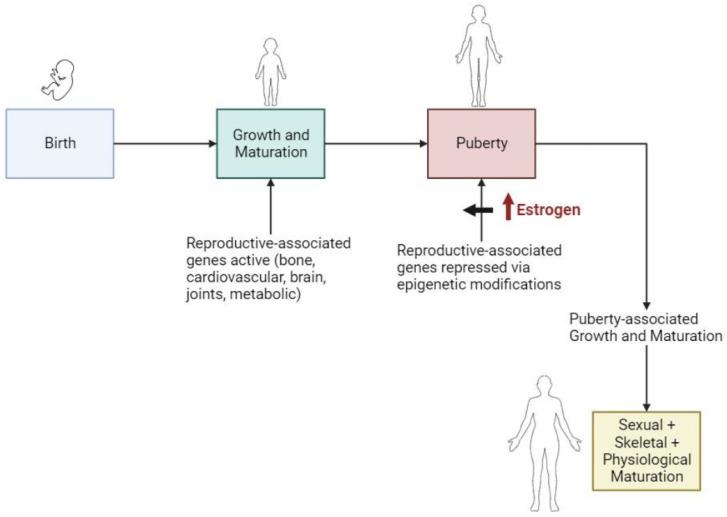
For much of human evolution, the average lifespan was <40 years, due in part to disease, infant mortality, predators, food insecurity, and, for females, complications of childbirth. Thus, for much of evolution, many females did not reach the age of menopause (45-50 years of age) and it is mainly in the past several hundred years that the lifespan has been extended to >75 years, primarily due to public health advances, medical interventions, antibiotics, and nutrition. Therefore, the underlying biological mechanisms responsible for disease risk following menopause must have evolved during the complex processes leading to to serve functions in the pre-menopausal state. Furthermore, as a primary function for the survival of the species is effective reproduction, it is likely that most of the advantages of having such post-menopausal risks relate to reproduction and the ability to address environmental stresses. This opinion/perspective will be discussed in the context of how such post-menopausal risks could enhance reproduction, with improved survival of offspring, and perhaps why such risks are preserved. Not all post-menopausal females exhibit risk for this set of diseases, and those who do develop such diseases do not have all of the conditions. The diseases of the post-menopausal state do not operate as a unified complex, but as independent variables, with the potential for some overlap. The how and why there would be such heterogeneity if the risk factors serve essential functions during the reproductive years is also discussed and the concept of sets of reversible epigenetic changes associated with puberty, pregnancy, and lactation is offered to explain the observations regarding the distribution of post-menopausal conditions and their potential roles in reproduction. While the involvement of an epigenetic system with a dynamic "modification-demodification-remodification" paradigm contributing to disease risk is a hypothesis at this point, validation of it could lead to a better understanding of post-menopausal disease risk in the context of reproduction with commonalities may also lead to future improved interventions to control such risk after menopause.
在人类进化的大部分时期,平均寿命都不到 40 岁,部分原因是疾病、婴儿死亡率、捕食者、食物不安全以及女性分娩并发症。因此,在进化的大部分时期,许多女性都没有达到绝经年龄(45-50 岁),而在过去的几百年中,寿命才延长到了 75 岁以上,主要是由于公共卫生的进步、医疗干预、抗生素和营养。因此,绝经后导致疾病风险的潜在生物学机制必须在导致绝经前状态的复杂过程中进化。此外,由于物种的生存主要依赖于有效繁殖,因此绝经后存在这些风险的大多数优势可能与繁殖和应对环境压力的能力有关。这种观点将在讨论绝经后风险如何通过提高后代的存活率来增强繁殖的背景下进行讨论,也许可以解释为什么这些风险得以保留。并非所有绝经后的女性都存在这一组疾病的风险,而且那些确实患有此类疾病的女性也并非都有所有的病症。绝经后的这些疾病并不是作为一个统一的复杂系统运作,而是作为独立的变量,存在一定的重叠。如果风险因素在生殖期发挥重要作用,那么为什么会存在这种异质性,以及为什么会存在这种异质性也将进行讨论,并提出与青春期、怀孕和哺乳期相关的可逆表观遗传变化集的概念,以解释绝经后疾病的分布及其在繁殖中的潜在作用的观察结果。虽然涉及到一个具有动态“修饰-去修饰-再修饰”范式的表观遗传系统,有助于疾病风险,但这仍然只是一个假设,验证这一假设可能会更好地理解生殖期与绝经后疾病风险的关系,因为这些共同因素可能会为未来绝经后控制此类风险的干预措施提供参考。


 Zotero 插件