
经肛肠造口旁疝修补术:腹腔镜和机器人手术方法的系统评价。
End-colostomy parastomal hernia repair: a systematic review on laparoscopic and robotic approaches.
机构信息
General and Emergency Surgery Unit, Department of Medicine, Surgery and Dentistry, "Salerno Medical School", San Giovanni di Dio e Ruggi d'Aragona University Hospital, Scuola Medica Salernitana, University of Salerno, Faculty of Medicine and Surgery, Campus di Baronissi (SA), "Gaetano Fucito" Facility, Mercato San Severino (SA), Salerno, Italy.
出版信息
Hernia. 2024 Jun;28(3):723-743. doi: 10.1007/s10029-024-03026-8. Epub 2024 Apr 16.
INTRODUCTION
Parastomal hernia (PSH) is the most common and challenging complication after stoma creation, with an estimated 50% incidence 2 years after the index surgery. Mesh repair is the treatment of choice. Laparoscopic and/or robotic approaches allow acceptable outcomes.
MATERIALS AND METHODS
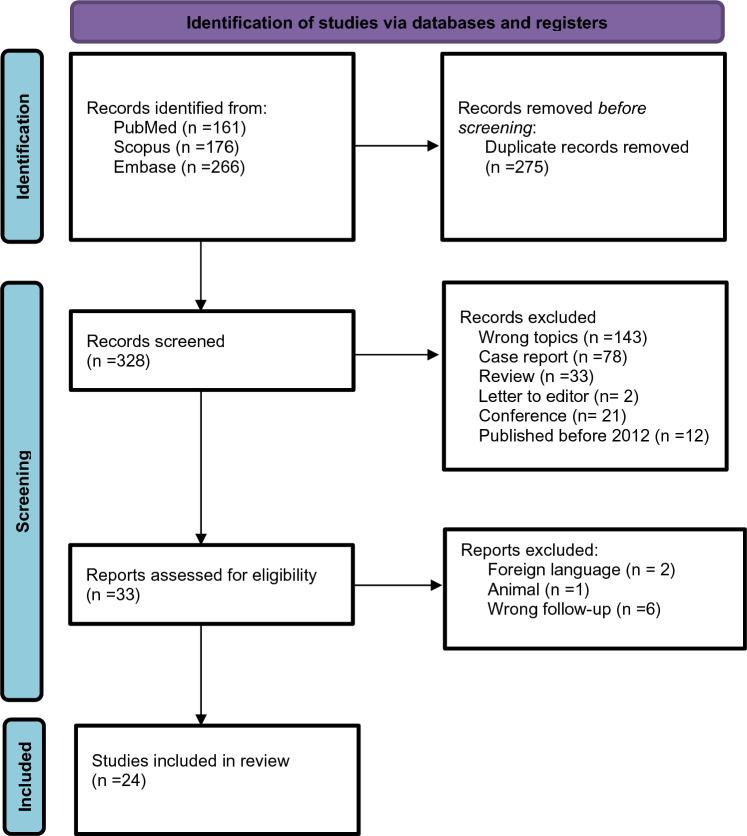
A systematic literature review from January 2012 to November 2023 was conducted according to the Preferred Reporting Items for Systematic Reviews and Meta-Analyses (PRISMA) statement. Embase, PubMed, and Scopus search were performed to select articles dealing with minimally invasive surgical treatment for PSH after end colostomy.
RESULTS
603 studies were found, and 24 were chosen. When compared to open surgery, laparoscopy showed decreased postoperative complications and recurrence. The main laparoscopic approaches are the keyhole (KH), the Sugarbaker (SB), and the sandwich technique. Continuous improvement in surgery, mesh technology, and surgeons' expertise led to an amelioration of surgical outcome and recurrence rate after repair. Recent studies showed comparable outcomes for SB and KH techniques, while novel surgical approaches have been proposed in an attempt to further increase the operative and long-term results. Reports on PSH robotic repairs are scarce and describe small series results, suggesting a role of the initial learning curve as a risk factor for complications.
CONCLUSION
End-colostomy PSH surgical repair still represents a challenge for surgeons. Recent evidence has not shown a significant advantage in postoperative complications and recurrence with a specific repair among SB, KH, and sandwich technique. The paucity of data on robotic surgery does not allow to draw definitive conclusion. Further primary, multicentric, and larger cohort studies are needed.
简介
造口旁疝(PSH)是造口术后最常见且极具挑战性的并发症,估计在指数手术后 2 年内的发生率为 50%。网片修补是首选治疗方法。腹腔镜和/或机器人方法可获得可接受的结果。
材料与方法
根据系统评价和荟萃分析的首选报告项目(PRISMA)声明,对 2012 年 1 月至 2023 年 11 月的文献进行了系统综述。对 Embase、PubMed 和 Scopus 进行了检索,以选择涉及经乙状结肠造口术后微创治疗 PSH 的文章。
结果
共发现 603 篇研究,选择了 24 篇。与开放手术相比,腹腔镜显示术后并发症和复发减少。主要的腹腔镜方法是小孔(KH)、Sugarbaker(SB)和三明治技术。手术、网片技术和外科医生专业技能的不断改进,导致修复后手术结果和复发率的改善。最近的研究表明 SB 和 KH 技术的结果相当,而新的手术方法已被提出,试图进一步提高手术和长期结果。关于 PSH 机器人修复的报道很少,仅描述了小系列结果,表明初始学习曲线作为并发症的一个危险因素。
结论
乙状结肠造口旁疝的外科修复仍然是外科医生面临的挑战。最近的证据表明,在 SB、KH 和三明治技术之间,特定修复方法在术后并发症和复发方面没有显著优势。机器人手术的数据很少,无法得出明确的结论。需要进一步进行初级、多中心和更大队列的研究。
 Zotero 插件