
产前新型冠状病毒病 2019(COVID-19)疫苗接种后的产科并发症和分娩结局。
Obstetric Complications and Birth Outcomes After Antenatal Coronavirus Disease 2019 (COVID-19) Vaccination.
机构信息
Kaiser Permanente Center for Health Research, Portland, Oregon; the Department of Obstetrics, Gynecology and Reproductive Sciences, Yale School of Medicine, New Haven, Connecticut; the Department of Obstetrics & Gynecology, Weill Cornell Medicine, New York, New York; HealthPartners Institute, Bloomington, Minnesota; the Institute for Health Research, Kaiser Permanente Colorado, and Ambulatory Care Services, Denver Health, Denver, Colorado; Kaiser Permanente Southern California, Pasadena, and the Kaiser Permanente Vaccine Study Center, Oakland, California; the Kaiser Permanente Washington Health Research Institute, Seattle, Washington; the Marshfield Clinic Research Institute, Marshfield, Wisconsin; the Harvard Pilgrim Health Care Institute, Boston, Massachusetts; and the Immunization Safety Office, Centers for Disease Control and Prevention, Atlanta, Georgia.
出版信息
Obstet Gynecol. 2024 Jun 1;143(6):794-802. doi: 10.1097/AOG.0000000000005583. Epub 2024 Apr 17.
OBJECTIVE
To evaluate the association between antenatal messenger RNA (mRNA) coronavirus disease 2019 (COVID-19) vaccination and risk of adverse pregnancy outcomes.
METHODS
This was a retrospective cohort study of individuals with singleton pregnancies with live deliveries between June 1, 2021, and January 31, 2022, with data available from eight integrated health care systems in the Vaccine Safety Datalink. Vaccine exposure was defined as receipt of one or two mRNA COVID-19 vaccine doses (primary series) during pregnancy. Outcomes were preterm birth (PTB) before 37 weeks of gestation, small-for-gestational age (SGA) neonates, gestational diabetes mellitus (GDM), gestational hypertension, and preeclampsia-eclampsia-HELLP (hemolysis, elevated liver enzymes, and low platelet count) syndrome. Outcomes in individuals vaccinated were compared with those in propensity-matched individuals with unexposed pregnancies. Adjusted hazard ratios (aHRs) and 95% CIs were estimated for PTB and SGA using a time-dependent covariate Cox model, and adjusted relative risks (aRRs) were estimated for GDM, gestational hypertension, and preeclampsia-eclampsia-HELLP syndrome using Poisson regression with robust variance.
RESULTS
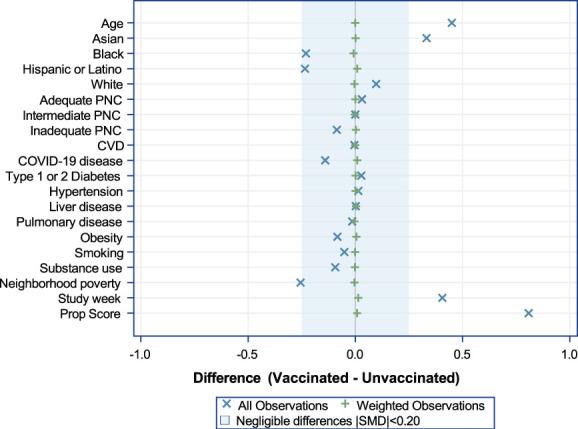
Among 55,591 individuals eligible for inclusion, 23,517 (42.3%) received one or two mRNA COVID-19 vaccine doses during pregnancy. Receipt of mRNA COVID-19 vaccination varied by maternal age, race, Hispanic ethnicity, and history of COVID-19. Compared with no vaccination, mRNA COVID-19 vaccination was associated with a decreased risk of PTB (rate: 6.4 [vaccinated] vs 7.7 [unvaccinated] per 100, aHR 0.89; 95% CI, 0.83-0.94). Messenger RNA COVID-19 vaccination was not associated with SGA (8.3 vs 7.4 per 100; aHR 1.06, 95% CI, 0.99-1.13), GDM (11.9 vs 10.6 per 100; aRR 1.00, 95% CI, 0.90-1.10), gestational hypertension (10.8 vs 9.9 per 100; aRR 1.08, 95% CI, 0.96-1.22), or preeclampsia-eclampsia-HELLP syndrome (8.9 vs 8.4 per 100; aRR 1.10, 95% CI, 0.97-1.24).
CONCLUSION
Receipt of an mRNA COVID-19 vaccine during pregnancy was not associated with an increased risk of adverse pregnancy outcomes; this information will be helpful for patients and clinicians when considering COVID-19 vaccination in pregnancy.
目的
评估产前信使 RNA(mRNA) 新冠疫苗接种与不良妊娠结局风险之间的关联。
方法
这是一项回顾性队列研究,纳入了 2021 年 6 月 1 日至 2022 年 1 月 31 日期间有活产单胎妊娠的个体,数据来自疫苗安全数据链接中的 8 个综合医疗保健系统。疫苗暴露定义为在妊娠期间接受一剂或两剂 mRNA COVID-19 疫苗(基础免疫系列)。将妊娠期间接种疫苗者的结局与未接种疫苗的具有匹配妊娠史者的结局进行比较。使用时间依赖性协变量 Cox 模型估计早产(PTB)和小于胎龄儿(SGA)的调整危险比(aHR)和 95%置信区间,使用具有稳健方差的泊松回归估计妊娠期糖尿病(GDM)、妊娠高血压和子痫前期-子痫-HELLP(溶血、肝酶升高和血小板计数降低)综合征的调整相对风险(aRR)。
结果
在 55591 名符合入选条件的个体中,23517 名(42.3%)在妊娠期间接受了一剂或两剂 mRNA COVID-19 疫苗。mRNA COVID-19 疫苗的接种情况因产妇年龄、种族、西班牙裔、COVID-19 病史而异。与未接种疫苗相比,mRNA COVID-19 疫苗接种与 PTB 风险降低相关(发生率:接种组为 6.4[接种] vs 未接种组 7.7[未接种],每 100 例 aHR 0.89;95%CI,0.83-0.94)。mRNA COVID-19 疫苗接种与 SGA 无关(每 100 例 8.3 例 vs 7.4 例;aHR 1.06,95%CI,0.99-1.13)、GDM(每 100 例 11.9 例 vs 10.6 例;aRR 1.00,95%CI,0.90-1.10)、妊娠高血压(每 100 例 10.8 例 vs 9.9 例;aRR 1.08,95%CI,0.96-1.22)或子痫前期-子痫-HELLP 综合征(每 100 例 8.9 例 vs 8.4 例;aRR 1.10,95%CI,0.97-1.24)。
结论
妊娠期间接种 mRNA COVID-19 疫苗与不良妊娠结局风险增加无关;这一信息将有助于患者和临床医生在考虑妊娠期间接种 COVID-19 疫苗时参考。

 Zotero 插件