
18至60个月大自闭症儿童与其兄弟姐妹及对照组的MicroRNA水平比较。
Comparison of MicroRNA Levels of 18-60-month-old Autistic Children with Those of Their Siblings and Controls.
作者信息
Karagöz Hülya, Akça Ömer Faruk, Yıldırım Mahmut Selman, Zamani Ayşe Gül, Oflaz Mehmet Burhan
机构信息
Department of Child and Adolescent Psychiatry, Binali Yıldırım University Mengücek Gazi Training and Research Hospital, Erzincan, Turkey.
Department of Child and Adolescent Psychiatry, Meram Faculty of Medicine, Necmettin Erbakan University, Konya, Turkey.
出版信息
Clin Psychopharmacol Neurosci. 2024 May 31;22(2):322-332. doi: 10.9758/cpn.23.1124. Epub 2024 Mar 22.
OBJECTIVE
The present study aims to compare the levels of 7 microRNAs (mi-RNAs) (mi-RNA-125b, mi-RNA-23a-3p, mi-RNA-146a-5p, mi-RNA-106a, mi-RNA-151a-3p, mi-RNA-28, mi-RNA-125a) in the blood of the preschool children with autism and those of their siblings with healthy controls, and to investigate the association between these mi-RNAs and the severity of autism, behavioral problems, and siblings' autistic traits.
METHODS
A total of 35 children diagnosed with autism spectrum disorder (ASD) at the ages of 18-60 months (patient group), 35 non-affected siblings of the ASD group (sibling group), and 30 control subjects (control group) were involved in the study. The severity of ASD was measured using the Childhood Autism Rating Scale and the Autism Behavior Checklist (ABC). The behavioral problems of the children with ASD were assessed with the Aberrant Behavior Checklist, and the autistic traits of the siblings were assessed using the Autism spectrum screening scale for children.
RESULTS
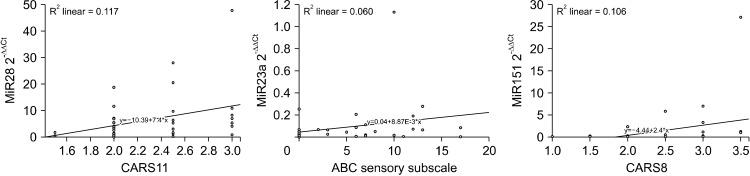
mi-RNA-106a-5p, mi-RNA-151a-3p, and mi-RNA-28-3p were found to be expressed significantly lower in the patient group compared to the control group. There was a significant positive correlation between mi-RNA-23a and the sensory subscale of the ABC. mi-RNA-151a was significantly associated with sound sensitivity and mi-RNA-28 with echolalia. After controlling for age and sex, the differences between groups were disappeared.
CONCLUSION
The present study examined mi-RNAs that have been reported as biomarkers in the literature. Although several symptom clusters are found to be related to certain mi-RNA expression levels, they were not found to be significant in discriminating the patient and healthy groups.
目的
本研究旨在比较自闭症学龄前儿童及其健康对照的兄弟姐妹血液中7种微小RNA(mi-RNA)(mi-RNA-125b、mi-RNA-23a-3p、mi-RNA-146a-5p、mi-RNA-106a、mi-RNA-151a-3p、mi-RNA-28、mi-RNA-125a)的水平,并研究这些mi-RNA与自闭症严重程度、行为问题及兄弟姐妹自闭症特征之间的关联。
方法
本研究纳入了35名年龄在18至60个月被诊断为自闭症谱系障碍(ASD)的儿童(患者组)、35名ASD组未受影响的兄弟姐妹(兄弟姐妹组)以及30名对照对象(对照组)。使用儿童自闭症评定量表和自闭症行为检查表(ABC)来测量ASD的严重程度。使用异常行为检查表评估ASD儿童的行为问题,并使用儿童自闭症谱系筛查量表评估兄弟姐妹的自闭症特征。
结果
与对照组相比,发现患者组中mi-RNA-106a-5p、mi-RNA-151a-3p和mi-RNA-28-3p的表达显著降低。mi-RNA-23a与ABC的感觉分量表之间存在显著正相关。mi-RNA-151a与声音敏感性显著相关,mi-RNA-28与模仿言语显著相关。在控制年龄和性别后,组间差异消失。
结论
本研究检测了文献中报道为生物标志物的mi-RNA。虽然发现几个症状簇与某些mi-RNA表达水平相关,但未发现它们在区分患者组和健康组方面具有显著性。
 Zotero 插件